RRTS, Expressways, Metro Links: The Infrastructure Push Powering Faridabad’s Property Boom
By Paras Rai

New Delhi, December 12, 2025: The NCR real estate market is experiencing remarkable growth– fuelled by increasing demand, infrastructure development, and the significant impact of raw material prices on real estate. With expanding metro networks, expressways, and industrial corridors, the region continues to attract investors, homebuyers, and businesses. Traditionally dominated by Gurugram and Noida, the real estate spotlight is now shifting towards Faridabad, a city that is rapidly transforming into a major commercial and residential hub.
Faridabad is standing at the cusp of one of its most defining transformation phases—one that isn’t fueled by isolated developments, but by a coordinated push in regional mobility. What once felt like a peripheral city is now being pulled into the heart of NCR’s growth story, due to a series of high-impact infrastructure upgrades unfolding simultaneously. The city’s transformation is propelled by projects like the FNG Expressway, set to reduce travel time to Noida International Airport to just 20 minutes, and metro extensions that enhance daily commutes. In addition, the upcoming Faridabad-Jewar Expressway is another transformative project that promises to link Faridabad directly to the airport, further boosting accessibility for working professionals and investment potential for businesses and investors.
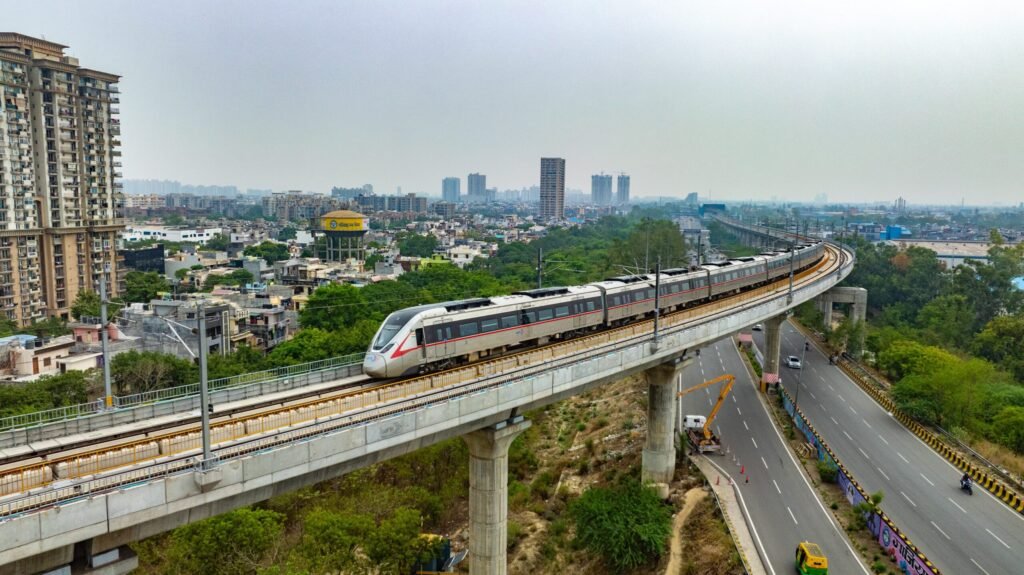
At the center of this momentum lies the biggest catalyst of all—the upcoming NaMo Bharat RRTS corridor. With trains designed to run at 160 kmph and shrink intercity travel to mere minutes, Faridabad is on the verge of joining NCR’s ‘15–20 minute commute’ economy. The NCRTC’s recently finalised INR 15,000-crore DPR for the Gurugram–Faridabad–Noida corridor has set this shift in motion, marking one of the most consequential infrastructure approvals for the city in years.
This development isn’t happening in isolation. Faridabad is already the longest metro-connected city in Haryana through the Violet Line, and upcoming feeder systems are expected to dovetail seamlessly with the RRTS, creating a powerful multimodal network. For working professionals traveling daily to Gurugram, Noida, or Central Delhi, this integration will dramatically cut last-mile travel time—turning mobility from a daily strain into a genuine convenience. With two RRTS stations planned within Faridabad, neighbourhoods around them are poised for the kind of uplift already seen along the Ghaziabad–Meerut stretch, where property values spiked and retail ecosystems expanded once construction began. As the corridor advances toward its targeted construction start in late 2026, Faridabad is gearing up for a new era of transit-oriented living—walkable districts, integrated commercial hubs, and residential clusters built around speed, access, and urban ease. This is where the city’s next growth story truly takes root.
As per Anarock, India’s property market has been buzzing over the past three years, and the NCR again stood out among the eight major real estate markets in the country. From affordable homes to luxury penthouses, NCR has delivered the strongest price appreciation across every category. With a massive 72 per cent jump in luxury home prices, 54 per cent growth in mid-range and premium housing, and 48 per cent rise in the affordable segment, NCR has firmly positioned itself as the country’s most aggressive growth market in real estate.
Meanwhile, as per JLL, the overall residential real estate witnessed strong growth, achieving a record sales of 3,02,867 across seven major cities including Delhi-NCR’s Delhi, Gurugram, Noida, Greater Noida, Ghaziabad, Faridabad, and Sohna. Faridabad is steadily emerging as a strong competitor to these cities, offering a cost-effective yet high-growth alternative for real estate investments.
Besides, areas around the proposed RRTS stations are seeing a noticeable uptick in land enquiries, with plotted developments and mid-to-premium housing emerging as early favourites for both end-users and investors. Neharpar and Greater Faridabad, long viewed as “future markets,” are now moving firmly into the spotlight due to their expressway access and rapidly improving social infrastructure—new schools, hospitals, and retail centres that make daily living easier.
Thus, Faridabad is transforming from a traditional industrial belt into a contemporary residential and commercial powerhouse, driven by the integration of high-speed rail, expressways, and metro connectivity. Over the next 3–5 years, the city is set for a phase of accelerated launches, strengthening demand, and a recalibration of property values as developers pivot toward premium, mixed-use, and transit-linked formats. With RRTS construction gaining momentum and key expressway corridors nearing operational status, Faridabad is firmly positioned to emerge as one of NCR’s most promising high-growth real estate markets.
The author is Co-Founder & Managing Director, Property Master
DISCLAIMER: The views expressed in the above piece are personal and solely those of the writer. They do not necessarily reflect Realty & More’s views.