From Global PE to Domestic Power: The New Capital Story of Indian Real Estate

By Gautam Kanodia, Founder, KREEVA and Kanodia Group
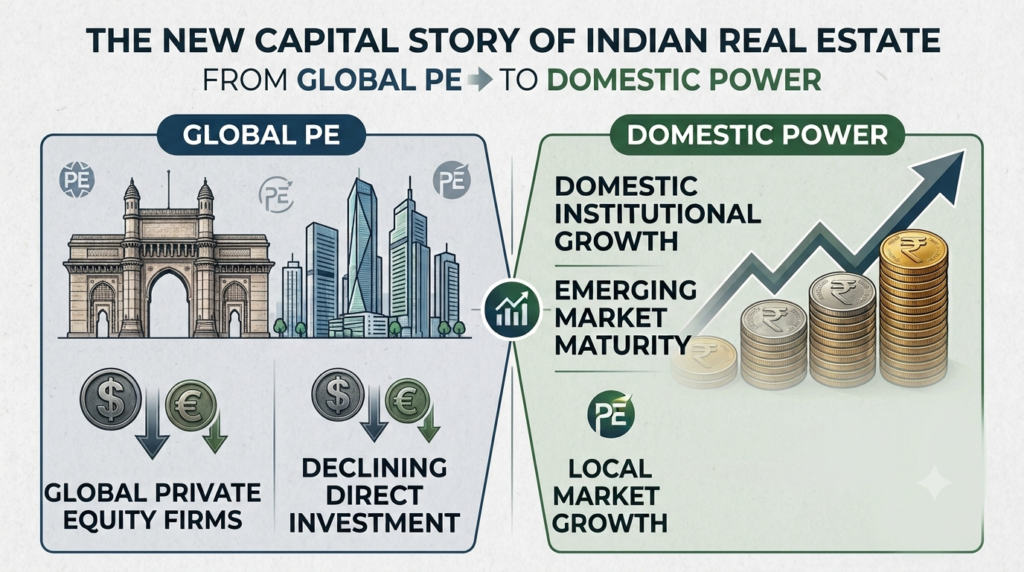
The capital table in Indian real estate looks different today from what it did even a few years ago. Global private equity remains an important source of funding, but domestic institutions, family offices, HNIs and alternative funds have moved from being a smaller part of the investment landscape to becoming major sources of capital for the sector. Domestic institutions, family offices, HNIs, AIFs and developers are increasingly becoming active participants in transactions across the sector.
The numbers make that shift difficult to miss. Institutional investment in Indian real estate reached $4.5 billion in the first half of 2026, up 50% from a year earlier. Domestic investors accounted for $2.6 billion of that, an 80% increase, taking their share to about 57% of total institutional inflows. In Q1, the domestic share was even higher at 75%.
This is not simply about more money being available. The more significant change is the confidence with which domestic capital is approaching real estate. An Indian family office today can look at a development platform, an income-producing office asset, private credit or an AIF structure with a level of familiarity that was not as common earlier. Family offices are also directing 40-45% of their portfolios in many cases towards alternatives such as private equity, private credit, AIFs, REITs and InvITs.
The sector itself has helped create this confidence. Developers have become more institutional in the way projects are structured, capital is reported, and businesses are governed. Better disclosure, clearer project-level accounting and more organised development platforms make it easier for domestic investors to assess an opportunity on its fundamentals rather than simply on the reputation of a promoter.
The spread of domestic capital is also visible beyond equity. In private credit, domestic funds accounted for 74% of deal value and nearly 79% of deal volume in the first half of 2026. Real estate was the largest recipient, accounting for 35% of private-credit deal value. That is a meaningful development because it gives developers another pool of capital for refinancing, acquisition funding and structured transactions.
The implications will be felt differently across asset classes. Office remains a major institutional destination, with $1.9 billion invested in the segment during H1 2026. But mixed-use and alternative assets also attracted about $0.8 billion each. Industrial and warehousing, hospitality, data centres and other specialised formats are becoming part of a broader investment conversation.
For developers, this wider capital base changes the choices available at different stages of a project. Capital can increasingly be matched to the nature of the asset, its cash-flow profile and the development horizon. It also creates room for stronger platforms to grow through partnerships, acquisitions and consolidation rather than depending on a single source of funding.
Global capital will continue to matter. It brings scale, experience and access to international pools of money. But Indian real estate is reaching a point where domestic capital can increasingly stand alongside it, participate on its own terms and, in some segments, lead the market. The interesting shift is that capital for Indian real estate is no longer coming from one direction; it is increasingly being created, structured and deployed within the market itself.
Disclaimer: Views expressed in this article are those of the author, and not necessarily of Realtynmore.com.