News
Complete Guide to Buying Your First Home in India

Mumbai, March 17, 2026:
Buying Your First Home

Buying your first home is a major milestone in life. It is not just a financial investment but also an emotional decision for many families. However, the process of purchasing a property in India can seem complicated for first-time buyers because it involves several legal, financial, and technical steps.
This guide will help you understand the complete process of buying your first home in India so you can make an informed and confident decision.
Understanding Your Budget
Before starting your property search, it is important to determine how much you can afford. This includes evaluating your savings, income, and loan eligibility.
Most banks and financial institutions provide home loans that cover 70–90% of the property value, depending on the borrower’s financial profile. Buyers must also keep additional costs in mind, such as:
- Down payment
- Stamp duty and registration charges
- Legal fees
- Interior and furnishing costs
Setting a clear budget helps you narrow down property options and avoid financial stress later.
Choosing the Right Location
Location is one of the most important factors when buying a home. A good location not only improves your lifestyle but also increases the future value of your property.
When evaluating locations, consider the following:
- Connectivity to workplaces and major roads
- Availability of schools, hospitals, and markets
- Public transportation options such as metro or bus services
- Future infrastructure developments
Properties located near upcoming infrastructure projects often see higher appreciation in value.
Deciding the Type of Property
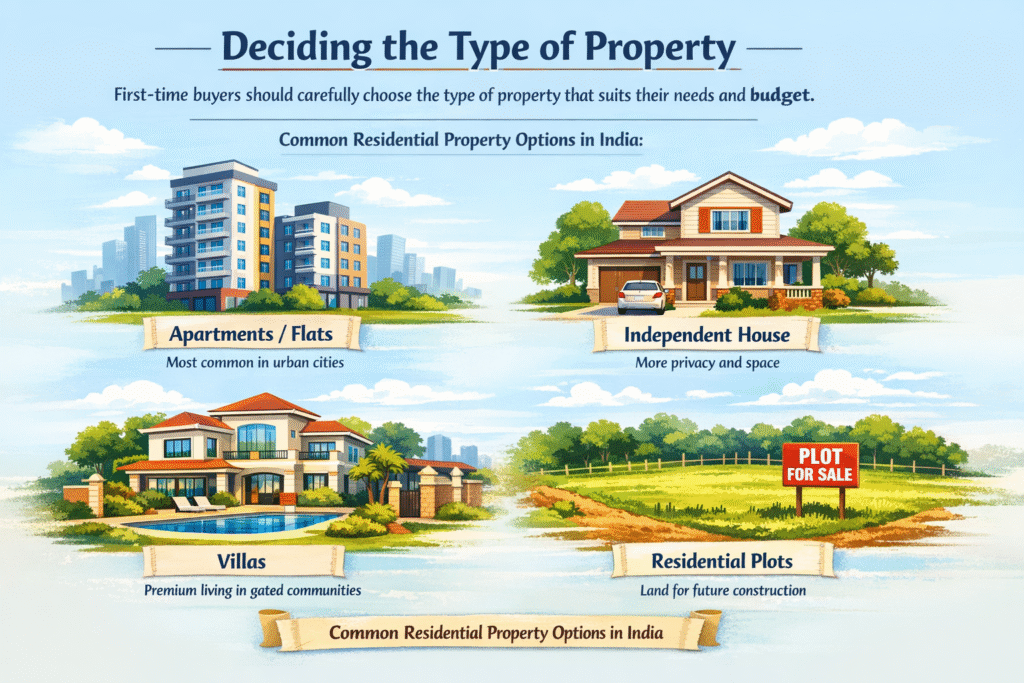
First-time buyers should carefully choose the type of property that suits their needs and budget.
Common residential property options in India include:
- Apartments or flats – Most common in urban cities
- Independent houses – Offer more privacy and space
- Villas – Premium residential properties in gated communities
- Residential plots – Land purchased for future construction
Each option comes with different pricing, maintenance costs, and lifestyle benefits.
Checking the Builder’s Reputation
If you are purchasing a property in a newly developed project, it is essential to check the reputation of the builder or developer.
Look for the following factors:
- Past projects delivered by the developer
- Project completion history
- Customer reviews and feedback
- Construction quality and transparency
Choosing a reliable developer reduces the risk of project delays and legal complications.
Verify Legal Documents
Legal verification is one of the most important steps when buying property. Buyers must ensure that the property has clear ownership and all required approvals.
Important documents to verify include:
- Title deed
- Sale agreement
- Encumbrance certificate
- Land use approval
- Building approval plan
It is often advisable to consult a legal expert or property lawyer to review these documents before making the purchase.
Understanding RERA Registration
The Real Estate Regulatory Authority (RERA) was introduced to increase transparency in the real estate sector and protect homebuyers.
Under RERA, developers must register their projects and provide accurate information about project timelines, approvals, and property details.
Before buying a property, buyers should check the project’s RERA registration number on the official state RERA website.
Applying for a Home Loan
Most homebuyers rely on home loans to finance their property purchase. Banks evaluate factors such as income, credit score, and employment stability before approving loans.
Key points to consider when applying for a home loan:
- Compare interest rates from different banks
- Check loan tenure options
- Understand EMI calculations
- Review prepayment and foreclosure charges
Choosing the right home loan can significantly reduce your financial burden over time.
Property Inspection and Site Visit
Before finalizing the purchase, it is important to visit the property site personally. This helps you verify the construction quality and surrounding environment.
During the site visit, check:
- Construction progress
- Quality of materials used
- Water and electricity supply
- Safety and security arrangements
- Parking facilities
A physical inspection helps avoid surprises after purchase.
Registration and Ownership Transfer
The final step in the home-buying process is property registration. This legal procedure transfers ownership from the seller to the buyer.
Buyers must pay:
- Stamp duty
- Registration charges
- Applicable government fees
Once the registration is completed, the buyer officially becomes the legal owner of the property.
Conclusion
Buying your first home in India is a significant financial decision that requires careful planning and research. From setting a budget and selecting the right location to verifying legal documents and securing a home loan, each step plays an important role in the process.
With the right information and guidance, first-time buyers can avoid common mistakes and make a smart investment that provides both financial security and personal satisfaction. Latest News
https://erera.co.in/ereradelhi



Max Estates Hits INR 5,305 Crore Pre-Sales Milestone for FY2026
New Delhi, April 6, 2026: Max Estates Limited announced today that it has achieved total pre-sales of approximately Rs 5,305...


YEIDA Launches 973-Plot Housing Scheme Near Noida International Airport With Special Quota for Local Farmers
Greater Noida, April 6, 2026: In a major boost to residential development near the newly inaugurated Noida International Airport, the...


Smartworks Expands Multi-City Partnership with Forbes 2000 CX Leader; Total Seat Count Exceeds 5,000
GURUGRAM, April 6, 2026: Smartworks Coworking Spaces Limited has announced a significant expansion of its multi-city engagement with a Forbes...


Ambience Mall Expands Culinary Portfolio with Opening of Global Japanese Curry Chain CoCo Ichibanya
Gurugram, April 6, 2026: Ambience Mall, Gurugram, has announced the expansion of its dining offerings with the opening of CoCo...


India’s GCC Leasing Reaches Historic High of 9.1 Million Sq. Ft. in Q1 2026: CBRE
New Delhi, April 6, 2026: India’s office market has achieved a record-breaking start to the year, with Global Capability Centres...


Singer Shreya Ghoshal and Family Purchase Luxury Worli Residence for Rs 29.70 Crore: Square Yards
Mumbai, April 6, 2026: Indian playback singer Shreya Ghoshal, along with her mother Shamishtha Ghoshal and father Biswajit Ghoshal, has...
-

 News3 weeks ago
FractoProp Receives SEBI Registration for Ridhama Real Estate Fund
-
 News3 weeks ago
Enviro Infra Engineers Secures ₹411 Crore Bihar Sewerage Project Under AMRUT 2.0
-
News1 week ago
How Noida International Airport Will Impact Property Prices
-
News1 week ago
Noida International Airport Inauguration Sparks New Real Estate Boom For NCR
-
News3 weeks ago
Rise of Airport-Linked Real Estate: Opportunities Emerging Around Jewar
-
News4 weeks ago
Greenlands Global Private Limited Appointed as Managing Partner for Big FM Realty’s ₹1,200 Crore Mixed-Use Development
-
News4 days ago
Tata Realty Seals Bengaluru Land Deal at ₹2,300 Crore; CBRE Advisor for Transaction
-

 News3 weeks ago
India Maintains Competitive Edge as Asia-Pacific Office Fit-Out Hub, Reports Knight Frank