CII Proposes National Law to Unify Elevator Regulations
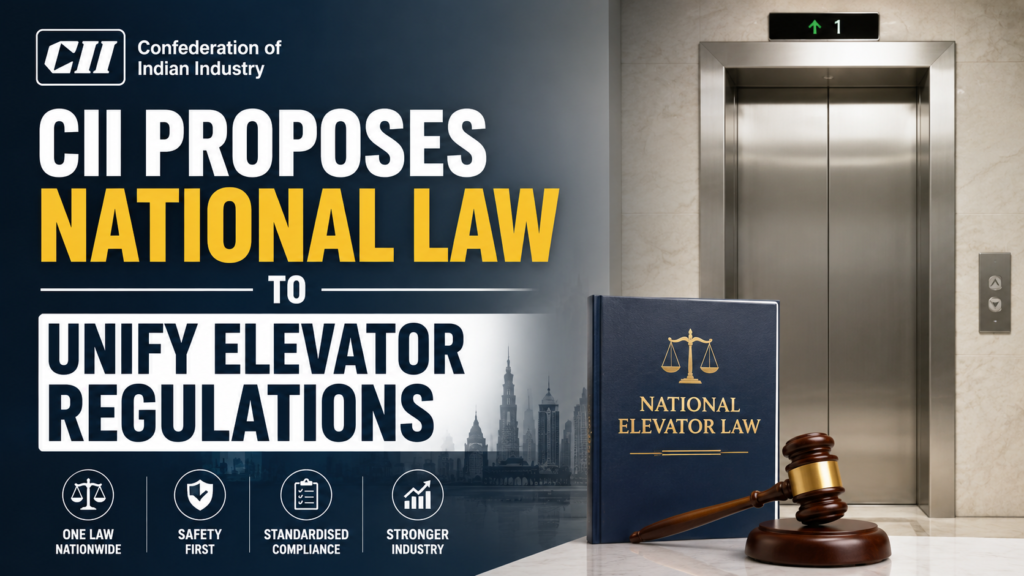
New Delhi, August 24, 2026: India’s lifts and building technologies sector requires a single national-level Model National Lift Act to replace the country’s current patchwork of state-level elevator laws, according to a report released on Friday by the Confederation of Indian Industry (CII) in New Delhi.
The report, titled Enabling Ease of Doing Business in India’s Building Technologies Sector: A Policy Reform Roadmap and Model National Lift Act Proposal, argues that a judicial push for accountability renders regulatory harmonisation “no longer merely an operational best practice, but a public safety imperative.”
Currently, lifts are governed by state legislations dating back to the Bombay Lifts Act, 1939 and the Delhi Lifts Act, 1942, each featuring different inspection cycles and approval authorities. Inspections currently range from once every six months in Maharashtra to once every ten years in Karnataka. Industry consultations highlighted that this fragmentation raises compliance costs, delays projects, discourages technology adoption, and creates safety gaps in states lacking comprehensive lift laws.
India ranks among the fastest-growing elevator and escalator markets globally, installing over 100,000 new units annually according to industry estimates. The domestic elevator market is valued at Rs 1.22 trillion.
The publication outlines seven priority reforms, including a harmonised national framework, a single-window digital approval system, and risk-based inspections that tie inspection frequency to a lift’s risk profile rather than a fixed calendar. It also calls for a lifecycle-based regulatory approach covering maintenance and modernisation—including linking high-risk lifts to Regional Control Centres for real-time monitoring—alongside a national skilling and certification ecosystem for technicians trained in mechatronics and digital diagnostics, developed with the CII Centre of Excellence on Skills. Additionally, the proposal advocates rationalised GST treatment for multi-year lift installation contracts and Production-Linked Incentive-style schemes to encourage domestic manufacturing of safety components under Atmanirbhar Bharat.
At the core of the proposal is a Model National Lift and Escalator Act establishing a uniform national taxonomy for lift categories. The report further recommends establishing a Unified Digital Lift Portal with a Unique Asset Identification Number assigned to every installation.
“Where the competent authority fails to issue approval or communicate a reasoned rejection within the prescribed period (not exceeding 21 working days), the system shall automatically generate a deemed approval, subject to post-audit verification,” the report states. It also suggests establishing a National Registry of Certified Lift Installers equipped with a de-empanelment mechanism to handle fraudulent certifications.
To navigate India’s federal structure, where building codes fall under state jurisdiction, the report outlines a phased two-year rollout strategy. This process would begin with voluntary adoption and technical assistance, progress to linking adoption with central funding under schemes such as AMRUT 2.0 and NITI Aayog’s Business Reform Action Plan rankings, and culminate in a central regulatory backstop under the Electricity Act, 2003, administered through the Central Electricity Authority.
Pointing to China, Japan, and Germany as benchmark models for digital governance, lifecycle regulation, and standardisation respectively, the report highlights that these reforms could eliminate inter-state compliance duplication, accelerate approvals, and position India as a global manufacturing and export hub for vertical mobility systems while supporting national safety outcomes and urban infrastructure goals.