Convenience Can Be Offered at Home. Experience Is What We Step Out For
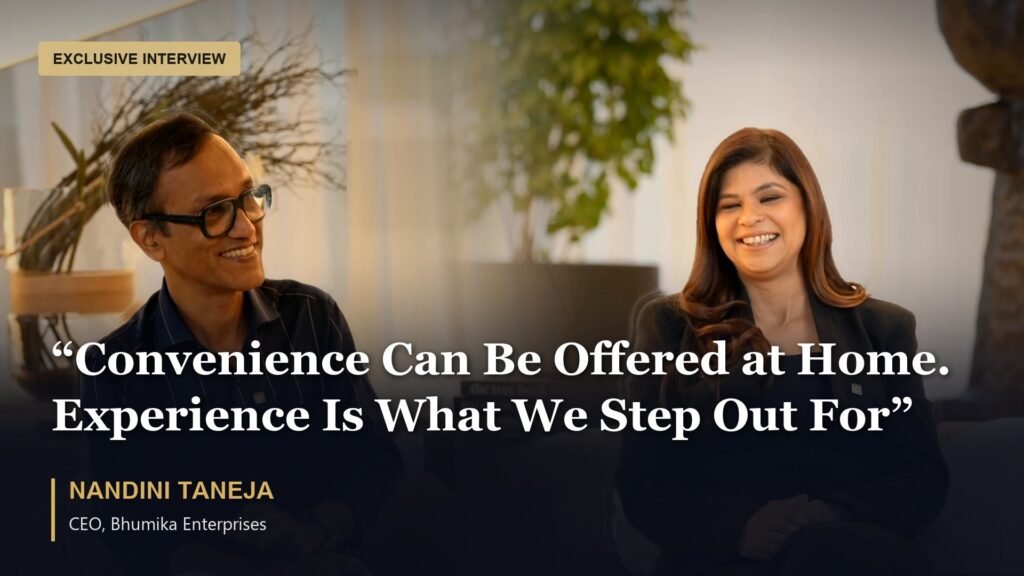
Bhumika Enterprises CEO Nandini Taneja on experience-led malls, data-driven leasing, and why the next chapter of Indian retail is being written in Udaipur and Faridabad
When Nandini Taneja started out in 2001, a 100,000 sq ft building counted as a shopping mall. Today she plans centres of 2 million sq ft. Over two decades she has seen retail real estate from every side. She spent 11 years at Cushman & Wakefield, where she drove the firm’s India business as global brands arrived on the back of FDI reforms. She then moved to REACH Developers, taking two suburban Gurgaon assets from construction through leasing to stabilisation. A year ago she joined Bhumika Enterprises, the asset arm of Bhumika Realty, which is expanding Bhumika Urban Square in Udaipur and building Bhumika Icon, a mixed-use development in Faridabad.
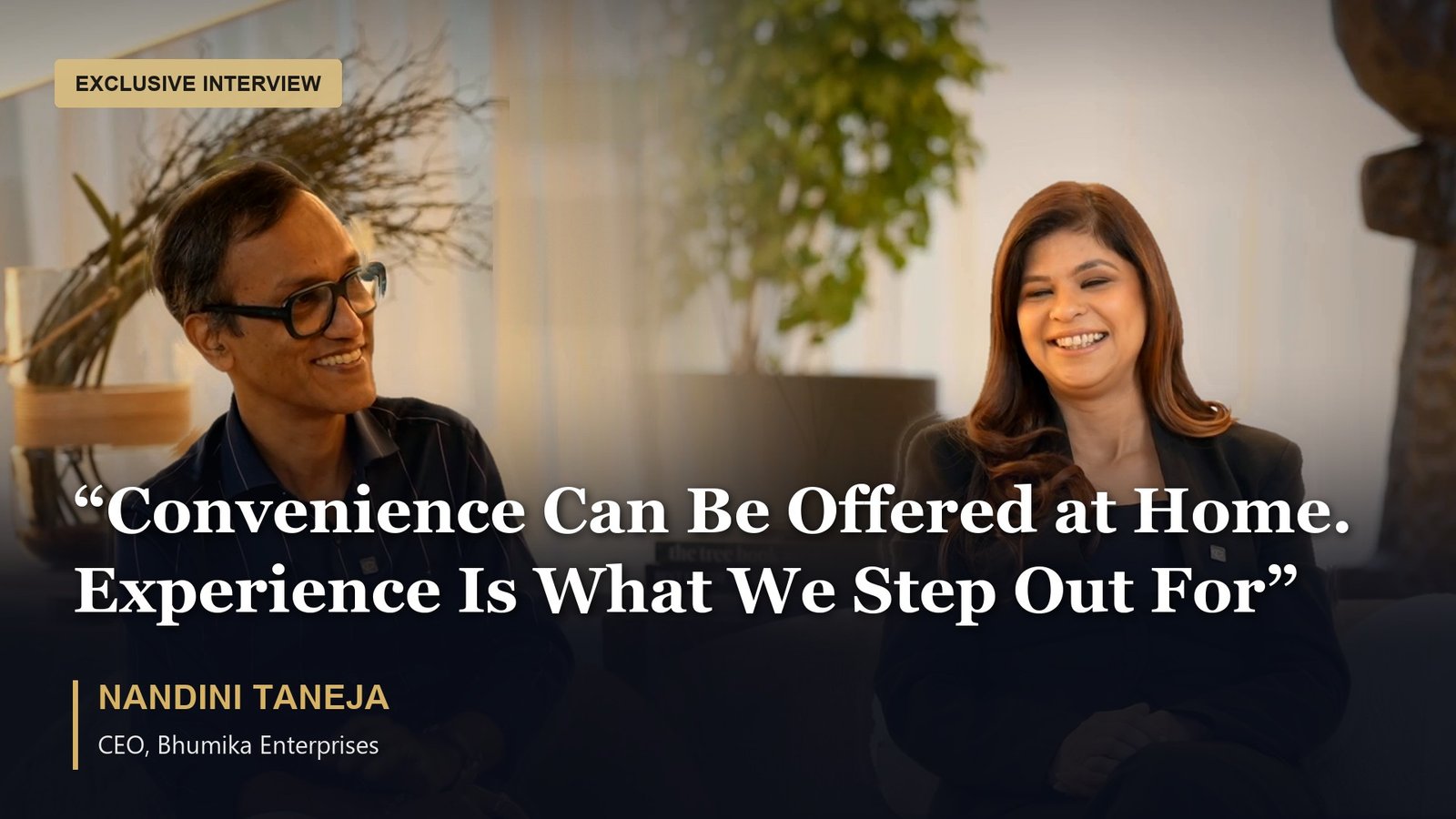
In conversation with Palash Roy, editor Realtynmore.com, on the R&M Podcast, recorded at Bhumika Icon, she talks about why shopping has become incidental to the mall visit, how sales data decides which brands stay, and why she would put long-term asset value ahead of everything else. Edited excerpts:
You have more than two decades in retail destinations, asset management and hospitality. How has the business changed, and how has your approach changed with it?
When I started, retail real estate was at a very nascent stage. Malls were only just being planned, and a lakh square feet was considered a mall. Now we are talking about 2 million square feet. Back then, the approach was simply how to fill that space with retailers willing to move into organised retail.
Today we are building larger, more organised assets. The goal is no longer just to fill space. It is about the right fit, the right positioning, data that backs the retailers we bring in, and the overall profitability of the centre. We look at the mall as an asset that has to perform and deliver returns over the years, not just something to lease out.
You have worked with an international property consultant, a developer and an operator. What have you brought from those roles to Bhumika?
I joined Cushman & Wakefield in 2008, and most of my career learning happened there. We saw all three sides of the business: the developer, the retailer or occupier, and the consultant who balances the two. FDI was opening up, and I was personally driving the India business. I travelled a lot to meet occupiers who wanted to enter the country, and pitched them on how India was growing and the kind of assets coming up. I was lucky to be part of that growth phase.
After 11 years I moved to REACH Developers, which had two assets in suburban Gurgaon. That gave me the full cycle: construction, leasing, managing and stabilising an asset. Cushman gave me the broad perspective. Working on the Indian developer side taught me the nuts and bolts of real estate. I have been at Bhumika for a year now, and I look forward to applying all of that and learning a lot more.
What is your five-year vision for Bhumika Enterprises?
Bhumika Enterprises is the asset arm of Bhumika Realty, the parent company. Our intent is to build experiential centres: integrated, mixed-use assets that combine hospitality, retail, commercial and residential. We want to be known as a developer that builds and manages quality real estate, not one that builds and moves on to the next project. Our aim is to grow the scale of our business in managed, organised real estate.
Bhumika works across retail, asset management and hospitality. How do these fit together, and what are the challenges in creating long-term value?
Retail and hospitality are two pillars of real estate for us. Retail brings the experiential side of the mall. Hospitality adds service for the customer who walks in. They go hand in hand. When you add another asset class, whether residential or office, those people become your captive audience. All three support each other as an ecosystem.
The first challenge in our country is buying quality land in the location you want, and location is the most important criterion. The second is planning: the right traffic movement, walking paths and open areas. These days we put a lot of emphasis on green areas and health. Then you need the right components for the catchment or micro market, and you have to manage the asset well over the years that follow.
Experience over shopping
What does an experience-led retail destination offer that a traditional mall doesn’t?
Coming to a shopping centre is no longer just about buying things. Families come for the food, the movies, and the experience retailers now offer, with easier shopping and more digital services. If a family only wants to shop, e-commerce is easy and convenient. So to get people to step out of their homes, we have to give them a reason: food, cultural events, movie shows, outdoor screenings, community events. Together that becomes a complete bouquet that brings people out to spend those hours with us.
How are F&B, community spaces and entertainment changing the economics of a modern mall?
When mall leasing began, F&B was no more than 4–5% of a leasing portfolio. Today it averages 22–23%. Add entertainment, meaning family entertainment centres, cinemas and other experiential formats, and together they make up nearly half of a retail centre. When we talk about experiences, shopping becomes incidental.
Every time we plan a centre, we ask what unique proposition we can offer that no other development does. I have been talking to some of the leading family entertainment chains, and it is interesting to see them create new formats with developers, built around what the local demographic needs. That could be an ice-skating rink, a gaming area, or an amphitheatre for movie screenings.
How much is e-commerce cannibalising physical retail?
When e-commerce started, people feared it would take away a large part of retail. But look where we are: a $1.3 trillion retail economy that is expected to double by 2030. We are building more malls, and consumption in the first half of this year was 10% higher than last year. That means shopping in retail centres is growing.
E-commerce complements malls. Malls are going omnichannel, and brands offer the same prices in store as online. But customers still want to touch and feel what they buy. Online’s share varies from tier 1 to tier 2 cities, from single digits to low double digits at most.
The science of the tenant mix
How important is the right tenant mix to a retail destination’s success?
The first factor is location. The next is how well you curate and lease the centre. Unless you are a regional centre, you are serving a radius of about five to seven kilometres. So you look at purchasing power, consumer spending and the profile of the people living around you. Whether demand is corporate-led or family-led defines your trade mix and your tenant mix.
A catchment can be very cash-rich and still prefer mid-level brands to luxury formats if its tastes are not yet that evolved. So deciding how much F&B, how many jewellery brands and how much entertainment to include depends on the micro market.
This matters even more because we are leasing malls that will open three years from now. We study which categories are growing, but we also have to watch where the city’s infrastructure is moving. Look at what happened in Gurgaon, then Noida, and now Faridabad, Ghaziabad and the newer NCR markets. As corporates move in, people from nearby tier 2 and tier 3 towns come to live there, and people from neighbouring cities come in to shop. A large part of a retail centre’s success comes from how it is curated and leased.
How is data changing the way you choose brands?
Technology has made a lot of data analysis easier, and several companies now build the dashboards we need to make decisions. We track trading density, sales per square foot and other performance metrics to see how the mall and each brand are doing. It goes beyond sales: where consumers are coming from, whether they prefer youth-oriented or more mature products, and which price points they respond to, whether high or mid value. That spending data tells us how to position the mall and whether any churn is needed.
If beauty is growing at 18–20% a year, we may give it more space because it can absorb more. We see a lot of young people shopping for leisure and casual wear, which was not the case earlier, so we give that category more area. Many developers now hold workshops with retailers and consumers to understand their plans. Larger brands are launching sub-brands for younger shoppers or for plus sizes, depending on the micro market. So these are informed, data-based decisions, made with the right tools and technology.
What happens when a brand isn’t performing? Does it leave on its own, or do you ask it to go?
It is an ongoing exercise in every mall. Next time you visit one, notice how some brands have moved floors or moved out. Repositioning happens all the time. When a brand isn’t performing, we first work out what help it needs. Is it marketing support, such as cross-promotions or voucher activities? Is it rental support? Or does the brand simply not fit the mall? Either way, it has to be a mutual decision, whether we approach the retailer or the retailer approaches us. At the end of the day it has to be a win-win.
You’ve spoken about a shift from “build and sell” to “build and operate.” What does that mean for developers and asset managers?
In the early days, building a mall was about building and exiting, often by selling it. Now it is about how well you manage the asset you have created. Some assets may still be sold, but control, maintenance and end-to-end integration need to stay with the developer if you want an asset that works over the long term.
How has the strategy for zoning brands, F&B and entertainment changed?
Leasing used to be quite standardised: here are the anchors, here is the F&B zone, the kids’ zone, the international brand zone. That has changed. Today you will find a café or food outlet on every floor. It is no longer international versus domestic, or apparel versus F&B. You want to create breakout zones and engaging zones. A customer who is shopping might want to sit down for a cup of coffee. Why should they go up three escalators for coffee or lunch? They should have that option downstairs too.
Categories are shifting as well. Jewellers once hesitated to be in malls at all. Now there are malls built around jewellery, including a recently announced one with zones for traditional and lab-grown jewellers. Others focus heavily on beauty. What matters is watching the trends and how fast your customer is changing. A catchment full of young families with small children may need a bigger kids’ zone, with kidswear and footwear. It varies by micro market and keeps changing.
When do you decide that a mall needs to be repositioned or rebuilt?
When the asset has aged, or when performance data or the need for new categories shows that repositioning is cheaper than rebuilding. Many Indian malls have been repositioned, not just in their tenant mix but with new service areas, circulation and exhibition space. That is often the easier choice. The key condition is that the city’s growth supports it. When the city and its population have grown and need a different kind of product, it is time to reposition or reformat the mall.
Udaipur, Faridabad and the new growth map
What is the strategy behind taking Bhumika Urban Square into its next phase, Urban Square 2.0?
Tier 2 and tier 3 cities have grown very fast in the last few years. Udaipur has become a smart city with more than a million people, yet only two retail assets serve it. On population alone, there is consumption demand for at least two more good centres. Our current centre already has leading brands, but we see a need to add more retail, bring in the newer brands young people are asking for, and curate a fresh mix for the population that has been added to Udaipur.
What makes a smaller city capable of supporting a Grade A retail destination?
A large part of today’s demand comes from tier 2 and tier 3 cities, so most national developers are looking at land parcels with highway connectivity. Infrastructure has driven much of this. Connectivity to tier 2 cities has become very good. You can now reach Mumbai in about 10 hours, a journey that used to take 18 or 19, and Jaipur in about three. Being close to bigger cities, along with local development, means people can live in their hometown instead of moving to a metro for work.
As more jobs are created there, those families need retail infrastructure too. Going by some recent reports, about half of the next five years’ development supply is in tier 2 and tier 3 cities.
How do you see Delhi, Noida, Gurugram and Faridabad evolving differently?
Before joining Bhumika I worked in Gurgaon, and I watched it grow from one market into seven micro markets, and it is still growing. Noida has grown mostly on housing and residential, along with the large industrial groups based there, and we see further growth along the corridors to Greater Noida and Greater Noida West. Faridabad is a new growth corridor that did not see much growth earlier. That is changing with new infrastructure, Jewar Airport, better connectivity to Delhi, new housing and large developers moving in. Ghaziabad is similar. Wherever there is the right infrastructure near Delhi, developers building quality housing and connectivity to support it, that is where we as developers can focus and grow.
After Udaipur, you have come to Faridabad. Are you looking at more tier 2 cities for retail?
Udaipur remains a focus, and we have more land there. But we are growing within NCR. In Faridabad we have taken a large share with commercial, retail, hospitality and some residential townships, and we have another development coming up in Gurgaon. NCR still has a lot of potential, and if land comes to us at a good cost and in a good location, we should definitely build more here. On the residential side, our parent company is looking at tier 2 and tier 3 cities as well.
We are sitting at Bhumika Icon, a mixed-use development with retail, commercial and residences. What was the thinking behind it?
Faridabad is the part of NCR closest to South Delhi. A lot of industry operates here, and there is old wealth here. But the last few years went into building other parts of NCR, like Gurgaon and Noida, and Faridabad did not get much attention. We saw huge potential, and we were fortunate to get a land parcel in the heart of the city. Once we did, it was clear the location needed an integrated asset: good residential, a good retail asset and potentially a hotel, forming an ecosystem for the people of Faridabad.
Why has hospitality become so important to mixed-use projects?
Hospitality has grown enormously since Covid. Leading chains like Marriott, Accor and Taj are looking at every micro market in NCR and also at tier 2 and tier 3 cities. Travel has increased, and so have travel spending, spiritual travel, the wedding business and dining. All that data tells us hospitality linked to well-placed residential and retail supports the whole ecosystem. A family living nearby might come in for a staycation, a meal, a birthday, a small function or a wedding. So we are building more hospitality assets where we see clear demand.
AI, value and leadership
How big a role does AI play in customer experience and asset management?
Our next generation will rely on AI completely. We are fortunate to be living through the AI revolution, but the key is to use it with our own skills and find the right balance. There are tools that help us decide based on how consumers move through an asset, their demographics, or the heat maps those movements generate. AI can help us make certain decisions, steer the asset in the right direction and manage it with AI cameras and dashboards. But the decisions are ours. I wouldn’t rely on AI completely.
When commercial viability, customer experience and long-term asset value pull in different directions, which do you choose?
Long-term asset value creation. It is like investing in stocks: wealth is created over time. In real estate we have always held assets for the long term, and they have given good returns. Commercial assets like retail and hospitality are long-term assets that can create great wealth.
What is one thing experience has changed about your view of leadership?
Build a team before you need it, and one that works alongside you.
Five to seven years from now, how would you like Bhumika Enterprises to be known?
As a group that has created and managed quality assets, delivered on time, taken a long-term view and contributed to the growth of Indian real estate. That contribution matters, and it comes from people who create spaces that others keep coming back to. That is what we would like to be known for.
If the board gave you an unlimited marketing budget, what is the craziest thing you would do?
We need to build assets that make a profit, of course. But I would add community spaces and open spaces where adults and children can play and bond, and more green areas, which are disappearing as cities develop. Tennis courts, padel courts, skating areas. That is what I would do.
Rapid fire
A mall or a high street?
A mall for a long-term, organised, all-under-one-roof experience. A high street for easy in and out. It depends on the purpose.
Delhi, Noida, Gurgaon or Faridabad?
All of them are growing, with growth corridors inside each. Right now we are betting on Faridabad, and we have a project coming up in Gurgaon.
Retail or hospitality?
Both. Retail doesn’t work without hospitality, and hospitality needs some retail to support it.
Experience or convenience?
Convenience can be offered at home. Experience is what we step out for.
Tier 2 cities or metros for the next retail revolution?
It depends on logistics and the developer’s focus. Tier 2 offers exponential growth, but tier 1 still has a lot of demand.
One retail trend you genuinely believe in?
Food and experience-led destinations.
One that’s overhyped?
Jewellery, right now.
The leadership quality you value most?
Giving the team ownership and empowering them to make decisions. I learned that from my mentors, and I want to pass it on.
One skill every real estate professional must have?
On-the-ground experience. You have to walk the streets.
One word for the future of Indian retail?
Evolving. Ever evolving.
One thing a great retail destination should never compromise on?
Service standards.
One thing you’d change about how people see Indian malls?
Malls are community spaces, and that is how they should be known, not just as places to shop.
Your leadership style?
Giving team members ownership and authority.
Finish the sentence: a great retail destination is all about…
People coming back again and again.
How does Nandini Taneja unwind?
I love food and trying new restaurants. And at the end of the day, nothing beats spending time with my son and listening to good music.