D2C Brands Deepen Physical Footprint, Capture 28% Of Indian Retail Leasing Activity In H1 2026
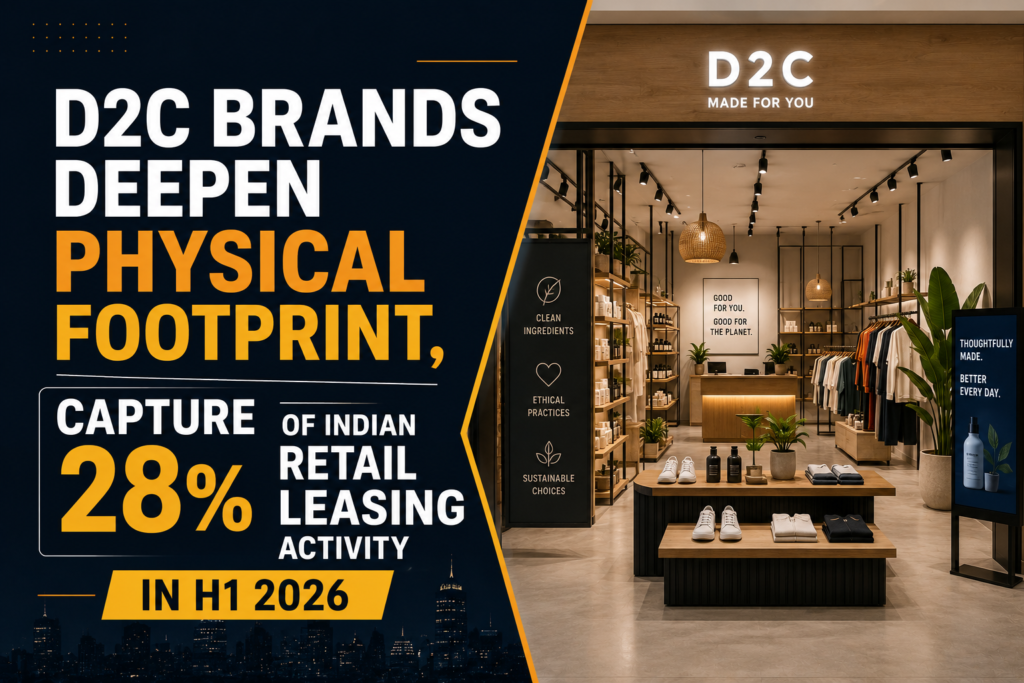
New Delhi, July 30, 2026: Direct-to-consumer (D2C) brands in India continued to expand their physical brick-and-mortar footprint, accounting for approximately 28 percent of total retail leasing activity between January and June (H1) 2026, up from around 23 percent in H1 2025, according to the latest report by real estate services firm CBRE South Asia Pvt. Ltd.
The growth in D2C leasing coincided with a broader surge in the Indian retail market, where total leasing activity grew by 20 percent year-on-year to reach approximately 3.9 million square feet in H1 2026. The April–June period (Q2 2026) alone contributed roughly 2 million square feet to the total. Regionally, Delhi-NCR led the retail space absorption with a 35 percent share, followed by Chennai at 17 percent and Mumbai at 15 percent. Domestic retailers continued to drive the overall market, representing over 70 percent of total space take-up, led by brands in Fashion & Apparel, Food and Beverage (F&B), Entertainment, and Jewellery.
According to CBRE’s India Retail Figures H1 2026 report, digital-native brands are increasingly turning to offline retail to build credibility, elevate brand visibility, and deliver immersive, personalized shopping experiences. However, the report highlights a strategic evolution: as competition for prime retail locations intensifies, D2C players are prioritizing store-level profitability, capital efficiency, and omnichannel integration rather than rapid physical expansion.

Commenting on the shifting dynamics of the market, Anshuman Magazine, Chairman & CEO – India, South-East Asia, Middle East & North Africa, CBRE, noted: “India’s retail story in H1 2026 reflects a market that is maturing, not just growing. Retailers today are making sharper, more considered choices about where and how they expand, and that discipline is exactly what is building a more resilient, long-term retail sector for the country.”
Within the D2C segment, Fashion & Apparel remained the predominant sector, capturing roughly 69 percent of D2C physical leasing in H1 2026. Homeware and Furnishings followed with a 12 percent share, while Jewellery accounted for 7 percent.

Reflecting on the strategic recalibration among retailers, Rami Kaushal, Managing Director, Consulting & Valuations, India, Middle East & Africa, CBRE, stated: “What stands out this half is how deliberately retailers are recalibrating their growth strategies: balancing new-market opportunities with the fundamentals of long-term viability. This shift in approach is a sign of a retail sector that is planning for the next decade, not just the next lease.”
This pivot toward long-term retention is also reflected in the store formats D2C brands are deploying. Alongside traditional storefronts, digital-first players are adopting purpose-built formats, including micro-stores that serve primarily as experience hubs, and shop-in-shop arrangements that leverage the footfall and established credibility of existing retailers. Furthermore, lifestyle-led multi-brand retail platforms—which bring various D2C labels under one roof alongside community events—are becoming a preferred low-risk entryway for digital brands venturing offline for the first time.