News
Infrastructure as the New Real Estate Catalyst: What the Dwarka Expressway Interchange Means for Gurugram

By Viren Mehta, Founder & Director at ElitePro Infra
Real estate in Gurugram has always moved a few steps ahead of infrastructure, and when it finally caught up, it ended up providing a significantly high ROI to the farsighted investors. The proposed Rs. 923-crore underground trumpet interchange near the Pataudi Road junction on the Dwarka Expressway feels like one of those moments. Developers had already marked the corridor out. Land was being quietly assembled around Sectors 36, 37 and further west. What the interchange does is something subtler: it redraws the mental map of the city.
A signal-free loop feeding into the expressway changes how distance is perceived. When access becomes continuous rather than interrupted by traffic lights and local road bottlenecks, a location that once felt peripheral begins to behave like a central node. And this is where infrastructure stops being background and becomes a market signal.
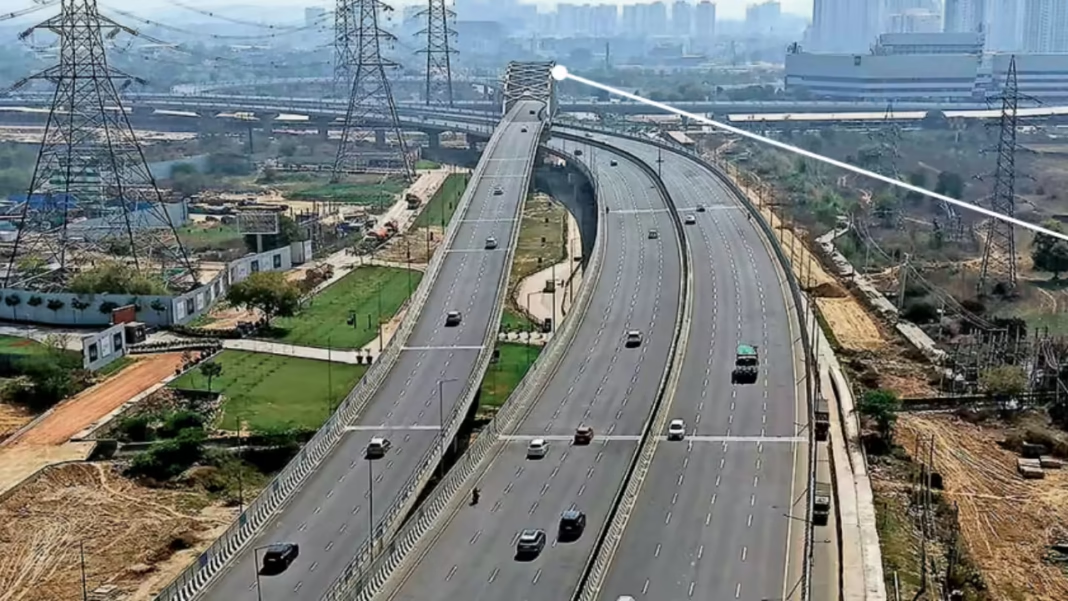
The interchange itself will sit near the emerging junction of multiple growth stories, the Dwarka Expressway spine, the Pataudi Road corridor, and the planned Global City development spread over roughly 1,000 acres, as reported in MagicBricks. The engineering details , about 3.2 kilometres of ramps and approach roads and an underground trumpet configuration , are less important than the behavioural effect it will produce.
Markets respond quickly to perceived certainty.
Over the past year or so, real estate experts with an eye on the Dwarka Expressway belt have noticed something slightly unusual. Buyer enquiries in the corridor are no longer dominated by speculative investors from Delhi. Instead, a noticeable share is coming from end-users working in cyber-city clusters and looking westwards for larger homes and better road access. The shift is anecdotal but hard to ignore.
Numbers have begun to reflect the mood, though unevenly. According to a Square Yards report, as infrastructure completion moved from promise to visibility, property values have climbed from approximately Rs 6,300 per sq ft in 2020 to Rs 21,700-24,000 per sq ft in 2025 (3.5 times) in the last five years.
If one spends enough time in site offices around Sector 37 or 88A, one notices something else. Brokers have begun describing distances in minutes rather than kilometres. “Twenty minutes to IGI” is a common refrain. That shift in vocabulary usually precedes a shift in pricing.
It is worth remembering that the Dwarka Expressway itself is not new anymore. The corridor runs about 27.6 kilometres between Mahipalpur and Kherki Daula, effectively forming an alternate Delhi–Gurugram spine. Interchanges like this one are what convert highways into urban systems.
With the improvement in connectivity, land values too have accelerated. In several pockets of the Dwarka Expressway belt, land parcels that were being negotiated two years ago at relatively modest valuations are now trading at numbers that assume a fully mature urban ecosystem. Add to it the signal-free corridors like the underground trumpet interchange near the Pataudi Road junction, which start linking emerging employment zones like Global City and Vision City directly to a major expressway, the gravitational pull of the corridor becomes difficult to resist.
Infrastructure has always shaped Gurugram’s geography. Examples like the NH-48 corridor in the early 2000s, the Sohna elevated road later, and now the Dwarka Expressway belt can be recalled immediately. Instead of following development, infrastructure is beginning to anticipate it.



Gulshan Group to Invest ₹1,000 Crore in North India’s First Taj Branded Residences
Noida, March 19, 2026: Gulshan Group, a real estate developer in North India, has announced a landmark partnership with the...


Why End-User Demand Is Creating a Stronger Foundation for Long-Term Returns
By Ashwani Kumar, Pyramid Infratech Over the last two years, the NCR housing cycle has begun to resemble less a...


Panasonic Debuts SIP-Based Video Intercom to Secure India’s Booming Smart Township Sector
New Delhi, March 19, 2026: Panasonic Life Solutions India has officially launched the VL-VQ Series, a sophisticated SIP-based IP Video...

Ansals Highland Park Secures OC in Gurugram; Over 400 Units Ready for Possession
Gurugram, March 19, 2026: Identity Buildtech Private Limited, a wholly owned subsidiary of Ansal Housing Limited, has received the Occupation...


Penalty of ₹5 Lakh Each Imposed on 3 Projects in the Authority Meeting by Rera
RERA Cracks Down on Promotion of Unregistered Projects; ₹63 Lakh Penalty Imposed on 13 Projects in the Last Six Months...

NCLT Approves Adani Enterprises’ Resolution Plan for Jaiprakash Associates
New Delhi, March 19, 2026: National Company Law Tribunal (NCLT) has cleared the path for Adani Enterprises Limited (AEL) to...
-
 News3 weeks ago
Hiranandani Communities Launches Watersports Centre at Premium Coastal Hiranandani Sands, Alibaug Township
-
Guest Column2 weeks ago
Retail Trends to Watch Out for in 2026
-
News3 weeks ago
Strategic Partnership between Brigade Group, Primus Senior Living to Develop Senior Living Communities
-
News4 weeks ago
Sambhav Homes Completes 85-acre Land Delivery for ₹600-Cr ESR Hosur Advanced Manufacturing Park
-
 News3 weeks ago
FY27 Outlook Residential Real Estate: High Base and Affordability Challenges; Tier I Mid-Premium Segment Resilient
-
News3 weeks ago
TARC Marks New Milestone at TARC Kailasa with Grand Tower Launch, New Experience Gallery Reveal
-
Guest Column3 weeks ago
Trust-Led, Lifestyle-Focused, Infrastructure-Driven: Punjab’s Real Estate Evolution
-
News3 weeks ago
Mumbai Real Estate Hits 14-Year High with Over 13,000 Property Registrations in February 2026