How the Delhi–Dehradun Expressway is Reshaping Residential Real Estate Market
New Delhi, February 20, 2026: Until recently, a drive from Delhi to Dehradun meant navigating choked highways, unpredictable bottlenecks and an exhausting eight-hour haul that turned weekend plans into logistical calculations. But now, the Delhi–Dehradun Expressway, designed to compress travel time to nearly four to five hours, promises smoother carriageways, safer access-controlled stretches and faster freight movement across the corridor. Beyond improving mobility, the project fits into India’s larger infrastructure push, recalibrating the economic value of distance.
The expressway instruments urban expansion, redistributing residential demand and redefining how cities at the periphery connect with the capital’s growth story. Stretching 210 km and backed by a INR 13,000 crore outlay under the Bharatmala Pariyojana, the expressway promises to slash commute times from 6.5 hours to just 2.5 hours. But the numbers only tell part of the story. By linking urban centres like Ghaziabad, Muzaffarnagar, and Saharanpur with pilgrimage and tourist spots such as Haridwar and Dehradun, the corridor stitches together economies and aspirations. Its design, marked by twin tunnels and a thoughtfully elevated stretch through Rajaji National Park, signals a rare blend of progress and preservation.
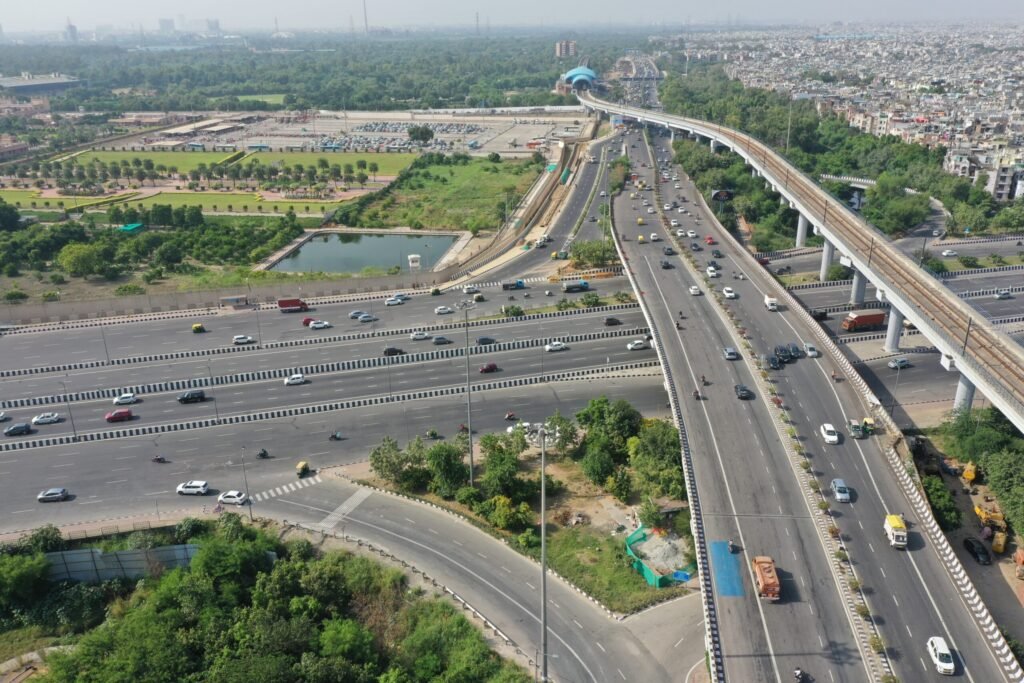
Improved connectivity has a way of redrawing maps. The Delhi–Dehradun Expressway, unfolding in four calibrated phases, illustrates how infrastructure can steadily reposition entire districts. Phase 1’s largely elevated 32-km stretch from Delhi’s Akshardham to the Eastern Peripheral Expressway in Baghpat has already compressed what was once a grinding commute into a swift 25-minute drive.
The 118-km greenfield expansion in Phase 2 toward Saharanpur, equipped with more than 60 underpasses and multiple interchanges, blends speed with local accessibility, pulling western Uttar Pradesh more firmly into the NCR’s orbit.
Phase 3 extends the corridor from Saharanpur to Ganeshpur in Uttarakhand, bridging the plains with the Himalayan foothills and opening up quieter geographies to residential and tourism-led possibilities.
The final 19.5-km stretch through the Shivalik Hills to Dehradun, including the Daat Kali Devi tunnel near the Rajaji landscape, underscores how connectivity and ecological sensitivity can coexist. Together, these phases are steadily recasting Dehradun, Saharanpur and Muzaffarnagar from peripheral addresses to emerging nodes of strategic residential demand.
According to Anarock, land deals across Tier-II and III cities in H1 2025 have surpassed those done in Tier-I cities. In H1 2025, land deals in Tier-II and III cities lapped up around 1,907 acres, compared to 991 acres in Tier-I cities. Besides, property in Tier II cities is 2–3 times cheaper than in metros, yet cities like Kanpur (+24% YoY), Lucknow (+22%), Jaipur (+18%), and Dehradun (+4.9%) are witnessing robust price appreciation. Even with an overall dip in unit sales, the total sales value in Tier-II cities grew, driven primarily by premium housing demand.
Post-Covid, smart-city adoption has further accelerated growth. Dehradun, in particular, saw a 47% rise in sales and a 100% jump in new supply, defying broader slowdown trends. Areas near Saharanpur and Muzaffarnagar also saw a significant increase in land prices. Moreover, developers, sensing early-mover advantage, have accelerated plotted developments and low-rise gated community launches, with several projects reporting healthy initial absorption and faster sales velocity than previously seen in these towns.
What is equally telling is the shift in buyer profile. Demand is no longer driven solely by end-users within the district; NRIs, high-net-worth individuals and Delhi–NCR families scouting for second homes or weekend retreats are now active participants. The result is a market that is transitioning from incremental local growth to a more diversified, investment-led expansion.
Beyond pure investment logic, the expressway is also catalysing a cultural shift in how urban families define “home.” The appeal of cleaner air, open landscapes and a slower rhythm of life is resonating strongly with Delhi–NCR’s upwardly mobile households. Hybrid work models have made extended weekend stays, and even mid-week remote working, turning second homes from indulgences into functional lifestyle assets. Developers along the corridor are responding with gated communities, serviced villa clusters and curated plotted developments that promise security, infrastructure and curated amenities rather than standalone farmhouses.
The ripple effects of the expressway are extending well beyond residential plots. Around key interchanges and access points, early signs of commercial and retail clustering are emerging, as fuel stations, warehousing units, neighbourhood shopping hubs and hospitality brands position themselves to capture transit and local demand. Land parcels that were once predominantly agricultural are gradually being reimagined for mixed-use development, blending residential enclaves with retail, institutional and logistics components. In that sense, the expressway is not merely stitching cities closer together; it is reshaping the economic fabric of the regions it traverses.
Thus, the next three to five years are likely to determine whether the corridor’s early momentum translates into sustained urban expansion. As connectivity stabilises and ancillary infrastructure falls into place, new sub-markets are expected to crystallise around interchanges and bypass junctions, particularly in the peripheries of Saharanpur and Muzaffarnagar, as well as along Dehradun’s growth edges. Ultimately, the Delhi–Dehradun Expressway will continue calibrating aspirations, altering not just commute patterns but the very geography of residential choice.