News
India Can Cut up to 8 Gigatons of Emissions from Its Buildings by 2050: Report
New Delhi, May 26, 2025: India is undergoing a significant influx of urban migration and a reclassification of rural areas, resulting in a rapidly growing urban population projected to reach 612 million by 2030 and 843 million by 2050.
Policymakers and industry leaders are working towards achieving a net-zero target by 2070. To further strengthen this ambitious goal, the National Institute of Urban Affairs (NIUA) and Rocky Mountain Institute (RMI) highlighted the urgent need for new housing and infrastructure based on low-carbon strategies across the nation.
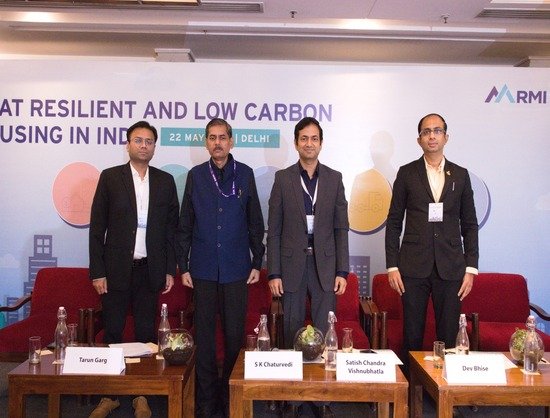
They launched the ‘Build Right for the First Time: Scaling Adoption of Net-Zero Carbon Buildings in India’ report at the “Heat Resilient and Low Carbon Housing in India” convention in New Delhi.
Several prominent persons, including Debolina Kundu, Director, National Institute of Urban Affairs (NIUA); Sachin Kumar, Director, Shakti Sustainable Energy Foundation; Satish Chandra Vishnubhatla, Deputy V-P, Johnson Controls–Hitachi Air Conditioning; Tarun Garg, principal, RMI India Foundation and S K Chaturvedi, Joint Director, National Council for Cement and Building Materials (NCB), were present.
As India’s urban landscape grows, so does the carbon footprint of its buildings. The report highlights a uniform definition for net-zero carbon structures and outlines five high-impact decarbonisation strategies that could collectively reduce up to 8 gigatons (Gt) of emissions by 2050.
Notably, these results can be achieved with a modest cost premium of approximately INR 4,566/m² compared to a business-as-usual scenario.
Vishnubhatla highlighted the industry-wide challenge of translating policy into actionable solutions. “There is universal agreement on the need to work towards heat-resilient housing and low-carbon housing. Yet implementation remains a key challenge at the ground level,” he noted.
Recognising the critical role of innovation in overcoming barriers to adoption, he emphasised its potential to enable widespread acceptance of sustainable cooling solutions.
“Innovation should ease adoption, removing obstacles so that policy can seamlessly transition into action. As a technology leader, Hitachi takes a three-pronged approach to this challenge. First, we focus on bringing the most energy-efficient technologies to Indian consumers, thereby reducing the load on the grid. Second, Hitachi has developed technologies, such as a self-cleaning function, to ensure the products maintain this efficiency throughout the life of the product,” he added.
“Last but not least, for adoption to happen at the ground level, we communicate the benefits of the technology to the customers in a simple manner without industry jargon.”
In collaboration with RMI, Johnson Controls-Hitachi Air Conditioning is embracing an ambitious challenge—developing air conditioning systems that are 5 times more efficient than conventional systems available in the market, pushing boundaries in energy efficiency.
Through groundbreaking innovations, Johnson Controls-Hitachi Air Conditioning is leading the charge toward a carbon-neutral future, setting new benchmarks in sustainable cooling technology.

Akshima Ghate, MD, RMI India, said, “India stands at a pivotal juncture in its development journey with rapid urbanisation and economic growth set to more than double its building stock by 2050. This moment presents a critical opportunity to align infrastructure expansion with climate goals.”
The report further suggests national and subnational policy interventions to facilitate the implementation of the proposed measures at the sector level. Moreover, it introduces a behaviour change framework to encourage the adoption of net-zero carbon buildings in India, targeting various stakeholders, including policymakers, real estate developers and industry professionals.

Debolina Kundu, Director, NIUA, requested stakeholders to come together to build a coalition for future-ready heat-resilient houses in India.
“India’s urban trajectory and economic growth present a once-in-a-generation opportunity to shape a low-carbon and heat-resilient future. We hope this effort empowers stakeholders across the value chain to lead India’s building sector toward a climate-resilient, energy-efficient, and equitable future.”
Mrinalini Shrivastava, IPS, Director, National Disaster Management Authority, proposed a platform like an urban heat mitigation lab that would act as a knowledge hub for urban heat mitigation research in India.

Shailesh Agrawal, Executive Director, Building Material & Technology Promotion Council (BMTPC), also urged innovators to empanel their products as green materials.
The gathering of policymakers, industry leaders and stakeholders aimed to strengthen India’s housing value chain while addressing the urgent need for decarbonization in the building sector.



India’s Data Center Capacity Set to Quadruple to 4 GW by 2030, Reports CareEdge Ratings
Mumbai, March 25, 2026: India’s data center industry is on the verge of a massive expansion, with capacity projected to...


Dev Accelerator Limited Board Approves ₹35 Crore Fundraise for Major Ahmedabad Expansion
Ahmedabad, March 25, 2026: Dev Accelerator Limited announced on March 24, 2026, that its Board of Directors has officially approved...


IITL Nimbus Group Announces ₹83 Lakh CSR Contribution for FY 2025–26
New Delhi, March 25, 2026: In a significant year-end philanthropic move, IITL Nimbus Group has announced a donation of ₹83,00,320...


House of Swamiraj Expands Its Presence as India’s Housing Sector Enters a New Growth Phase
Mumbai, March 25, 2026: House of Swamiraj is intensifying its footprint across the Mumbai Metropolitan Region (MMR) as the Indian...


Spectrum@Metro welcomes The Burger Company with Its New Outlet in Tower D
Noida, March 25, 2026: Spectrum@Metro has officially announced the further strengthening of its retail and dining portfolio with the grand...


Ofis Square Unveils ‘Ofis Select’: Premium Private Cabin Day Passes for Delhi NCR Professionals
New Delhi/NCR, March 25, 2026: Ofis Square, a prominent provider of coworking and managed office solutions, has announced the launch...
-
 News4 weeks ago
Hiranandani Communities Launches Watersports Centre at Premium Coastal Hiranandani Sands, Alibaug Township
-
Guest Column3 weeks ago
Retail Trends to Watch Out for in 2026
-
News4 weeks ago
Strategic Partnership between Brigade Group, Primus Senior Living to Develop Senior Living Communities
-

 News4 weeks ago
FY27 Outlook Residential Real Estate: High Base and Affordability Challenges; Tier I Mid-Premium Segment Resilient
-

 News1 week ago
FractoProp Receives SEBI Registration for Ridhama Real Estate Fund
-
News4 weeks ago
TARC Marks New Milestone at TARC Kailasa with Grand Tower Launch, New Experience Gallery Reveal
-
Guest Column4 weeks ago
Trust-Led, Lifestyle-Focused, Infrastructure-Driven: Punjab’s Real Estate Evolution
-
News3 weeks ago
Mumbai Real Estate Hits 14-Year High with Over 13,000 Property Registrations in February 2026