Guest Column
Plan Talk: Can Townships Give Urban India its Time Back?
By Siddharth Katyal

New Delhi, February 11, 2026: India’s congestion crisis is not just a mobility issue. It is the outcome of how cities have expanded, with housing, jobs, and services spreading in disconnected patterns. As urban India grows, the cost of this fragmentation is rising in time lost, fuel consumed, and infrastructure strain. Integrated townships offer a structural solution because they reduce the need to travel long distances in the first place.
Townships are master-planned, mixed-use environments that combine residential, commercial, retail, education, healthcare, and recreation in one coordinated framework. Their importance is best understood through market data and urban trends.
Spatial Imbalance
Residential research by ANAROCK shows that in major Indian metros, over 40–50 per cent of new housing supply in recent years has shifted toward peripheral micro-markets, largely due to affordability and land availability. However, job creation has not moved at the same pace, resulting in longer commute corridors between residential peripheries and employment hubs.
At the same time, JLL’s India office market reports indicate that a growing share of Grade A office absorption has been occurring in decentralised business districts and suburban locations, reflecting corporate attempts to move closer to where employees live. This is a response to commute-related productivity losses and employee retention concerns.
CBRE’s India market outlooks similarly note that mixed-use and integrated developments are attracting stronger investor and occupier interest, because they combine multiple demand drivers in a single location. This convergence of residential and commercial real estate trends reflects a shift toward proximity-based urban growth.
Townships Reduce Travel
When daily needs such as schools, retail, clinics, and leisure are located within the same development, a large share of routine trips becomes local. ANAROCK’s consumer preference studies highlight that convenience and reduced commute time now rank among the top decision factors for urban homebuyers.
Urban Activity Becomes Polycentric
JLL research shows that Indian cities are evolving toward multi-nodal structures, where employment is distributed across several hubs rather than concentrated in one central district. Townships that incorporate office and commercial space accelerate this shift, easing pressure on legacy CBDs and major arterial roads.
Car Dependence Reduces for Short Trips
CBRE occupier surveys indicate rising emphasis on walkability and integrated amenities. In master-planned townships, internal circulation networks allow many short trips to be completed on foot or via local mobility solutions, reducing the number of vehicles entering citywide road networks.
Jobs Move Closer to Homes
Office market trends from JLL and CBRE show continued expansion of workspace in emerging corridors and suburban hubs. When even a portion of employment demand is met within or near residential clusters, cross-city commuting reduces structurally.
Faridabad as Emerging Example
Faridabad’s growth pattern reflects this broader shift. The city has seen rising residential supply because of price advantages and connectivity improvements. However, a large share of its workforce still travels toward other NCR employment centres, adding pressure to regional corridors.
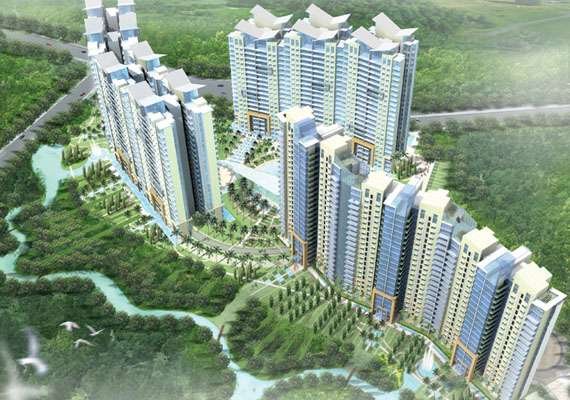
Industry research consistently shows that infrastructure-led corridors attract both housing and office demand. In cities like Faridabad, integrated townships that combine residential supply with employment space, retail, and social infrastructure can gradually reduce outward commuting flows. Over time, this helps convert a commuter-dependent city into a more balanced urban node.
Infrastructure Efficiency and Sustainability
Large-format, planned developments allow infrastructure to be delivered more efficiently. Concentrated growth reduces the per-unit cost of utilities, roads, and social infrastructure compared to scattered expansion. CBRE and JLL research both note stronger absorption and investment interest in projects aligned with infrastructure corridors and planned clusters.
Environmental benefits follow. Shorter travel distances lower fuel consumption and emissions, while integrated green spaces improve heat and stormwater management. Reduced commute stress also has social value, returning time to households and improving work-life balance.
Conditions for Success
Townships reduce congestion only when certain planning principles are met:
- Genuine mix of residential, commercial, retail, and social infrastructure
- Walkable internal layouts
- Linkage to mass transit corridors
- Density sufficient to support services
- Phased delivery so jobs and amenities grow alongside housing
A Structural Response
Urban congestion in India stems from how cities are spatially organised. Townships respond by aligning homes, jobs, and services within the same ecosystem. Market evidence from ANAROCK, JLL, and CBRE shows that buyer demand, occupier strategy, and investor capital are already moving in this direction.
Townships are therefore not just a development format. They represent a shift toward proximity-driven, mixed-use urban growth, which can help Indian cities expand with lower congestion, more efficient infrastructure, and stronger liveability.
The author is CEO, Bhumika Realty



Retail Meets Real Estate: The Rise of Experience-Led Commercial Developments in Faridabad
By Paras Rai, Managing Director and Co-Founder, Property Master Faridabad, once perceived as a peripheral industrial hub in the NCR,...

Euro Pratik Sales Expands National Footprint with ₹33.20 Crore Acquisition of Chawla Brothers
Mumbai, March 23, 2026: In a move that significantly reshapes the competitive landscape of the interior solutions industry, Euro Pratik...


Sunday PropTech Announces 5% EBITDA Dividend Payout Following Strategic ₹800 Crore Asset Acquisition
New Delhi, March 23, 2026: In a move signaling robust fiscal health and a commitment to investor returns, Sunday PropTech...


Agrocorp Targets ₹200 Crore Revenue with Launch of ‘Vacation Village’ Second-Home Community in Chikkamagaluru
Chikkamagaluru, March 23, 2026: Bengaluru-based real estate developer Agrocorp has officially entered the destination holiday home market with the launch...


Luxury vs Affordable Housing: Where Smart Money Is Going in 2026
The Indian real estate market is no longer what it used to be a decade ago. Back then, property buying...

CM Yogi Reviews Noida International Airport Preparedness Today Ahead of Mega March 28 Launch
Noida, March 23, 2026: Uttar Pradesh Chief Minister Yogi Adityanath on Sunday inspected the Noida International Airport to review preparations...
-
 News4 weeks ago
Hiranandani Communities Launches Watersports Centre at Premium Coastal Hiranandani Sands, Alibaug Township
-
Guest Column3 weeks ago
Retail Trends to Watch Out for in 2026
-
News4 weeks ago
Strategic Partnership between Brigade Group, Primus Senior Living to Develop Senior Living Communities
-
 News4 weeks ago
FY27 Outlook Residential Real Estate: High Base and Affordability Challenges; Tier I Mid-Premium Segment Resilient
-
News4 weeks ago
TARC Marks New Milestone at TARC Kailasa with Grand Tower Launch, New Experience Gallery Reveal
-

 News6 days ago
FractoProp Receives SEBI Registration for Ridhama Real Estate Fund
-
Guest Column4 weeks ago
Trust-Led, Lifestyle-Focused, Infrastructure-Driven: Punjab’s Real Estate Evolution
-
News3 weeks ago
Mumbai Real Estate Hits 14-Year High with Over 13,000 Property Registrations in February 2026