News
Real Estate Generating Huge Need For Capital, Need For New Funding Sources: SBICAPS Report

Mumbai, August 1, 2025: The fourth stage of real estate evolution has seen premiumisation (increasing share of luxury flats and Grade A offices), hybrid work (larger share of co-working spaces in leasing) and consolidation (rise of national-level listed players).
Formalisation of the sector, starting with RERA and IBC, has reached a crescendo. These factors have increased the thirst for funds, according to the latest SBI Capital Markets (SBICAPS) report on the real estate sector titled ‘Building A New Funding Architecture For Sky-scraping Growth’.
Promoters have tapped into the QIP route aggressively in FY25 to raise equity. On the debt side, banks, with their exposure of INR 35-plus trillion, are doing most of the heavy lifting. Yet, there are some crannies where traditional sources are constrained to lend due to regulatory mandate or risk perception—particularly land acquisition and stressed projects.
NBFCs tackled the need for institutional capital in early-stage real estate development during the 2010s. Their space is now being gobbled up by private capital
The vacuum left by banks had erstwhile been occupied by NBFCs, who expanded their CRE portfolios vigorously in the 2010s. Since then, the decline of some large NBFCs due to wholesale exposures and inadequate liability management and the merger of a large HFC into a bank have made them cede ground to AIFs.
Further, recent RBI norms have limited the ability of NBFCs to take indirect exposure. Therefore, we are increasingly seeing that the high-risk, reward early stage, which involves land acquisition and construction financing, is occupied by AIFs.
Indeed, real estate is the largest investment sector for them, nearly double that of the next sector. With several regulatory actions in favour of institutional capital and sectoral cash flow stabilising, the trend of diverse fundraising (IPOs, AIFs, sovereign wealth funds, etc.) will continue.
Commercial realty, especially offices, represents a high-growth segment where opportunities exist for every investor’s risk-reward matrix
Office spaces had a breakthrough year in CY24 with leasing beating the previous record year by 20 per cent, rents increasing and vacancy decreasing. Momentum continues in CY25 with activity particularly strong in Bangalore, Delhi NCR and Pune. GCC is emerging as the leading source of demand with MNCs using India for core functions instead of only for labour arbitrage—the outlook for them seems positive with their number expected to reach 1.3x in the next few years.
Flex space operators are showing globally unprecedented success in India, and a string of IPOs in the space highlights the same. The rise of start-ups and a strong MSME ecosystem will grow this more. With this rosy future, REITs have looked to first tap this market.
REIT ecosystem for offices is well-established. Global experience shows that asset class diversification is needed to achieve true potential
REIT AUM has grown at a CAGR of 30 per cent in the last five years driven by the creation of new REITs and the addition of new properties (largely ROFO). Indian REITs have till now been able to deliver steady distribution in a tax-efficient manner and tided over the pandemic period largely unscathed as far as leasing-rental dynamics are concerned.
With almost 500 msf of Grade A non-institutional office assets remaining in the stock, we estimate an additional REITable value of INR 7 trillion. The global REIT ecosystem is much larger, and to achieve saturation like the USA (where 98 per cent of listed real estate is housed in REITs), there is a need to expand the scope beyond offices. While the retail REIT is welcome, forays into hotels, warehousing, etc., are imperative.
Regulatory ecosystem is conducive to widening the investor base, retail participation will increase as REIT AUM expands in the future
Over time, regulators have eased norms on sponsor stake, allowing dilution so that REITs can achieve their primary goal of providing developers with an exit and recycling capital.
Average sponsor stake has reduced from close to half at inception to less than one-third as of June. Correspondingly, the stakes of DII and FII have risen from 28 per cent to 46 per cent on average with much of it coming from DII. No doubt this is greatly helped by regulatory largesse for key institutions such as DIIs, enabling them to invest more in REITs.
The retail investor, however, remains elusive. We believe the availability of a larger number of asset classes and a steady stream of investible assets shall lead to the REIT AUM to increase at a 25-30 per cent CAGR in the coming years



Highway Hub Signs MoU With Viva Apotek to Develop Retail Network
Highway Hub, a venture by the Pragati Group, has signed an MoU to form a Joint Venture with Viva Apotek...


How Technology is Changing Real Estate
A complete, human-style deep dive into the future of property, investment, and living Introduction: A Digital Revolution in Real Estate...
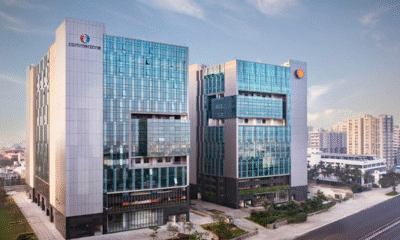

Mindspace REIT Expands Chennai Footprint with ₹2,541 Crore Acquisition of Commerzone Pallikaranai
Mumbai, April 2, 2026: Mindspace Business Parks REIT has announced a major expansion of its southern India footprint with the...


Abhee Ventures Brings a Scotland-Inspired Living Concept to Bengaluru
Bengaluru: Abhee Ventures is preparing to bring a residential development in Bengaluru,inspired by the enduring architectural charm and pastoral serenity...


Chelvies Coffee Company Opens at Spectrum@Metro, Noida
Noida, April 3, 2026: Strengthening its vibrant retail and F&B mix, Spectrum@Metro haswelcomed the launch of Chelvies Coffee Company, a...


Record Sales, Production Propel SAIL’s Strongest-ever Performance in FY2025-26
New Delhi, April 2, 2026: The largest steelmaking public sector company, SteelAuthority of India Limited (SAIL), has achieved its highest-ever...
-
 Guest Column4 weeks ago
Retail Trends to Watch Out for in 2026
-

 News3 weeks ago
FractoProp Receives SEBI Registration for Ridhama Real Estate Fund
-
News1 week ago
How Noida International Airport Will Impact Property Prices
-
News5 days ago
Noida International Airport Inauguration Sparks New Real Estate Boom For NCR
-
News2 weeks ago
Rise of Airport-Linked Real Estate: Opportunities Emerging Around Jewar
-
News3 weeks ago
Enviro Infra Engineers Secures ₹411 Crore Bihar Sewerage Project Under AMRUT 2.0
-
News3 weeks ago
Greenlands Global Private Limited Appointed as Managing Partner for Big FM Realty’s ₹1,200 Crore Mixed-Use Development
-

 News3 weeks ago
India Maintains Competitive Edge as Asia-Pacific Office Fit-Out Hub, Reports Knight Frank