News
RICS global guidance for land measurement

New guidance on the measurement of land for development projects such as new housing and commercial development has been published by the Royal Institution of Chartered Surveyors, which defines common measurements used across the built environment and associated metrics such as density.
The guidance will be used by planners, surveyors, developers, architects, Government and legal administrators around the world.
Titled ‘Measurement of Land for Planning and Development Purposes’, it provides clear definitions for measurements widely used in the property and built environment sectors, advocating consistency worldwide. Five core definitions have now been formalised by RICS to assist with the global measurement of land, they are:
- Land Ownership Area (LOA): an area of land, measured on a horizontal plane, which is held in a single legal interest or title by one or more legal owners, which may be the subject of a proposed or actual sale, letting or other disposal, valuation or compulsory purchase, and which may comprise all or part of that single legal interest or title.
- Site Area (SA): the total land area on which development authorisation is sought, measured on a horizontal plane.
- Net Development Area (NDA): the extent of the Site Area upon which one or more buildings or other operations and their ancillary space can be built, measured on a horizontal plane.
- Plot Ratio (PR): the ratio of total development floor area to SA. Development floor area may be measured as gross external area (GEA) or gross internal area (GIA) but whichever is used or modifications of them should be clearly stated.
Floor Area Ratio (FAR) and Floorspace Ratio (FSR) are similar terms, used interchangeably in some jurisdictions to reference the same point. For consistency, PR should be used wherever possible. Where jurisdictional requirements are for the use of either FAR or FSR, PR should be reported as well.
- Site Coverage (SC): the ratio of ground floor area (measured in accordance with GEA) to SA, expressed as a percentage.
A key difference with the new guidelines is that calculations of density should now always be expressed in terms of Gross Density (based on SA), rather than on a Net basis, with Net Density providing an additional and complementary metric for understanding the intensity of development of a site.
The guidance is lead-authored by one of Britain’s foremost urbanists, chartered surveyor and town planner Jonathan Manns, Executive Director at Rockwell.
 Tony Mulhall, Associate Director of the Land Professional Group at the RICS, said, “This guidance offers a consistent way to measure land – whether that’s delivering desperately needed homes, new infrastructure or preparing vacant spaces for future development.”













CP67 Surges as North India’s Premier Retail Hub Amidst Sustainability-Led Growth
New Delhi, March 22, 2026: CP67, a major mixed-use commercial and lifestyle development located on the International Airport Road in...
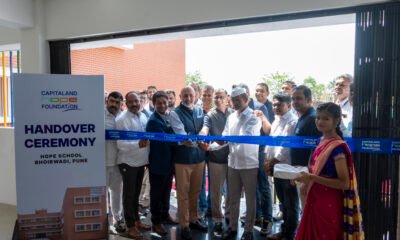

CapitaLand strengthens Hope School Programme in Pune, expanding total capacity to over 1,400 students
Pune, March 22, 2026: CapitaLand Hope Foundation (CHF) has completed the second phase of its Hope School Programme in Pune,...


TK Elevator Names Ravikrishnan Srinivasan as New CEO for India Operations
New Delhi, March 21, 2026: TK Elevator, a global frontrunner in vertical transportation and urban mobility, has officially appointed Ravikrishnan...


Is Real Estate Better Than Stock Market? A Complete Investment Guide (2026)
When it comes to building wealth, two of the most popular investment options are real estate and the stock market....


Patel Engineering Secures ₹230.70 Crore Contract for Bhutan’s Largest PPP Hydropower Project
Mumbai, March 21, 2026: Patel Engineering Limited (PEL), a Mumbai-based infrastructure firm, has been awarded a contract by Dorjilung Hydro...


Cushman & Wakefield Report Highlights Noida International Airport as Catalyst for NCR Economic Surge
Noida, March 21, 2026: As the National Capital Region prepares for the historic inauguration of the Noida International Airport on...
-
 News4 weeks ago
Hiranandani Communities Launches Watersports Centre at Premium Coastal Hiranandani Sands, Alibaug Township
-
Guest Column2 weeks ago
Retail Trends to Watch Out for in 2026
-
News3 weeks ago
Strategic Partnership between Brigade Group, Primus Senior Living to Develop Senior Living Communities
-

 News3 weeks ago
FY27 Outlook Residential Real Estate: High Base and Affordability Challenges; Tier I Mid-Premium Segment Resilient
-
News3 weeks ago
TARC Marks New Milestone at TARC Kailasa with Grand Tower Launch, New Experience Gallery Reveal
-
Guest Column3 weeks ago
Trust-Led, Lifestyle-Focused, Infrastructure-Driven: Punjab’s Real Estate Evolution
-

 News5 days ago
FractoProp Receives SEBI Registration for Ridhama Real Estate Fund
-
News3 weeks ago
Mumbai Real Estate Hits 14-Year High with Over 13,000 Property Registrations in February 2026