Main
The myth of increased housing sales during the Indian festive season: JLL

The following is the report by Akshit Shah, AVP – Capital Markets Research, JLL India
Typically, residential property sales are slow in the first half of the year. The first quarter coincides with school exams, during which family decision makers tend to steer clear of major disruptions in the schedule. In the third quarter, sales also tend to be subdued because of the monsoon season and Pitru Paksh, which is considered an inauspicious period for new beginnings.
Sales are usually expected to pick up in the fourth quarter, because this time of the year brings with it various festivals which are considered auspicious for purchasing a new house. With a visible increase in new launches and marketing activity, the fourth quarter should be contributing a significantly bigger share to the annual absorption of residential units. However, the primary residential absorption numbers of the past few years tell a different story:
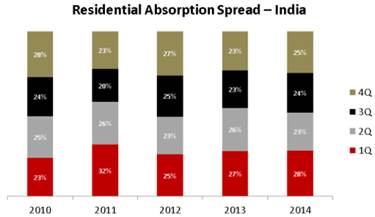
Source: Real Estate Intelligence Service, JLL India
A look at the demand for residential real estate during the past five years shows that, contrary to the general perception that a majority of sales happen in the second half of a year, the absorption is largely the same in both halves. A weighted average of the past five years shows that the first quarter attracts the highest number of deals at 27 per cent, while the fourth quarter (i.e. the festive season) attracts 25 per cent, which is at par with the average.
The hypothesis that residential property sales pick up markedly during the festive season was valid in the pre-2010 period, but it does not hold water today. This is because of the following reasons:
The average age of home buyers has come down from the mid-50s to the mid-20s. The younger generation prefers to take informed decisions and focuses on better bargaining opportunities rather than auspicious days to purchase property.
The service industry is growing rapidly, and now contributes over 55 per cent of India’s GDP. A larger part of this industry announces salary hikes and bonuses in the second quarter. The manufacturing and trading industry, on the other hand, announces bonuses during Diwali – which falls in the fourth quarter.
Many people belonging to the upper-middle and high-income groups plan their investments during the first quarter, for effective tax management purposes.
In short, the trend has changed, and the seasonal impact on housing demand is a thing of the past. If the first half of the year has not seen good business, it is quite futile to expect the remaining half to compensate for the deficit. In any year where such a scenario has played out, it does not make sense for developers to bank on the festive season to bring a significant change in fortunes.



India’s Data Center Capacity Set to Quadruple to 4 GW by 2030, Reports CareEdge Ratings
Mumbai, March 25, 2026: India’s data center industry is on the verge of a massive expansion, with capacity projected to...


Dev Accelerator Limited Board Approves ₹35 Crore Fundraise for Major Ahmedabad Expansion
Ahmedabad, March 25, 2026: Dev Accelerator Limited announced on March 24, 2026, that its Board of Directors has officially approved...


IITL Nimbus Group Announces ₹83 Lakh CSR Contribution for FY 2025–26
New Delhi, March 25, 2026: In a significant year-end philanthropic move, IITL Nimbus Group has announced a donation of ₹83,00,320...


House of Swamiraj Expands Its Presence as India’s Housing Sector Enters a New Growth Phase
Mumbai, March 25, 2026: House of Swamiraj is intensifying its footprint across the Mumbai Metropolitan Region (MMR) as the Indian...


Spectrum@Metro welcomes The Burger Company with Its New Outlet in Tower D
Noida, March 25, 2026: Spectrum@Metro has officially announced the further strengthening of its retail and dining portfolio with the grand...


Ofis Square Unveils ‘Ofis Select’: Premium Private Cabin Day Passes for Delhi NCR Professionals
New Delhi/NCR, March 25, 2026: Ofis Square, a prominent provider of coworking and managed office solutions, has announced the launch...
-
 News4 weeks ago
Hiranandani Communities Launches Watersports Centre at Premium Coastal Hiranandani Sands, Alibaug Township
-
Guest Column3 weeks ago
Retail Trends to Watch Out for in 2026
-
News4 weeks ago
Strategic Partnership between Brigade Group, Primus Senior Living to Develop Senior Living Communities
-

 News4 weeks ago
FY27 Outlook Residential Real Estate: High Base and Affordability Challenges; Tier I Mid-Premium Segment Resilient
-

 News1 week ago
FractoProp Receives SEBI Registration for Ridhama Real Estate Fund
-
News4 weeks ago
TARC Marks New Milestone at TARC Kailasa with Grand Tower Launch, New Experience Gallery Reveal
-
Guest Column4 weeks ago
Trust-Led, Lifestyle-Focused, Infrastructure-Driven: Punjab’s Real Estate Evolution
-
News3 weeks ago
Mumbai Real Estate Hits 14-Year High with Over 13,000 Property Registrations in February 2026