Why India’s Jewellery Market Is Becoming Increasingly Organised
By Jatin Goel, Executive Director, Omaxe Group
India’s jewellery market has long been defined by trust, tradition and neighbourhood relationships. For decades, family jewellers and local markets dominated consumer preference, built on generational credibility rather than formal structures.
Few places capture this legacy better than Chandni Chowk in Delhi, one of India’s oldest and most iconic jewellery hubs. Known for its dense network of traditional jewellers and wholesale markets, it has historically been the backbone of gold and silver trade in North India.
Yet even markets like Chandni Chowk are now witnessing a gradual but clear transition.
The Indian jewellery market, estimated to be over $80–85 billion, is moving from a largely fragmented ecosystem to a more organised and transparent structure. While the transformation is still underway, its direction is unmistakable.
Trust is being redefined
Historically, trust in jewellery purchases was deeply personal. Buyers relied on relationships built over years with local jewellers. Today, that trust is increasingly institutional.
Standardisation through hallmarking, greater price transparency and formal billing practices have reduced information asymmetry. Consumers are less dependent on personal networks and more inclined toward brands that offer consistency and assurance.
Even in traditional markets like Chandni Chowk, organised formats are beginning to coexist with legacy businesses, reflecting changing consumer expectations.
The rise of the informed consumer
A key driver of this shift is the changing profile of the Indian consumer.
Today’s buyers are more aware, more research-driven and more value-conscious. Digital access has enabled price comparisons, design exploration and brand discovery in ways that were not possible earlier.
This has led to a growing preference for organised players who can offer:
- Transparent pricing
- Certified quality
- Wider design portfolios
- Structured after-sales services
Jewellery is no longer just a cultural purchase. It is increasingly viewed as a financial asset, especially in categories like gold.
Formalisation through policy and taxation
Policy interventions over the past decade have accelerated the move toward organised retail.
The introduction of GST has improved pricing transparency, while mandatory hallmarking has standardised quality across the industry. Compliance requirements have increased accountability, making it more difficult for informal operators to function without structure.
These changes are gradually reshaping even legacy markets. In places like Chandni Chowk, where trade has traditionally operated on informal systems, there is now a visible shift toward formal practices.
Retail infrastructure is evolving
Another important driver of change is the transformation of retail infrastructure.
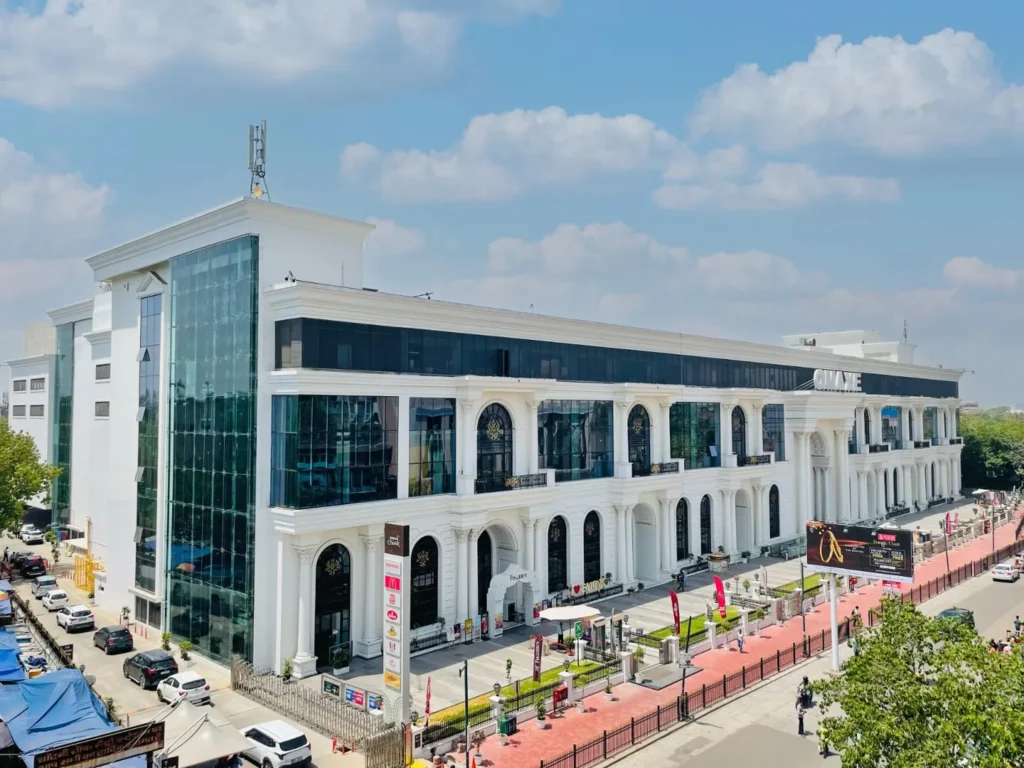
The emergence of organised retail destinations is enabling jewellery brands to present themselves in more structured, experience-led environments. This is particularly relevant in historic markets like Chandni Chowk, where redevelopment and modern retail formats are beginning to complement traditional trade.
Consumers today are increasingly drawn to spaces that offer convenience, accessibility and a curated experience. The jewellery purchase is no longer just transactional; it is experiential.
Tier II and III markets are accelerating the shift
The move toward organised jewellery retail is not limited to metros.
Tier II and III cities are witnessing strong growth in branded jewellery consumption, driven by rising incomes, increasing urbanisation and digital exposure. Organised retail is expanding into these markets, reducing the dominance of localised, unstructured formats.
The role of design and branding
As the market evolves, differentiation is increasingly driven by design, branding and customer experience.
Organised players are investing in product innovation and targeted collections, catering to a more diverse and aspirational consumer base. Store design, service quality and brand storytelling are becoming as important as the product itself.
A gradual but irreversible transition
Despite this progress, India’s jewellery market remains significantly fragmented, with the organised segment accounting for roughly 35–40 percent of the total market.
This indicates substantial headroom for growth.
The transition toward formalisation will be gradual, but it is unlikely to reverse. Over time, traditional markets and organised retail will not replace each other but coexist, with clearer boundaries and greater transparency.
Looking ahead
The evolution of India’s jewellery market reflects a broader shift in consumer behaviour and economic structure.
From the bustling lanes of Chandni Chowk to emerging organised retail destinations, the industry is moving toward a more structured, transparent and experience-driven future.
For consumers, this means greater confidence and choice.
For the industry, it signals the beginning of a more disciplined and sustainable growth phase.
Disclaimer: Views expressed in this article are those of the author and not of Realty & More