India’s Real Estate Equity Inflows Hit Record $30.7 Billion Amid Institutional Surge: CBRE Report

Mumbai, May 5, 2026: India’s real estate sector has reached a historic milestone, securing a record USD 30.7 billion in equity inflows between 2024 and the first quarter of 2026. According to a flagship report by CBRE South Asia Pvt. Ltd. titled “Deploying Capital in a Transformative Era: The Four-Quadrant Analysis,” released at the CII BFSI Summit 2026, these inflows represent a massive 88% surge compared to the USD 16.3 billion recorded during the 2022–2023 period. The surge was primarily fueled by the acquisition of development sites and built-up office assets, which together accounted for more than three-fourths of the total capital deployment, CBRE said in a press release.
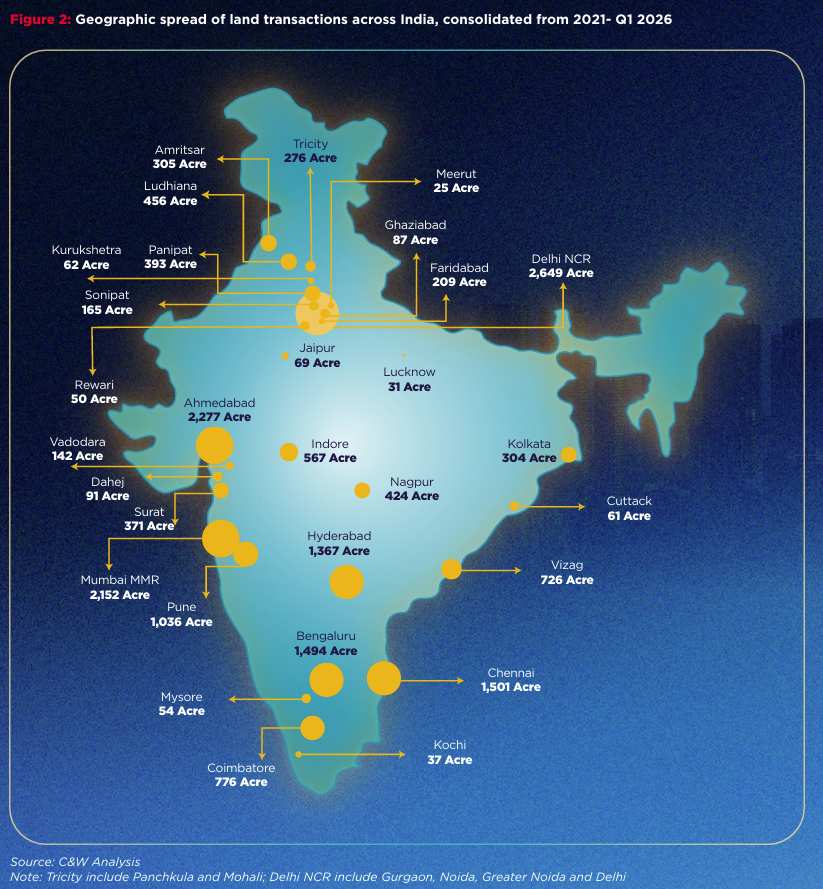
The report highlights a significant shift toward institutionalization, with institutional investors more than doubling their capital flows compared to previous years. This appetite for Indian assets was underscored by the acquisition of approximately 6,025 acres of land for greenfield developments, involving a capital outlay of roughly USD 13 billion. While over 80% of these funds targeted residential, mixed-use, and office projects, the remainder was committed to the burgeoning sectors of warehousing, data centers, and retail.
Public equity markets also played a transformative role, as Real Estate Investment Trusts (REITs) saw their market capitalization jump nearly six-fold to INR 1.7 trillion between 2020 and 2025. In a standout performance during the first quarter of 2026, listed REITs deployed a record USD 2 billion for investment-grade assets, marking a six-fold year-on-year increase. This rapid scaling of REITs has provided a transparent and liquid avenue for both domestic and international investors to participate in India’s premium property market.
The debt market showed equal resilience, with bank credit to commercial real estate growing by 16% year-on-year by February 2026. Furthermore, advances from Non-Banking Financial Companies (NBFCs) crossed the INR 1 lakh crore threshold in September 2025, reaching a five-year high. Total debt financing in the sector surpassed USD 146 billion during the analyzed period, with the “gateway cities” of Mumbai, Delhi-NCR, and Bengaluru attracting 60% of these flows.

Anshuman Magazine, Chairman & CEO — India, South-East Asia, Middle East & Africa, CBRE, attributed this success to a decade of policy evolution. “We are witnessing the payoff of a decade of structural reforms,” said Magazine. “From RERA and GST to the RBI’s Project Finance Directions in 2025, each intervention has made India’s real estate market more transparent, more resilient, and more institutionally credible. The documented debt inflows reflect a long-term conviction and remain well-informed and regulated. India’s BFSI sector has not just returned to real estate but has redefined its relationship with the sector.”
The investment narrative is also expanding into alternative asset classes like data centers and hospitality. Data centers, in particular, saw marquee players commit USD 178 billion in the first quarter of 2026 alone for future deployment. Highlighting the global interest in these diverse opportunities, Magazine added, “Against a backdrop of global geopolitical uncertainty and yield hardening, India’s real estate sector is increasingly regarded as a high-conviction, long-duration bet by both domestic and international institutional capital.”

Industry leaders emphasized that the synergy between real estate and the financial sector is now a cornerstone of national economic growth. Vir S Advani, Chairman, CII Western Region and CMD, Blue Star Limited, commented, “India’s real estate sector has evolved into a key avenue for institutional capital, driven by strong investor confidence, reforms, and the growing role of REITs. Sustained policy support, regulatory clarity, and closer alignment between industry and financial institutions will be critical to maintaining this momentum and expanding investment across segments and cities. Real estate and BFSI together form a powerful engine of India’s growth. With the sector contributing 7–8% to GDP and projected to reach ~13% by 2030, stronger linkages between the two will unlock investment, support sustainable development, and help shape future-ready cities.”