How Infrastructure and Urban Growth Are Driving Retail Expansion Across NCR Markets
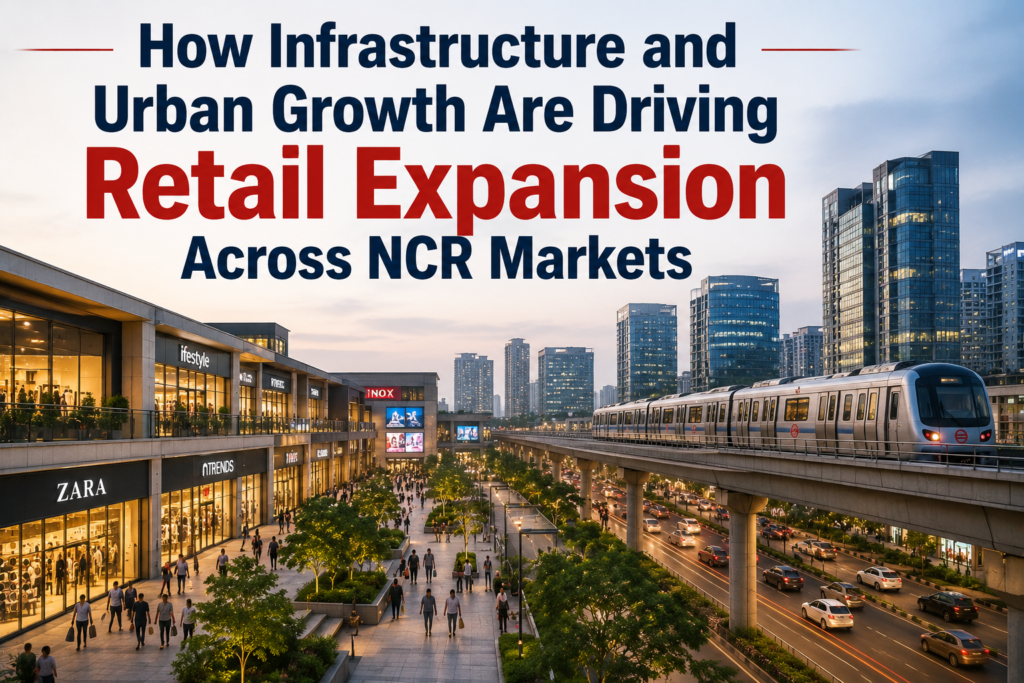
New Delhi, June 25, 2026: For years, the National Capital Region’s (NCR) retail geography revolved around South Delhi and Central Gurugram, which held the addresses that mattered while everything else waited in the wings. That certainty is now giving way as a decade of infrastructure investment—including expressways, metro corridors, elevated roads, and the impending Noida International Airport—has decentralised commercial gravity across the region, drawing organised retail into markets that once barely registered on a leasing map, a group of real estate developers said.
In the first quarter of 2026, NCR’s retail sector recorded a gross leasing volume of 0.65 million square feet, with the Prime Others and Suburbs submarkets together accounting for nearly the entire demand pie. Vacancy levels declined to 12.8 per cent, and close to 3 million square feet of new supply is expected to become operational through 2026, with locations such as Dwarka Expressway, Greater Noida, and Faridabad poised to absorb the next wave of retailer expansion.

Jatin Goel, Executive Director, Omaxe Group, said, “The NCR retail market is undergoing a structural shift, where growth is increasingly moving beyond traditional retail hubs into infrastructure-led corridors. As developers, we are witnessing this transformation firsthand across our projects. Faridabad, for instance, has evolved significantly over the last decade and is now entering a new growth cycle, supported by expanding connectivity, metro access and a steadily growing residential catchment.”
He further added, “The same momentum is visible in Greater Noida, where infrastructure projects such as the upcoming Greater Noida Terminal and the Noida International Airport are strengthening the region’s position as a major consumption and business destination. Importantly, the benefits of the Jewar airport ecosystem will extend far beyond Noida and Greater Noida, positively impacting markets across NCR, including Faridabad. In Dwarka, strategic connectivity to Delhi, Gurugram and the airport corridor is creating a strong foundation for organised retail growth. The fact that retail vacancy across NCR has declined to 12.8% and nearly 3 million sq ft of new retail supply is expected this year reflects growing retailer confidence in these emerging destinations. We believe the next phase of NCR’s retail growth will be driven by markets where infrastructure, population growth and consumption demand are converging simultaneously.”
The retail opportunity in NCR is no longer concentrated but is spreading corridor by corridor and catchment by catchment, moving in step with the infrastructure making it possible. Long characterised by its industrial identity, Faridabad has undergone a steady residential transformation, and that divergence is now the opportunity. According to data from Square Yards, commercial property in Faridabad, particularly showrooms and retail shops, is responding accordingly, with showroom rates averaging ₹27,244 per square foot after rising 13.79 per cent in recent quarters. More telling still, Faridabad Central has recorded significant appreciation in property values, signalling that the market is repricing the city’s fundamentals in real time.

Nandini Taneja, CEO, Bhumika Enterprises, said “Faridabad and Gurgram have quietly built one of the most compelling consumption profiles in NCR. The concentration of GCCs, MNCs, and global brands along the expressway has created a consumer base that is internationally exposed, aspirationally oriented, and with spending patterns that are genuinely premium. We’re seeing brands that would previously have considered South Delhi or Greater Noida as their only NCR address now treating Faridabad and Gurgram as a primary market in its own right. The demand for premium and curated retail space in this corridor reflects a structural shift in who lives and works here.”
This real-time transformation is playing out across several NCR corridors simultaneously. The full operationalisation of the Dwarka Expressway unlocked a densely populated residential belt that had long outpaced its retail infrastructure, while the planning around the Noida International Airport aerocity is already shaping land use, mixed-use development, and long-term retail strategy across the Yamuna Expressway corridor.

Harinder Singh Hora, Founder Chairman, Reach Group, said, “The Dwarka Expressway corridor has transitioned from a future-growth story to a demand-led market. Strong infrastructure delivery, sustained residential absorption, and the emergence of an affluent consumer base are creating a compelling case for organised retail. With Gurugram’s population expected to nearly double by 2041 and residential demand in the micro-market remaining strong, retail growth is no longer a matter of anticipation but of timing. The increasing participation of leading brands and retailers through active leasing decisions reflects growing confidence in the corridor’s long-term potential and the demand already visible on the ground.”
Connectivity, once the market’s primary limitation, has strengthened materially for developers and brands with the foresight to read emerging markets ahead of the curve.

Mitul Jain, Managing Director, SPJ Group, said “Gurugram’s retail sector has long been defined by its destination malls and premium high streets. But the more interesting conversation today is happening in Old Gurgaon– a dense, affluent, and deeply established residential pocket. What makes this market particularly compelling is the momentum building around neighbourhood malls. These formats cater to consumers who value proximity, quality, and experience in equal measure. The demographic here is wealthy and discerning. Developers and brands that are reading this market closely are recognising a rare convergence strong demand, an established consumer base and a format evolution that is only just beginning.”
What was once positioned primarily as an affordable residential and back-office destination has completed a quiet but thoroughgoing transformation into a mixed-use economy. Micro-markets are now anchored by a heavy concentration of Global Capability Centres (GCCs), MNC campuses, and knowledge-sector employers whose workforce mirrors, in both income profile and consumption aspiration, the premium demographics of South Delhi and Cyber Hub.