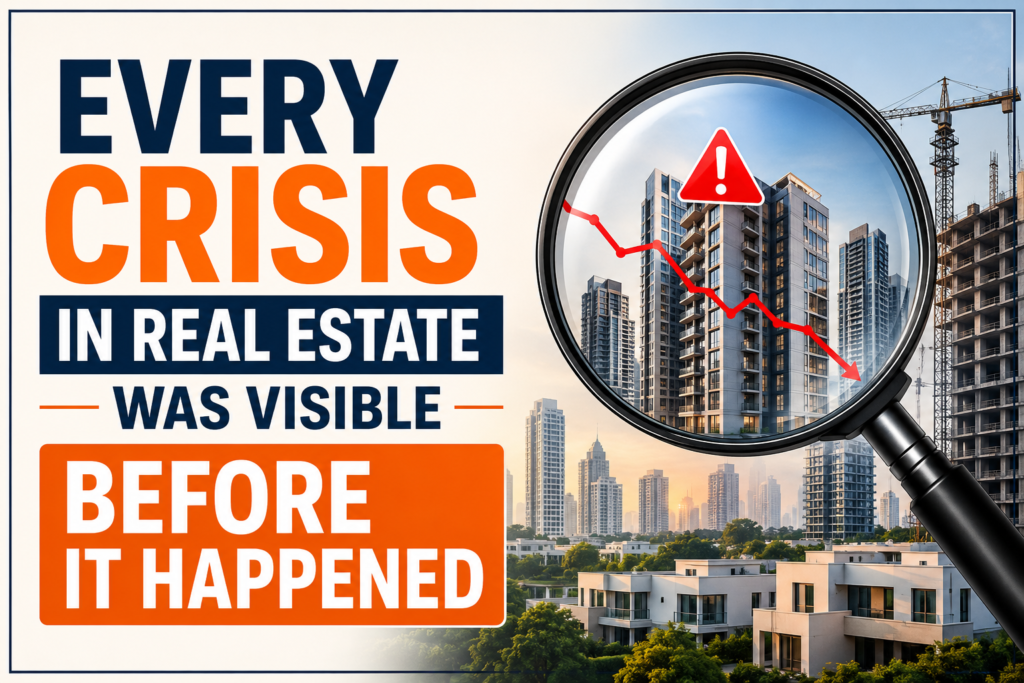
Every Crisis in Real Estate Was Visible Before It Happened
By Srini Gopalan, CEO, Arisinfra Solutions Limited

Consider what it would mean if hospital intensive care units worked the way most real estate projects are managed today.
A patient is admitted. Their vitals are checked on arrival, recorded in a file, and reviewed again at the end of the week. If something deteriorates between check-ins, nobody knows until the next scheduled review. By which point the intervention that would have taken twenty minutes three days ago now requires something far more serious.
Nobody would accept this in medicine. We accept it in real estate every day.
A project’s financial health, construction progress, sales velocity, regulatory status, and cash flow all move continuously every hour of every working day. Yet the standard operating model of Indian real estate involves a promoter receiving a manually assembled status report, typically compiled by someone whose incentive is to surface good news, typically covering a period that ended ten to fourteen days before the report lands on a desk.
By the time a problem appears in that report, it stopped being a problem and became a situation some time ago.
This is not a technology observation. It is a governance one.
The Indian real estate sector contributes 7.3% to national GDP and is on a trajectory toward ₹85 lakh crore by 2030. It employs over 50 million people. And yet the operating infrastructure of a significant proportion of its projects the systems by which capital deployment is tracked, construction is monitored, and risks are identified would be recognisable, and largely unchanged, to a developer working twenty years ago.
The consequences are not abstract. ₹3.5 lakh crore is currently locked in stalled or delayed developments. Over 5 lakh homes remain frozen mid-construction. Forty percent of residential projects miss their delivery timelines. Post-RERA, these failures carry legal and reputational consequences that did not exist a decade ago.
What is striking, when you examine the failures closely, is how rarely they are sudden. The project that stalled was not struck by an unforeseeable event. It was undone by a cash flow gap that was visible in the collections data months before it became a crisis to anyone who was looking at the right thing in real time. The cost overrun that broke a timeline was the accumulation of procurement decisions made without live market benchmarks. The lender dispute that froze construction was the downstream consequence of a governance gap that had been widening, quietly, for the better part of a year.
The information that would have changed these outcomes existed. It simply wasn’t connected, surfaced, or acted upon while it still could be.
The most significant shift in Indian real estate over the next decade will not be about capital or land or even demand all of which are well-supplied. It will be about visibility.
Specifically: the move from periodic, assembled, backward-looking reporting to continuous, integrated, forward-looking intelligence. From knowing what went wrong to understanding, with enough lead time to act, what is about to.
This is not a small operational improvement. It is a structural one because it changes the nature of the relationship between every stakeholder in a project. A lender who has live visibility into fund utilisation and construction progress does not need to rely on the developer’s word. An investor who can see procurement benchmarks and sales velocity in real time does not need to accept opacity as a feature of the asset class. A homebuyer whose project is governed by a live operational system rather than a promoter’s judgment has something genuinely new: a basis for confidence that is not built on faith.
The industry phrase for what we have historically offered homebuyers is “delivery commitment”. What we have rarely offered is the infrastructure that makes commitment credible.
Real estate does not lack demand. It does not lack capital. What it has lacked and is only now beginning to build is the operating intelligence to convert both into outcomes that are predictable, not just promised.
The developers who define the next decade will not be the ones with the most land or the deepest balance sheets. They will be the ones who treated visibility as infrastructure who built, or partnered with, systems that make the invisible visible before it becomes irreversible.
Predictability is not a promise a developer makes at the time of booking. It is a property of the system a project runs on.
For decades, what we offered the people who bet on us, homebuyers, lenders, investors was our word. That was never nothing. But it was never enough. The infrastructure now exists to replace faith with visibility and promises with systems. The only question is how long we wait before we decide that is what this industry deserves.
Disclaimer: Views expressed in this article are those of the author, and not necessarily of Realy&More.