From PMAY to Ecosystem: How Land and Transit Reforms Will Redraw India’s Housing Map
By Rahul Purohit , Co-founder & CBO, Square Yards

For more than a decade, India’s urban housing story has been closely associated with expanding access through government-supported programmes. Pradhan Mantri Awas Yojana–Urban (PMAY-U) has played an important role in strengthening housing delivery, bringing together government, States, Urban Local Bodies and beneficiaries around the objective of housing for eligible urban families. But as India urbanises at greater speed, the challenge before the housing sector is changing. The question is no longer simply how many homes can be delivered. It is how cities can create the conditions for affordable homes to be built, financed, accessed and sustained at scale.
This is the significance of the National Conference on Affordable Housing Reforms, organised by the Ministry of Housing and Urban Affairs in August 2026 under the theme “Reimagining Affordable Housing: From Scheme to Sustainable Ecosystem.” The conference brought a broader proposition into focus: affordable housing cannot be treated as a standalone housing programme. It is fundamentally an urban development challenge, shaped by land, planning regulations, density, mobility, finance and rental markets.
From Housing Delivery to Urban Ecosystem
That shift in perspective matters because land remains one of the most consequential determinants of housing cost. As NITI Aayog Member Rajiv Gauba put it at the conference, “Land is the most binding constraint in the housing sector.” The recommendations emerging from the conference therefore place land and urban planning at the centre of the next phase of affordable housing reform, with most implementation expected to rest with States and municipal authorities.
The proposed changes are significant. The framework recommends expanding planned urban areas and reserving at least 10% of residential land in master plans for affordable housing zones. It also proposes raising permissible Floor Area Ratio (FAR) for such projects to around 5 or 6, alongside measures such as land pooling, Transferable Development Rights, more flexible parking and density norms and the creation of land banks. There are also proposals to reduce project costs through measures such as waiving land-use change fees for land dedicated to affordable housing and exempting affordable housing units from stamp duty.
The larger idea behind these measures is more important than any individual planning instrument. If land is scarce and expensive, affordability cannot be achieved simply by asking developers to reduce the price of the finished home. The economics have to be addressed much earlier in the development cycle—through the availability of land, the amount of development permitted on it and the cost of bringing that land into productive urban use.
Making Land Work for Affordability
Higher density, therefore, should not be viewed simply as a means of building more. Used intelligently and supported by infrastructure, it can allow cities to accommodate more households without pushing affordable housing further towards the periphery. The real opportunity lies in making density work alongside roads, water, sewerage, public facilities and, increasingly, public transport.
This is where the land question becomes a mobility question.
A home may have a lower purchase price and still impose a high economic cost on a household if it is located far from employment, education and essential services. The definition of affordability therefore needs to expand beyond the price of the dwelling. What a household spends in time and money to live in that home is becoming an equally important part of the affordability equation.
When Affordability Becomes a Question of Location
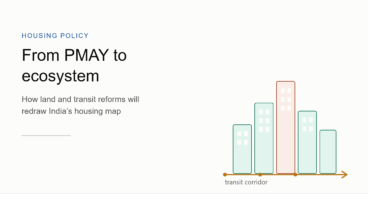
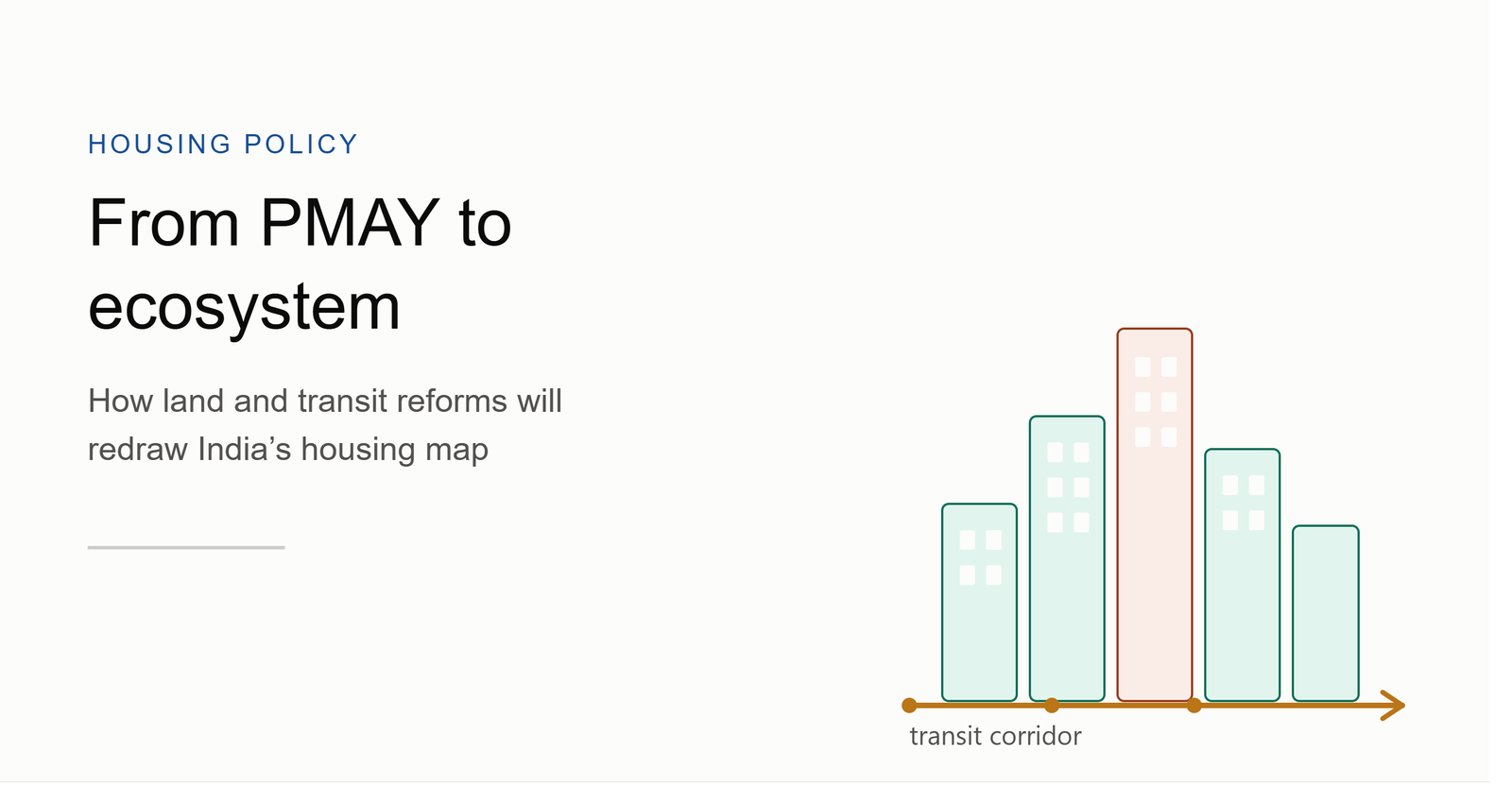
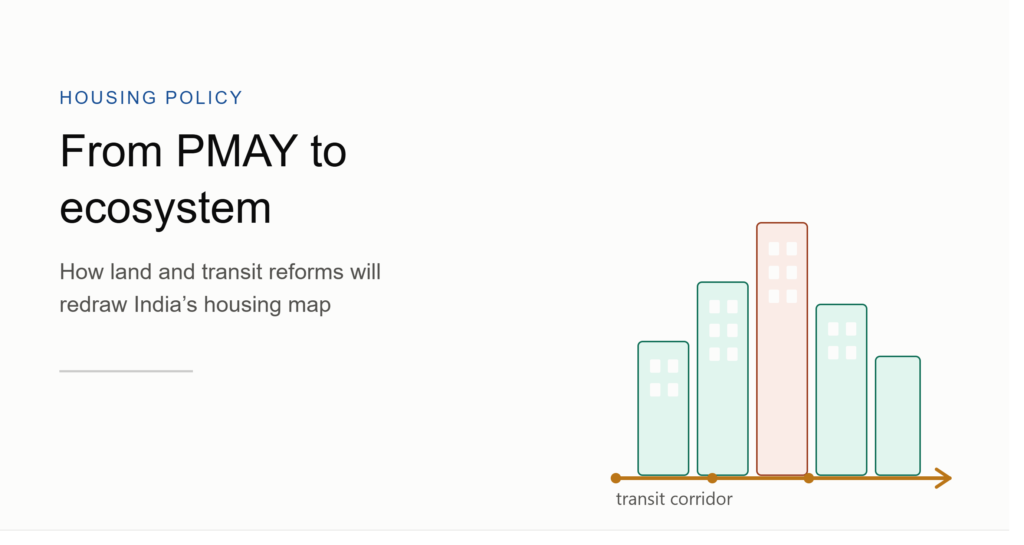
Transit-oriented development offers a way to address that equation. The affordable housing framework places greater emphasis on developing housing around metro, RRTS and railway corridors, creating higher-density, mixed-use environments where homes can be connected more closely to jobs and services. The objective is not merely to put housing next to a station. It is to use transit as an organising principle for urban growth.
Delhi’s Transit-Oriented Development Regulations 2026 offer an early illustration of what this could mean in practice. The policy opens up approximately 207 sq km around metro corridors and RRTS/railway stations for planned, high-density and mixed-use development. It allows development on plots as small as 2,000 sq m, with maximum FAR of up to 500 on qualifying plots with an 18-metre road. Importantly, 65% of the total permissible FAR is mandatorily earmarked for residential use, with dwelling units of up to 100 sq m built-up area intended to provide affordable housing along transit corridors.
The significance of this approach extends beyond Delhi. It demonstrates how transport infrastructure can become an instrument of housing policy. Instead of allowing urban expansion and transport networks to evolve independently, cities can begin planning them together—using existing and upcoming transit infrastructure to determine where higher-density housing should be encouraged and where land can be used more efficiently. Delhi’s policy also brings around 80 sq km of land under land pooling, low-density residential areas and unauthorised colonies into the ambit of the new TOD framework, illustrating how previously excluded areas can potentially be integrated into planned urban growth.
Putting Transit at the Heart of Housing
This is also where the next phase of PMAY-U becomes important.
PMAY-U 2.0 is designed to support one crore additional eligible urban families through a demand-driven approach, with an emphasis on diverse housing solutions, technology-enabled implementation, access to finance and stronger institutional partnerships. The experience of PMAY-U provides the foundation; the reform agenda now being discussed seeks to strengthen the ecosystem around that demand.
From Delivering Homes to Building Demand and Choice
In other words, the next phase cannot be about housing delivery alone. Demand must meet supply, and supply must meet urban opportunity. A household needs access to finance to buy or build a home. A developer needs viable land and predictable planning norms to supply it. A worker or young professional may need a formal rental option rather than ownership. And the city needs the transport and civic infrastructure that makes all of these choices viable.
That is why the conference’s emphasis on rental housing, vacancy unlocking and finance is not a separate policy conversation. It completes the ecosystem. The deliberations included reforms to rental housing and tenancy frameworks, approaches to unlocking existing housing stock, and measures to strengthen finance for both housing projects and homebuyers. Financial institutions also discussed project finance, home loans for people working in the informal sector and credit guarantees.
Completing the Ecosystem
For the real-estate industry, this represents an important change in the way affordable housing may need to be approached. The opportunity is no longer confined to constructing individual projects under a government programme. It increasingly lies in participating in a larger urban system—one in which land assembly, development rights, infrastructure, transit, finance and housing demand are planned together.
The role of States and cities will be particularly important. India’s urban markets are too diverse for a single model to work everywhere. The conference itself brought together examples from Gujarat, Maharashtra, Telangana, Tamil Nadu and Delhi, covering town-planning models, Affordable Housing Zones, cluster development and TOD. The larger lesson is one of cooperative federalism: national policy can establish the direction, but the actual shape of affordable housing will ultimately be determined by how individual States and Urban Local Bodies translate these ideas into planning regulations and development practices.
What the Shift Means for Real Estate
There will, of course, be a critical test of implementation. Higher FAR will create affordability only if the resulting increase in development potential is not fully absorbed by higher land values. Affordable housing zones will have limited impact if they are disconnected from jobs and transport. TOD will not deliver its full promise if density increases faster than civic infrastructure. Land pooling and TDR will require transparent processes, institutional capacity and participation from landowners. And financial innovation will matter only if it reaches households and developers that conventional lending has historically struggled to serve.
The Test Will Be Implementation
The opportunity, therefore, is not simply to build more affordable housing. It is to change the economics and geography of how affordable housing is built.
India’s next housing map is likely to be shaped by the places where five forces come together: land, density, transit, employment and finance. The cities that can align these elements will have a better chance of creating housing that is not only affordable to acquire, but also affordable to live in.
That is ultimately what the transition from a scheme-centric approach to an ecosystem approach represents. PMAY-U helped establish the scale and institutional architecture for urban housing delivery. The next chapter is about building the urban conditions around that foundation—so that affordable housing becomes not an isolated intervention at the edge of the city, but an integral part of how India’s cities grow. The future of affordable housing, in that sense, will be decided as much in master plans, zoning regulations and transit corridors as it is in housing projects themselves. And for developers, policymakers and financiers alike, that is where the next opportunity and responsibility lies.
Disclaimer: Views expressed in this article are those of the author, and not necessarily of Realtynmore.com.