Agreement to Sale vs Sale Deed: Key Differences Every Property Buyer Must Know in 2026
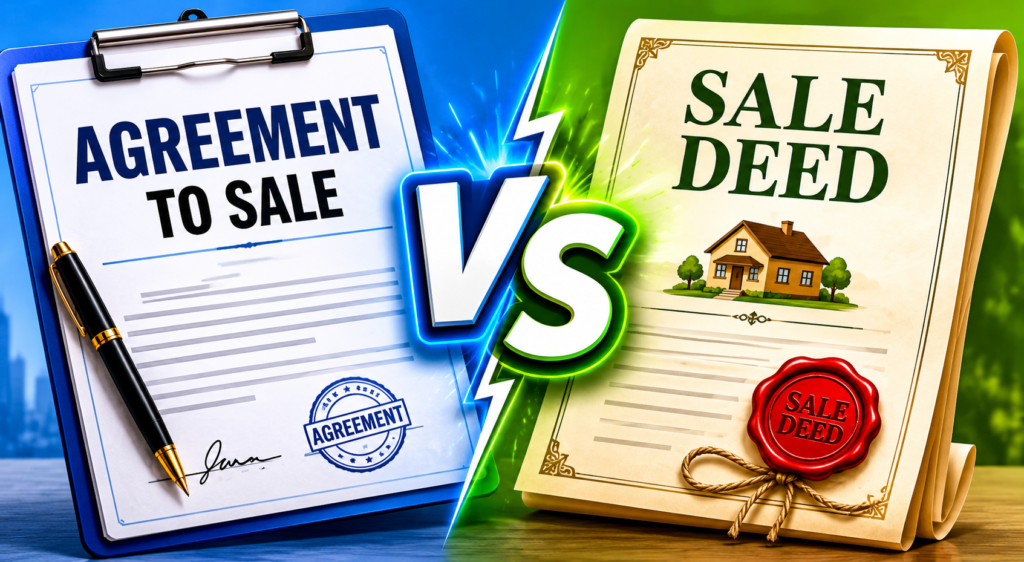
Buying property is one of the most significant financial decisions of your life. Yet many buyers sign documents without fully understanding what those papers mean — and that gap in knowledge can cost them dearly.
Two documents that sit at the heart of every property transaction in India are the Agreement to Sale and the Sale Deed. At first glance, they appear similar. Both relate to the sale of property. Both involve the buyer and seller. But legally, they are worlds apart.
Understanding the difference between an Agreement to Sale and a Sale Deed is not just useful — it is essential. This guide breaks down everything you need to know in plain language.
What is an Agreement to Sale?
An Agreement to Sale (also called Agreement for Sale or Agreement to Sell) is a preliminary legal document that records the intention of a seller to transfer a property to a buyer at a future date, subject to fulfillment of certain terms and conditions.
Think of it as a written promise — the seller agrees to sell, and the buyer agrees to purchase, but the actual transfer of ownership has not taken place yet.
What does it typically include?
- Names and details of both buyer and seller
- Complete description of the property
- Agreed sale price and payment schedule
- Amount of advance or token money paid
- Timeline for completing the final sale
- Conditions that must be fulfilled before registration
- Penalty clauses for breach by either party
Under the Transfer of Property Act, 1882, an Agreement to Sale creates a right in the buyer to obtain specific performance of the contract. However, it does not transfer ownership of the property to the buyer.
Registration of an Agreement to Sale is not compulsory under the Registration Act, 1908 in most states, though it is strongly advisable to register it for legal protection.
What is a Sale Deed?
A Sale Deed is the final legal document that officially transfers ownership of a property from the seller to the buyer. Once a Sale Deed is executed and registered, the buyer becomes the lawful owner of the property.
Unlike the Agreement to Sale, a Sale Deed is an executed contract — meaning the transaction is complete. The property now legally belongs to the buyer.
What does a Sale Deed typically include?
- Full description of the property with boundaries
- Sale consideration (final agreed price)
- Declaration that the title is clear and free of disputes
- Confirmation that possession is being transferred
- Indemnity clause protecting the buyer against future claims
- Signatures of both parties and two witnesses
- Details of stamp duty and registration fees paid
Registration of a Sale Deed is compulsory under Section 17 of the Registration Act, 1908. An unregistered Sale Deed is not legally enforceable and does not confer ownership to the buyer.
Agreement to Sale vs Sale Deed: Side-by-Side Comparison
| Agreement to Sale | Sale Deed |
| A promise to transfer property in the future | Actual transfer of ownership |
| Executory contract (pending conditions) | Executed contract (completed) |
| Does not transfer title or possession | Transfers title and possession immediately |
| Buyer does not become owner | Buyer becomes legal owner |
| Registered or unregistered (both valid) | Compulsory registration required |
| Can be cancelled if conditions not met | Legally binding and final |
| Lower stamp duty applicable | Full stamp duty payable |
| Risk of property remains with seller | Risk of property passes to buyer |
| No right to sell the property | Buyer has full right to sell or mortgage |
Why the Distinction Matters for Buyers
Many property disputes in India arise from a simple misunderstanding: the buyer believes that signing an Agreement to Sale means they own the property. They do not.
Ownership transfers only when the Sale Deed is executed and registered. Until that happens, the seller legally retains ownership — and can technically sell the same property to a third party.
This is why home buyers who pay significant advance amounts based on an Agreement to Sale must ensure the following:
- The agreement is registered to give it stronger legal standing
- A clear timeline is mentioned for executing the Sale Deed
- The agreement includes penalty clauses if the seller backs out
- The agreement is backed by a verified title search report
Legal Framework: What Indian Law Says
Transfer of Property Act, 1882
Section 54 of the Transfer of Property Act clearly states that a contract of sale does not, of itself, create any interest in or charge on the property. Only a Sale Deed executed and registered in accordance with the law can transfer an immovable property worth more than Rs. 100.
Registration Act, 1908
Section 17 of the Registration Act mandates the compulsory registration of Sale Deeds for immovable property valued above Rs. 100. Without registration, the document has no legal standing in a court of law.
RERA and New Projects
For under-construction properties, the Real Estate (Regulation and Development) Act, 2016 (RERA) provides additional protection. Developers are required to enter into a formal agreement with buyers, which in many states has been standardized through RERA’s model agreement format. The Sale Deed is executed upon possession.
Stamp Duty: How It Differs
Stamp duty is a state government tax levied on property documents. The amount differs significantly between an Agreement to Sale and a Sale Deed:
- Agreement to Sale: A nominal stamp duty is charged, typically ranging from Rs. 100 to 0.1% of the property value depending on the state. Some states charge on the full value.
- Sale Deed: Full stamp duty is payable, typically ranging from 4% to 8% of the market value or circle rate of the property, depending on the state and gender of the buyer.
In some states, stamp duty paid on the Agreement to Sale can be adjusted against the stamp duty due on the final Sale Deed — always verify this with a local property lawyer before proceeding.
Common Mistakes Buyers Make
1. Paying large advances without a registered agreement
Many buyers pay 10–20% of the property value as advance on the basis of an unregistered agreement. If the seller backs out, recovering this amount becomes a prolonged legal battle. Always register the agreement.
2. Assuming agreement to sale = ownership
This is the single most common misconception. Possession of a property may be handed over after the Agreement to Sale, but legal title does not pass until the Sale Deed is registered.
3. Delaying the Sale Deed
Some buyers delay registration of the Sale Deed to avoid stamp duty. This is a serious risk — if the seller dies, faces insolvency, or sells to a third party in the interim, the buyer may have limited recourse.
4. Not verifying title before signing
Both documents are only as strong as the seller’s title to the property. Before signing either document, buyers should obtain a title search report for the past 30 years from an advocate to ensure the title is clear and marketable.
When is an Agreement to Sale Used?
The Agreement to Sale is most commonly used in the following situations:
- Under-construction or upcoming projects where the property is not ready for handover
- Resale properties where the seller needs time to clear a home loan or obtain documents
- Properties where mutation, khata transfer, or other formalities are pending
- When the buyer needs time to arrange financing or a home loan
In each of these cases, the Agreement to Sale acts as a bridge document — locking in the terms while both parties complete their respective obligations before the final Sale Deed is executed.
Final Checklist Before Signing Either Document
- Verify the seller’s identity and ownership documents (title deed, encumbrance certificate)
- Conduct a physical verification of the property
- Check for any existing loans, mortgages, or legal disputes on the property
- Confirm the property’s approved plan and RERA registration (for new projects)
- Engage a qualified property advocate to draft or review the agreement
- Register the Agreement to Sale at the Sub-Registrar’s office
- Execute and register the Sale Deed within the agreed timeline
Conclusion
The Agreement to Sale and the Sale Deed are not interchangeable documents. One is a promise; the other is the fulfillment of that promise. Both are important — but only the Sale Deed makes you the legal owner of the property.
As a buyer, understanding this distinction protects you from fraud, disputes, and financial loss. As a seller, it ensures your obligations are clearly defined and legally enforceable.
At Realtynmore, we believe informed buyers make better decisions. Before you sign your next property document, make sure you know exactly what it means — and what it does not.
For more real estate legal guides, property news, and market updates from across India, keep reading Realtynmore Insights — your trusted source for everything real estate.
Disclaimer: This article is for informational purposes only and does not constitute legal advice. Readers are advised to consult a qualified property advocate for guidance specific to their transaction.