News
FY27 Outlook Residential Real Estate: High Base and Affordability Challenges; Tier I Mid-Premium Segment Resilient
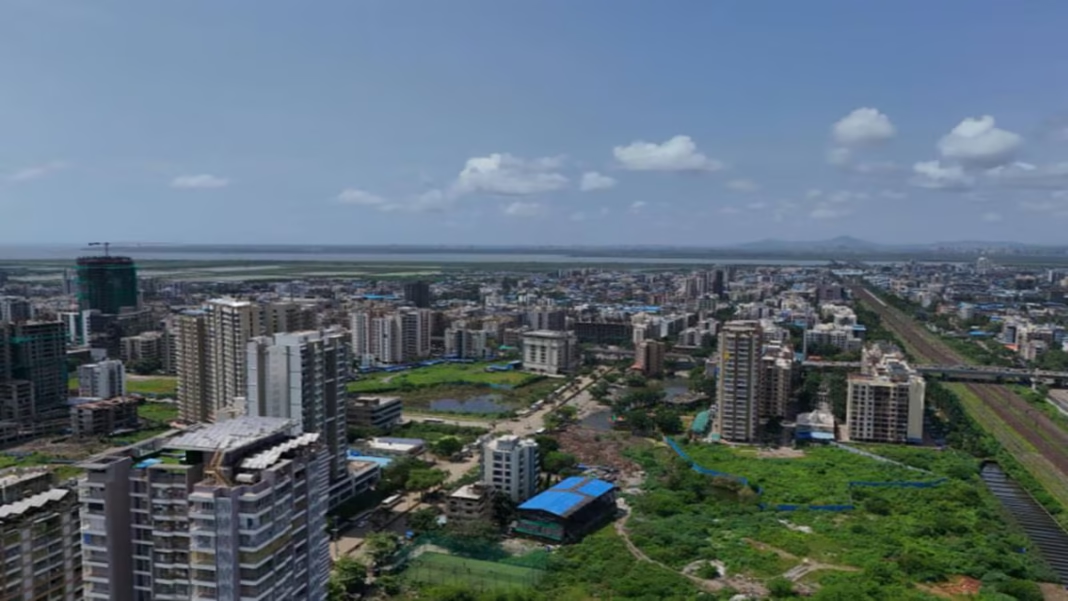
Mumbai, February 26, 2026: India Ratings and Research (Ind-Ra) has maintained a neutral outlook for the residential real estate sector for FY27. The agency expects the residential real estate sector to see subdued growth in FY27, following strong growth during FY23-FY25 and slow growth in FY26. Absorption and prices have largely been supported by growth in the premium and luxury segments, shifting supply preferences to upmarket segments. The high base over FY23-FY25 is likely to dampen growth rates in FY27. Ind-Ra expects year-on-year (YoY) sales growth to be up 5 per cent-7 per cent YoY in FY27, largely contributed by value growth.
Post-pandemic aggregate housing prices in the top eight metros surged by a CAGR of 9 per cent and remained high at 12 per cent at end-September 2025. Irrespective of macro cyclicality, slower net headcount additions across large Indian information technology (IT) services firms and role consolidation due to artificial intelligence (AI)/automation are reducing near-term upgrade demand in IT-dependent housing markets such as Bengaluru, Pune and Hyderabad.
Elevated property prices have reduced the affordability factor, which drove growth in the past three years. Demand dynamics in the mid-market has remained challenged, however even the premium segments affordability is turning into a headwind. The sector posted a five-year CAGR for 1HFY26 in the band of 5 per cent to 30 per cent across the top eight cities, with Hyderabad, MMR, and NCR posting plus 20 per cent. Although Chennai, Pune and Kolkata posted less 12 per cent growth, Ind-Ra estimates that price changes have been faster than changes in income levels. Interest rates reduction and higher income tax slabs leading to higher savings in the hand of consumers could support mid-market housing demand in FY27.
“The sector cycle has peaked the post pandemic growth phase and is now entering a period of moderated expansion. After strong sales momentum through FY25, growth could moderate in FY26 and FY27 due to a high base and affordability pressures led by elevated property prices. While the mid-income and premium segments are relatively resilient, the affordable/ mid-income segment may remain exposed to cyclicality. Tier II and III cities, which recorded robust growth during 2021–2024, are also witnessing slower growth,” said Srinivas Menon, Associate Director, Corporate Ratings, Ind-Ra.
Mumbai Metropolitan Region (MMR) forms the largest micro-market, with a 26 per cent share in the top eight real estate clusters, followed by Hyderabad at 16 per cent. Bengaluru, Ahmedabad and MMR posted the highest sales growth of 15 per cent to 17 per cent YoY during TTM1HFY26, closely followed by NCR. Pune, Chennai and Hyderabad posted negative to 5 per cent YoY growth. Within the cities, Hyderabad, Pune, and MMR posted strong sales growth with a CAGR exceeding 17 per cent during FY20-FY25. Sales growth in Bengaluru, NCR, Chennai, Ahmedabad, and Kolkata remained below the average five-year CAGR; hence, they may post better than average sales growth in FY27. Given entry-level hiring moderation in IT services and AI-driven efficiency gains, unit absorption in tech-linked corridors could see elongated decision cycles in FY27, despite a healthy end-user intent, with mid-market remaining stickier.
Ind-Ra has also maintained a Stable rating Outlook for its rated tier I real estate entities for FY27. The agency defines tier-I players as those that have positive brand equity, a large scale of operations, high execution capabilities, strong refinancing abilities, and healthy balance sheets. The Stable Outlook for Tier I and non-Tier I players is supported by historical improvements in cash flows and reduced leverage. Tier I players benefit from strong sales and brand recognition, while non-Tier I players (’IND A’ & below) are showing a stable operational performance. Tier I developers are expected to maintain healthy financial positions, supported by steady sales and adequate liquidity.
“We expect the favourable demand-supply equation, robust balance sheets, and liquidity buffer to enable our rated Tier I portfolio issuers to sustain the likely consolidation phase. However, the non-Tier I portfolio may face some liquidity pressure,” adds Harshil Mehta, Senior Analyst, Corporate Ratings, Ind-Ra.



Retail Meets Real Estate: The Rise of Experience-Led Commercial Developments in Faridabad
By Paras Rai, Managing Director and Co-Founder, Property Master Faridabad, once perceived as a peripheral industrial hub in the NCR,...


Euro Pratik Sales Expands National Footprint with ₹33.20 Crore Acquisition of Chawla Brothers
Mumbai, March 23, 2026: In a move that significantly reshapes the competitive landscape of the interior solutions industry, Euro Pratik...


Sunday PropTech Announces 5% EBITDA Dividend Payout Following Strategic ₹800 Crore Asset Acquisition
New Delhi, March 23, 2026: In a move signaling robust fiscal health and a commitment to investor returns, Sunday PropTech...


Agrocorp Targets ₹200 Crore Revenue with Launch of ‘Vacation Village’ Second-Home Community in Chikkamagaluru
Chikkamagaluru, March 23, 2026: Bengaluru-based real estate developer Agrocorp has officially entered the destination holiday home market with the launch...


Luxury vs Affordable Housing: Where Smart Money Is Going in 2026
The Indian real estate market is no longer what it used to be a decade ago. Back then, property buying...


CM Yogi Reviews Noida International Airport Preparedness Today Ahead of Mega March 28 Launch
Noida, March 23, 2026: Uttar Pradesh Chief Minister Yogi Adityanath on Sunday inspected the Noida International Airport to review preparations...
-
 News4 weeks ago
Hiranandani Communities Launches Watersports Centre at Premium Coastal Hiranandani Sands, Alibaug Township
-
Guest Column3 weeks ago
Retail Trends to Watch Out for in 2026
-
News4 weeks ago
Strategic Partnership between Brigade Group, Primus Senior Living to Develop Senior Living Communities
-
News4 weeks ago
TARC Marks New Milestone at TARC Kailasa with Grand Tower Launch, New Experience Gallery Reveal
-

 News7 days ago
FractoProp Receives SEBI Registration for Ridhama Real Estate Fund
-
Guest Column4 weeks ago
Trust-Led, Lifestyle-Focused, Infrastructure-Driven: Punjab’s Real Estate Evolution
-
News3 weeks ago
Mumbai Real Estate Hits 14-Year High with Over 13,000 Property Registrations in February 2026
-
News5 days ago
Rise of Airport-Linked Real Estate: Opportunities Emerging Around Jewar