Q-Commerce boom to Triple India’s Dark Stores to 7,500 by 2030: Savills India
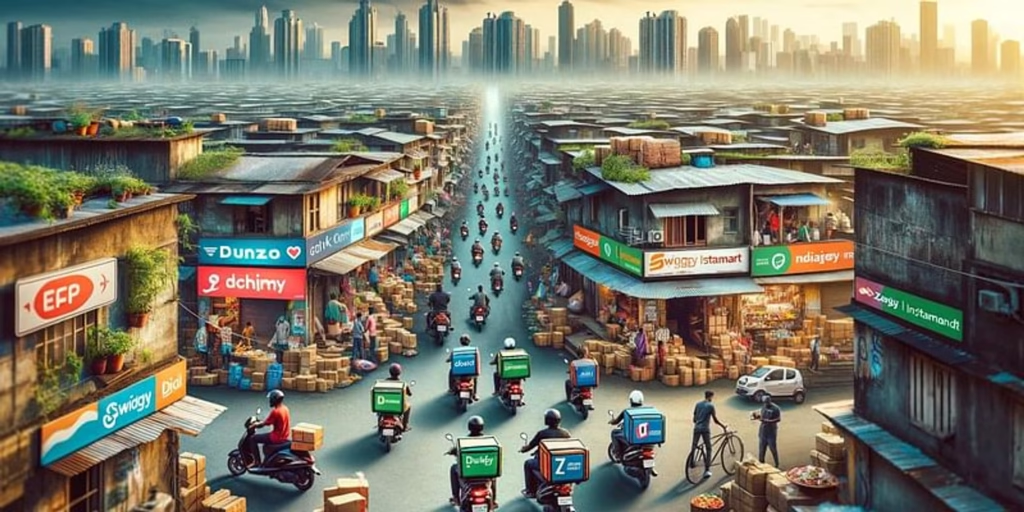
New Delhi, December 22, 2025: Driven by the rapid expansion of quick commerce and rising consumer demand for ultra-fast deliveries, the number of dark stores in India is projected to reach threefold by 2030 to around 7,500 says a Savills India report ‘Q-Commerce Growth: Dark Stores Shaping the Future of Retail’.
As of October 2025, India has an estimated 2,525 stores spread across eight Tier I cities and more than 100 Tier II and III cities, occupying a total area of around 13.0 million square feet (msf). Tier I cities comprising Ahmedabad, Bengaluru, Chennai, Hyderabad, Pune, Mumbai, Kolkata and Delhi-NCR account for 68 per cent of the total store count with area of around 9.0 msf, while around 100 Tier II & III cities together consist of 800 stores (32 per cent of the total) with area of 4.0 msf.
The growth of dark stores has been fueled by the rising adoption of Q-Commerce and the hyperlocal concept, where consumers are expecting essentials to be delivered within minutes. To meet this demand, Q-Commerce players are rapidly expanding dedicated fulfilment centers that serve only online orders and are closed to walk-in customers, across Tier I, II & III cities.

“Q-Commerce is rapidly evolving beyond its initial focus on groceries, food and daily essentials. Leading platforms are increasingly expanding into higher value categories such as premium personal care, luxury lifestyle products and time-critical medical supplies. Tier I & II cities will lead this expansion, while Tier III cities will emerge as high-potential markets for dark stores, with secondary and suburban micro markets playing a key role in balancing cost and accessibility,” said Srinivas N, Managing Director, Industrial & Logistics, Savills India.
He added, “Dual platforms such as dark stores and cloud kitchens within the Q-Commerce ecosystem are likely to emerge, while drone-based deliveries and AI- and robotics-based last-mile deliveries gain prominence going forward.”
The National Capital Region (NCR) covering Delhi, Gurugram, Ghaziabad, Noida and Faridabad host the largest concentration with 400 dark stores and with a total area of 2.0 msf. Its scale as a vast urban agglomeration, combined with high population density, strong purchasing power and a sizeable IT workforce, positions NCR as the most attractive and dominant market for Q-Commerce. Bengaluru, with its large tech-savvy population and strong presence of IT and ITeS sector, coupled with high purchasing power and E-Commerce penetration, is driving Q-Commerce growth with 360 dark stores with area of 1.9 msf. followed by Mumbai with 250 dark stores with area of 1.4 msf. and Chennai with 190 dark stores with area of 1.0 msf.
Dark Store Demand Forecasts by 2030
Alongside, online retail is growing at an unprecedented pace, driven by increasing internet penetration and the widespread adoption of E-Commerce platforms. Q-Commerce and quick, just-in-time (JIT) delivery services are becoming a norm, creating a strong need for efficient last-mile infrastructure. With dark stores expected to grow ~3X by 2030, these will require specialised design and infrastructure, including efficient layouts, temperature-controlled storage, and automation-ready facilities. The lack of organised players in this sector creates opportunities for builders and investors to establish themselves as early movers.