RBI Monetary Policy April 2026: Stability, Signals & What It Means for Real Estate
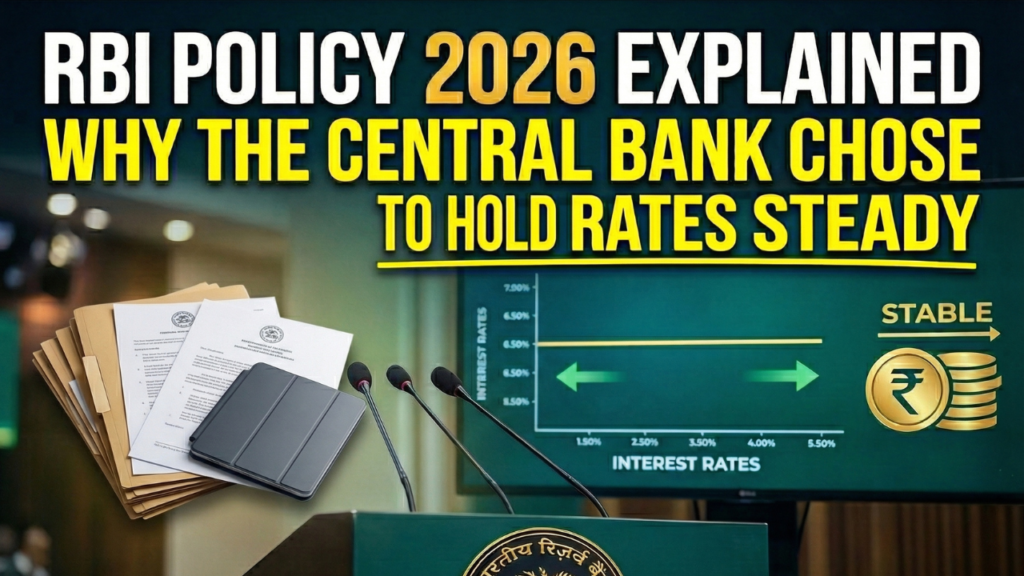
The latest monetary policy announced by the Reserve Bank of India after March 2026 marks a decisive shift from aggressive easing to a measured pause. The Monetary Policy Committee (MPC) has kept the repo rate unchanged at 5.25%, while maintaining a neutral stance, signalling flexibility amid rising global uncertainties and evolving inflation risks.
This policy comes at a time when India’s economy remains resilient, but external pressures—especially crude oil volatility and geopolitical tensions—are influencing inflation expectations and capital flows.
Policy Overview: Why RBI Chose Stability
The RBI’s decision to maintain status quo reflects three core considerations:
- Inflation risks resurfacing due to rising energy prices
- Global uncertainty impacting currency and capital markets
- Stable domestic growth, reducing the need for further stimulus
After cumulative rate cuts of around 125 basis points in 2025, the central bank is now in a phase of policy consolidation. Rather than pushing growth through further easing, the focus has shifted to sustaining stability and monitoring risks.
Macro Signals: Growth vs Inflation Balance
India’s GDP growth continues to remain strong, hovering around the 7% mark, supported by domestic consumption, infrastructure spending, and a stable banking system. However, inflation risks—particularly imported inflation through crude oil—are beginning to re-emerge.
This creates a delicate balancing act:
- Cutting rates → could fuel inflation
- Increasing rates → could slow growth
- Holding rates → ensures equilibrium
The RBI has therefore opted for a “wait and watch” approach, ensuring flexibility for future action.
Shift in Strategy: From Rate Cuts to Policy Maturity
The April 2026 policy highlights a structural shift:
- 2024–2025: Inflation control + rate cuts
- Late 2025: Growth support through easing
- 2026: Stability, liquidity management, and data-driven decisions
This evolution reflects a more mature monetary framework, where policy is no longer reactive but calibrated and forward-looking.
Real Estate Impact: Stability Drives Confidence
For the real estate sector, the biggest takeaway is predictability.
- Home loan rates remain stable
- EMIs stay unchanged
- Buyer sentiment improves
- Developers gain planning clarity
In a sector highly sensitive to interest rates, even a pause in policy can have a positive multiplier effect by sustaining demand momentum.
Industry Reactions: Real Estate Leaders Speak

Manoj Gaur, CMD, Gaurs Group says, “We welcome the RBI’s decision to maintain status quo on the repo rate at 5.25%. Given the global uncertainties, particularly the West Asia situation impacting crude prices, the RBI’s move signals predictability. Further the continuation of a neutral stance ensures flexibility while maintaining growth momentum. Along with stable EMIs and proactive liquidity management, this will support end-user demand and sustain real estate activity, especially as the economy continues to navigate a balanced growth-inflation trajectory.”

Deepak Kapoor, Director, Gulshan Group says, “In the backdrop of global volatility and inflationary pressures driven by high energy prices, the RBI’s move to hold the repo rate steady at 5.25% reinforces confidence in India’s economic resilience. The upward revision in near-term GDP projections further strengthens this outlook. For real estate, stable borrowing costs and policy continuity create a conducive environment for sustained demand, and we remain optimistic about steady growth across residential segments through the year.”

Yash Miglani, MD, Migsun Group, said, “The RBI’s decision to hold the repo rate at 5.25% could not have come at a more decisive moment for the housing market. Buyer sentiment is already strengthening, and this stability will make home loans more comfortable for buyers. In NCR, where demand for larger formats and luxury housing is already surging, we expect accelerated conversions in the coming quarters.”

Prateek Tiwari, Managing Director, Prateek Group, says “The RBI’s decision to keep the repo rate unchanged at 5.25% is a balanced approach against a backdrop of global economic uncertainties and geopolitical pressures. For the housing sector, the consistent rate helps strengthen sentiment, reassuring buyers and keeping financing conditions stable. This plays a key role in home buyers purchasing decision particularly for first-time buyers and end-users exploring opportunities in strong demand corridors. While we believe a rate cut could have further eased borrowing costs, the pause gives lenders clarity and allows existing monetary easing to fully transmit through the system.”

Sandeep Chhillar, Founder & Chairman, Landmark Group, says, “We welcome the RBI’s decision to hold rates steady. The announcement comes at a time when global uncertainty is still quite high. By keeping the repo rate at 5.25%, the RBI has avoided a premature shift that could have unsettled the broader economy. The neutral stance shows a clear awareness of both inflation risks and uneven global growth trends. For the real estate market, this means near stable home loan rates. It’s a measured pause that gives policymakers space to assess data more carefully, instead of reacting to short-term global volatility.”

Pankaj Jain, Founder and CMD, SPJ Group, says, “Maintaining the repo rate at 5.25% is a pragmatic move in an environment still shaped by global headwinds. It brings much-needed stability to home loan markets. For borrowers, this effectively means EMIs are likely to remain in the same range for now, without any immediate easing in interest burden. While a slight rate cut would have offered some relief and improved affordability at the margin, the RBI has clearly chosen to wait for stronger macro signals before shifting direction. Overall, it keeps borrowing conditions steady, giving homebuyers predictability in their financial planning, even if the expectation of softer loans gets pushed further down the line.

B.K. Malagi, Vice Chairman, Experion Developers says “”The decision to hold the repo rate at 5.25% supports a mature housing cycle. Housing thrives on consistency, in terms of policy, financing, and buyer expectations. Stable interest rates protect affordability while allowing developers to plan long-term projects without funding uncertainty. As global investors reassess emerging markets, India’s housing sector stands out for its stability and depth. This policy continuity strengthens the foundation for sustained residential growth rather than short-term demand distortions.”

Sanjay Sharma, Director, SKA Group says maintaining the repo rate at 5.25% reflects a clear “wait and watch” approach from the RBI amid global uncertainty. For real estate, this brings stable but subdued financing conditions. While developers would have welcomed a rate cut to further unlock demand momentum, especially in the affordable and mid-housing categories, the current geopolitical backdrop is keeping inflation risks elevated. The sector is therefore likely to lean on end-user-driven demand to sustain sales momentum through the coming quarters.

Bhupindra Singh, COO, Rise Infraventures says the MPC’s decision to keep the repo rate at 5.25% clearly shows that inflation control remains the priority. The current rate level feels balanced—it supports demand without overstimulating it. The neutral stance indicates that the RBI is still watching inflation closely and wants to keep flexibility for future moves. For housing, this means home loan rates are likely to remain steady, keeping EMIs predictable but without any immediate relief. On the commercial side, borrowing costs for developers and businesses also stay stable, which helps in planning investments and leasing strategies. Overall, it’s a stable credit environment, even if rate cuts are still some distance away.

Shyamrup Roy Choudhury, Founder and Managing Director, Aura World, says, the RBI’s decision to maintain the repo rate at 5.25%, while continuing with a neutral stance, ensures continuity in the benefits accrued from last year’s cumulative rate cuts. Stable EMIs and predictable financing conditions will encourage new homebuyers to enter the market. While inflationary risks persist due to global developments, such as crude prices, in particular, the stance taken by the RBI ensures policy certainty. The overall environment remains supportive for homebuyers and investors.

Gurpal Singh Chawla, Managing Director, TREVOC, says, “With GDP growth projections revised upwards and inflation expected to remain within a manageable range despite near-term pressures, the RBI’s decision to keep the repo rate unchanged at 5.25% will provide continued stability to the sector. The neutral stance reflects a calibrated approach amid global uncertainties. This, coupled with stable liquidity conditions and improving investment sentiment, will help maintain the current momentum in real estate, particularly across emerging urban centres.
Raj Kumar Sisodia, COO of Biigtech, says, “The decision to keep the repo rate unchanged at 5.25% works as a stabilising factor for the commercial real estate sector. In a market where long-term commitments drive decision-making, consistent interest rates help occupiers and investors move ahead with greater confidence. Office leasing and expansion plans are less likely to be delayed when borrowing costs are predictable. For developers, it allows better control over project timelines and capital planning. Rather than triggering a surge, this kind of policy environment quietly supports steady momentum, where demand builds gradually, and investment decisions are made with a longer-term view.”

Rajjath Goel, Managing Director, MRG Group: For first-time homebuyers, the unchanged repo rate brings a sense of clarity and comfort. With rates holding steady, EMIs remain predictable, which helps reduce the hesitation many end-users have been feeling. For developers, this kind of certainty supports more consistent booking activity, particularly in the mid-income and premium segments. Amid rising inflationary prices, this stability allows us to plan and build around genuine demand, rather than short-term rate movements, making the housing cycle more balanced and resilient.

Mayank Jain, CEO, KREEVA, says, “For homebuyers, the decision to keep repo rate unchanged feels like a moment of pause rather than progress; expectations of softer borrowing costs have been gently deferred. Even a small reduction in the repo rate would have eased EMIs and improved eligibility, particularly in the mid-income housing segment, where every basis point matters. That said, the RBI’s neutral stance brings predictability, which buyers appreciate in volatile times. However, with Middle East tensions influencing oil prices and broader inflation sentiment, borrowing costs are unlikely to soften immediately. In that sense, this is a moment for buyers to act with clarity, not delay decisions waiting for cheaper credit.”

Umang Jindal, Ceo, Homeland Group The status quo on the repo rate at 5.25% creates a balanced and predictable environment for both residential and commercial real estate segments. Stable financing conditions support homebuyer confidence in tier 2 cities, where affordability plays a major role, while also enabling investments in commercial assets. Amid global uncertainties and moderate inflation pressures, this continuity in policy will help sustain demand momentum and reinforce growth across key real estate segments.

Paras Rai, Managing Director and Co-Founder, Property Master, “The RBI’s decision to keep the repo rate unchanged while maintaining a neutral stance reflects a conscious effort to stay flexible. It gives the central bank room to respond as macro conditions evolve, rather than committing to a fixed direction too early. This kind of pause is less about inaction and more about staying prepared. For the real estate sector, it means a stable interest rate environment for now, with loan costs, both housing and commercial, remaining broadly unchanged. At the same time, it signals that future rate moves will be closely linked to how inflation and global factors play out in the coming months.”

Ashok Singh Jaunapuria, MD & CEO, SS Group says, the RBI’s decision to keep the repo rate unchanged brings a sense of stability for the housing market, especially at a time when affordability is closely linked to borrowing conditions. For homebuyers, steady benchmark rates translate into more predictable home loan offerings, which helps build confidence while planning long-term purchases. For developers, too, it brings comfort on the financing side, allowing smoother cash flow management and uninterrupted project execution. With India continuing to attract global interest as a stable growth market, this steady policy stance quietly supports housing demand by keeping sentiment steady and avoiding any disruption in credit conditions.

Mohit Batra, Regional Director , Realistic Realtors says, “The RBI’s decision to keep the repo rate unchanged reflects a clear, data-led and cautious approach. Inflation is still being shaped by global commodity movements and uneven supply-side pressures, so the central bank has rightly chosen to stay watchful rather than take a directional call. The neutral stance is equally important; it signals that policy is balanced for now, with no bias towards easing or tightening. For the real estate sector, this reinforces a sense of predictability. It allows both residential and commercial markets to operate in a stable interest rate environment, while the RBI waits for stronger, more sustained signals before making its next move.”

Udit jain, Director,One group says, the unchanged repo rate strengthens the outlook for housing in Tier 2 cities, where markets are still evolving and respond sharply to interest rate signals. In these regions, buyers tend to be more cautious and value clarity over short-term incentives. Stable home loan rates help build that confidence, allowing purchase decisions to move forward without hesitation. For developers, it creates a more predictable demand environment, where launches can be planned with greater alignment to actual absorption. As Tier 2 cities continue to benefit from improving infrastructure and local job creation, this kind of steady policy backdrop supports more organic, end-user-led growth rather than speculative spikes

Ashwani Kumar, Pyramid Infratech, said, “Keeping the repo rate unchanged at 5.25% is a careful balanced approach as it will facilitate stability for home loan borrowers at a crucial time. For prospective buyers, stable interest rates encourage affordability levels and lessen uncertainty around long-term financial commitments. Since home loans are directly subjected to the impact of rate cut movements, the status quo ensures that EMIs remain unchanged for existing borrowers, offering much-needed predictability in household cash flows. This will help families to plan their purchase decisions with greater confidence, without the fear of sudden rate-linked EMI spikes. Over all, the policy move strengthens homebuyer sentiment by ensuring continuity in borrowing costs and supporting responsible financial planning.”

Nitin Shrivastava, Managing Partner, Big FM Realty, says, “Stability in policy matters more than aggressive interventions. The RBI’s decision to keep the repo rate at 5.25% comes as a reassuring signal, especially for the housing sector. For homebuyers, it means EMIs remain predictable, making it easier to plan purchases with confidence. For developers, it supports pricing discipline and allows supply to be introduced in a more measured way. With India’s economic outlook holding steady despite global shifts, this kind of rate environment helps build trust among both buyers and investors. A stable interest rate cycle encourages more considered, long-term decisions, which is important for healthy and sustainable growth in the housing market.”

Piyush Kansal, Executive Director, Royale Estate Group says, the RBI’s decision to maintain the repo rate at 5.25% with a continued neutral stance provides much-needed stability for residential real estate, particularly in tier 2 cities where affordability and EMI sensitivity play a critical role. Despite near-term inflationary pressures driven by global factors, the current rate environment ensures predictable borrowing costs. This will encourage end-users, especially in the price-sensitive segments, to make purchase decisions, supporting steady demand across emerging cities.

Ajendra Singh, Vice-President – Sales & Marketing, Spectrum Metro, says, RBI’s announcement to keep repo rate stable comes as a positive step for the retail segment, where consumption and expansion plans are closely linked to borrowing conditions. With interest rates holding steady, retailers and brands get better visibility on financing costs, which supports store expansion and leasing decisions. It also helps maintain consumer confidence, which is critical for footfall-driven retail formats. For developers, this stability allows more structured planning of retail assets and tenant mix. In a broader sense, a predictable rate environment supports steady leasing activity, healthier occupancies, and sustained growth across organised retail spaces.

Mr. Tejpreet Gill, Managing Director, Gillco Group says, the RBI’s decision to maintain the repo rate at 5.25% with a neutral stance underscores policy stability at a time of global uncertainty and inflationary concerns. For the real estate sector, stable interest rates enable long-term planning and execution, while supporting sustained traction across residential and commercial projects. It is particularly important in markets where demand is closely aligned with affordability and long-term value.

Anshul Jain, Chief Executive, India, SEA, MEA, APAC Office and Retail, Cushman & Wakefield. “A heightened economic uncertainty stemming from the volatility in crude oil prices and supply chain disruptions are amongst key factors behind RBI’s decision to maintain the status quo on repo rate today. The central bank seems to be hinting at the possibility of a slightly downward revision of the economic growth to ~6.9%, and upward pressure on inflation owing to a second-round effect of the high energy prices. Previously though, borrowing rates have been lowered by ~125 bps in 2025 and are currently at low levels, so homebuyers in the affordable and mid-segment projects will continue to reap the benefits in the near-term. In this environment, policy predictability will remain critical in supporting steady growth across India’s real estate market.”

Mohit Goel, Managing Director, Omaxe Ltd.
“The RBI’s decision to maintain the current policy stance reflects a calibrated approach to sustaining growth while ensuring macroeconomic stability. For sectors like real estate and infrastructure, continuity in the rate environment provides the confidence required for long-cycle investments and disciplined execution. What is equally important is the broader signal of stability, which supports housing demand, especially in emerging markets where infrastructure is driving real economic activity. As India continues its urbanisation journey, predictable monetary conditions play a key role in enabling planned development and capital deployment. For us, this is not just about sectoral momentum, but about contributing to a larger nation-building agenda, where housing and infrastructure work together to create more resilient and future-ready cities.”
Conclusion: Stability Today, Opportunity Tomorrow
The April 2026 monetary policy by the RBI is not just about holding rates—it is about sending a signal of stability in uncertain times. For the real estate sector, this translates into:
- Predictable borrowing costs
- Sustained buyer confidence
- Stronger end-user driven demand
- Long-term growth visibility
As India navigates global volatility, the RBI’s calibrated approach ensures that real estate remains one of the most stable and promising sectors in the economy.