Guest Column
The Right Move: How RRTS Will Help Bridge Urban & Suburban Gaps in the NCR
By Gurpal Singh Chawla

New Delhi, February 20, 2026: As the NCR expands beyond its traditional urban cores, the gap between city centres and their surrounding towns has become increasingly evident. While Delhi, Gurugram and Noida continue to anchor economic activity, suburban and peri-urban hubs such as Sonipat, Panipat and Karnal are witnessing rapid residential and industrial growth. Yet, connectivity has not kept pace. Daily travel along NH-44 and other key corridors is plagued by congestion, longer commute times and rising pollution. With the NCR steadily transforming into a multi-nodal urban region, the need for a faster, dependable and high-capacity transit system has become increasingly pressing.
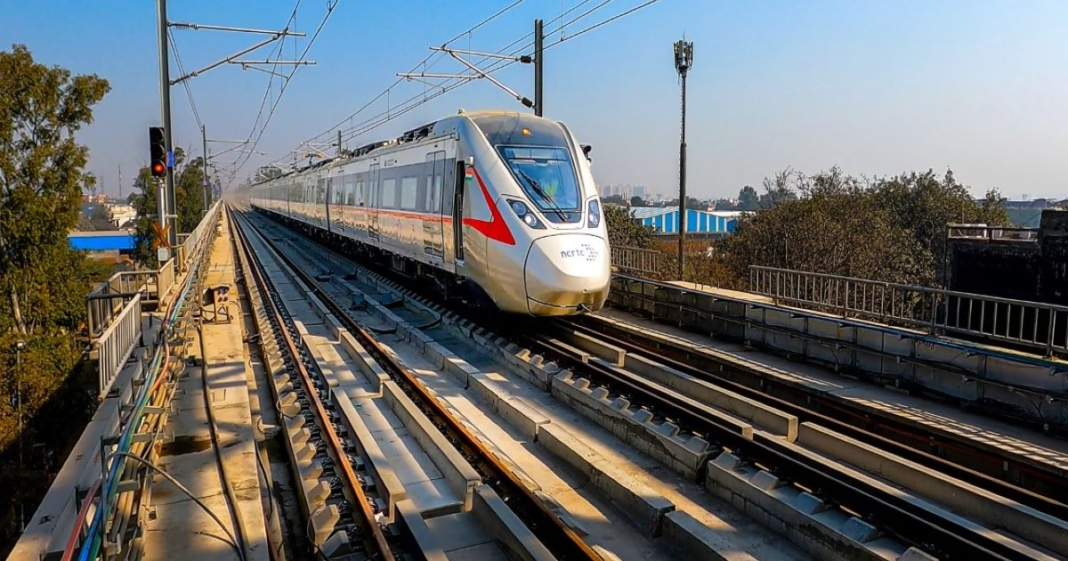
Envisioned as a response to this growing mobility deficit, the Regional Rapid Transit System (RRTS), branded as Namo Bharat, represents India’s first attempt at creating a high-speed, high-capacity rail network for regional travel. Unlike metro systems designed primarily for intra-city movement, RRTS is tailored for fast, frequent and reliable commuting across longer distances, linking urban centres with their suburban and satellite counterparts. Operating at significantly higher speeds and with fewer stops, the system aims to make daily inter-city travel both practical and time-efficient.
In doing so, RRTS is expected to reshape commuting patterns in the NCR, support more balanced urban development, and emerge as a critical enabler of inclusive mobility across the region’s expanding economic landscape.
Among the upcoming corridors planned under the RRTS framework, the Delhi–Panipat–Karnal stretch stands out as a particularly strategic link between the Capital and Haryana’s northern urban belt. For real estate markets across North NCR, it is widely seen as a major growth trigger. Stretching approximately 136 km from Sarai Kale Khan to Karnal and passing through Sonipat and Panipat, th corridor is expected to bring multiple residential and industrial catchments significantly closer to Delhi’s economic core. With 17–18 stations planned along the route and trains operating at high speeds, commute times that once discouraged daily travel are set to shrink dramatically.
Destinations such as Murthal, Panipat and even Karnal could soon fall within practical commuting distance of the Capital. For developers and homebuyers alike, this corridor illustrates how high-speed regional connectivity can unlock new micro-markets, redistribute demand, and reshape housing and commercial growth along the NCR’s northern spine. By sharply cutting travel durations, the network makes daily commuting from satellite towns not only feasible but attractive, allowing professionals to access jobs in Delhi and other urban centres without relocating.
This improved mobility is expected to deepen economic integration, with stations planned near industrial belts in Kundli, Sonipat and Panipat, as well as education and commercial hubs, helping attract talent and long-term investment into these emerging nodes.
From a real estate perspective, the impact could be equally transformative. Transit-oriented development around RRTS stations is likely to encourage mixed-use growth, push up land values and create self-sustaining urban clusters beyond Delhi’s crowded core. In the process, RRTS offers a more balanced alternative to auto-centric expansion, easing pressure on the Capital while catalysing structured, infrastructure-led growth across the suburban NCR.
Beyond mobility and market dynamics, the RRTS also carries important environmental and social implications for the region. By offering a faster and more dependable alternative to road travel, the system is expected to shift a significant share of commuters away from private vehicles, easing pressure on congested corridors such as NH-44. At a time when air quality remains a persistent concern, this transition towards high-capacity public transport could play a meaningful role in reducing the NCR’s carbon footprint, while also delivering a more comfortable, predictable and equitable commuting experience.
Taken together, the RRTS represents far more than just another layer of infrastructure for the NCR. It signals a shift in how the region can grow — by narrowing the distance between cities and their surrounding towns, dispersing economic opportunity, and enabling people to live farther from traditional urban cores without sacrificing access. As the network takes shape, RRTS has the potential to reshape daily mobility and, in the process, redefine the future urban geography of the NCR.
The author is Managing Director, TREVOC Group



Cricketer Rohit Sharma, Ritika Sajdeh are Bhumika Realty’s Brand Ambassadors
April 2, 2026: One of North India’s leading real estate developers, Bhumika Realty, has announced the onboarding of Rohit Sharma,...

Avaana Capital Announces Third Edition of Grand Challenge to Support Deep Tech Innovation in India
New Delhi, India – Avaana Capital, in partnership with the Department for Promotion of Industry and Internal Trade (DPIIT) under...

Tata Realty Seals Bengaluru Land Deal at ₹2,300 Crore; CBRE Advisor for Transaction
Bengaluru, April, 2026: Tata Realty and Infrastructure Ltd (TRIL) has entered into a binding agreement to acquire over 38 acres...

U.P. RERA Nod to 11 Real Estate Projects Worth Over₹3,200 Crores Across Nine Districts, Noida Leads in Units,Ghaziabad in Investment
Lucknow/Gautambuddh Nagar, April 1, 2026: The Uttar Pradesh Real Estate Regulatory Authority (U.P. RERA) has approved 11 new real estate...

DMart Opens Its Largest NCR Store at Omaxe Connaught Place, Greater Noida
Greater Noida, April 1, 2026: Omaxe Ltd. has announced the opening of Avenue Supermarts Limited (DMart) at Omaxe Connaught Place,...

U-Flex Appoints Dharmesh Joshi as Head – Data CenterSpecifications & Business Development
Mumbai, April 1, 2026: U-Flex, a flagship brand of Unitile, a raised access flooring company –on Wednesday announced the appointment...
-
 Guest Column4 weeks ago
Retail Trends to Watch Out for in 2026
-

 News2 weeks ago
FractoProp Receives SEBI Registration for Ridhama Real Estate Fund
-
News6 days ago
How Noida International Airport Will Impact Property Prices
-
News2 weeks ago
Rise of Airport-Linked Real Estate: Opportunities Emerging Around Jewar
-
News3 days ago
Noida International Airport Inauguration Sparks New Real Estate Boom For NCR
-
News3 weeks ago
Greenlands Global Private Limited Appointed as Managing Partner for Big FM Realty’s ₹1,200 Crore Mixed-Use Development
-

 News3 weeks ago
India Maintains Competitive Edge as Asia-Pacific Office Fit-Out Hub, Reports Knight Frank
-
News3 weeks ago
Enviro Infra Engineers Secures ₹411 Crore Bihar Sewerage Project Under AMRUT 2.0