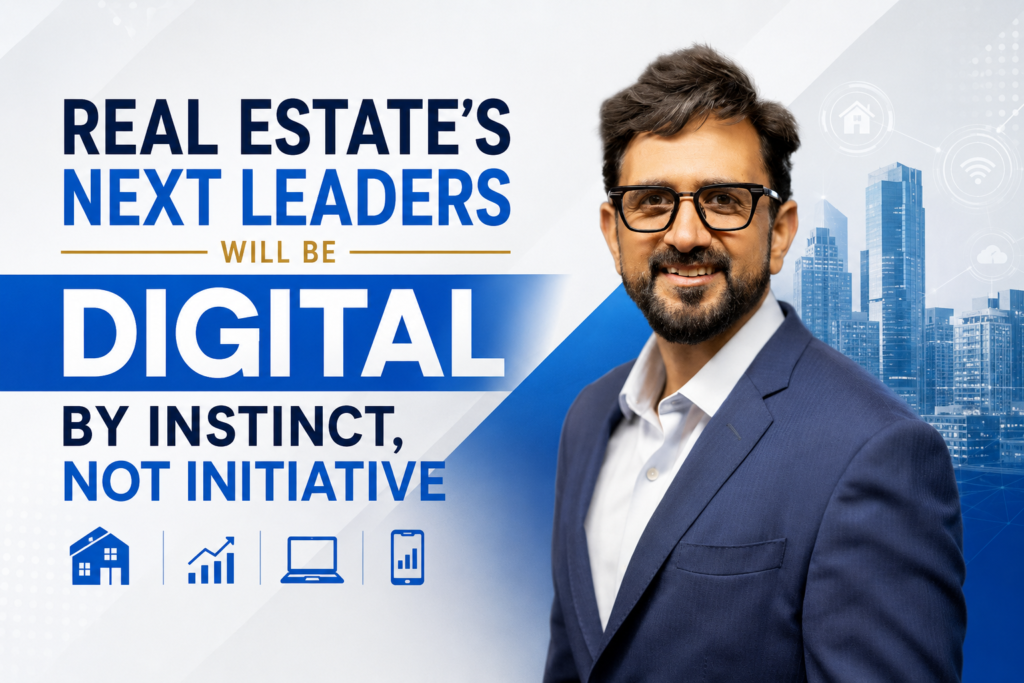
Real Estate’s Next Leaders Will Be Digital by Instinct, Not Initiative
By Sunil Pareek, Executive Director, Assetz Property Group
In real estate, every decade brings a new playbook. There was a time when land aggregation and speed of construction determined an advantage. Then came design thinking and brand-led differentiation. Today, the shift is deeper. The next decade will belong to developers who no longer treat technology as a function, but as culture. It is a subtle yet transformative mindset shift that will separate tomorrow’s industry leaders from those who struggle to keep pace.
For years, technology in real estate has been viewed as an enabler: drones for mapping, ERP systems for project tracking, or smart-home features for the customer experience. These tools are valuable, but unless the organisation embraces them as part of its identity, they fall short of becoming transformative. Technology becomes powerful when it stops being an ‘initiative’ and starts becoming an instinct, shaping decisions, influencing behaviours and guiding how teams collaborate.
This distinction between adoption and absorption is where the real opportunity lies. Developers who understand this are not just implementing technology; they are building cultures where innovation is everyone’s responsibility. In such organisations, technology is not the domain of CIOs or IT heads, it is embedded in finance, design, procurement, construction, sales and customer service. Because the question is no longer, “Should we bring in digital tools?” but rather, “How can data and technology help us make this decision better?”
This cultural mindset begins with leadership. When leaders intentionally weave innovation into strategic conversations – in assessing land parcels, thinking about capital strategy, or designing communities – the organisation learns that technology is a lever of value creation. When real-time data influences boardroom discussions, predictive analytics shape design choices, CRM data platforms refine amenities, and technology gains credibility. It becomes part of the company’s shared language.
A well-known developer based out of Australia offers a clear illustration of this thinking in practice. Rather than relying on fragmented digital tools, the organisation built a proprietary platform that connects planning, design, construction and live operations into a single system. Within this framework, algorithms and generative design guide structural planning at early stages, allowing teams to assess options with greater speed and precision. As projects move from delivery to occupation, performance data flows back into the same platform, informing operational efficiency, energy use and how spaces are experienced in real conditions. Ongoing investment in internal digital capability ensures this system remains embedded across the portfolio, reinforcing technology as a foundational way of working rather than a time-bound initiative.
The lesson is clear: when technology becomes cultural, innovation compounds. Tools become more effective because teams understand them, trust them and use them consistently. And this is where the real estate development sector stands today: on the brink of cultural reinvention.
In construction, cultural technology means project teams use digital twins or BIM models not because they are mandated, but because they consider these tools essential to quality and predictability. IoT sensors, drone surveys and real-time project dashboards become standard workflow, not special projects. When this mindset takes hold, efficiencies multiply. Costs are managed proactively. Delays are anticipated rather than discovered too late. Risks are shared transparently with stakeholders.
In design and sustainability, technology-driven culture enables developers to look beyond compliance and aim for genuine environmental performance. Predictive analytics can model heat loads or optimise airflow, reducing long-term energy consumption. Smart materials and environmental sensors can track building performance long after handover. In a sector where sustainability is frequently treated as a marketing differentiator, technology makes it measurable, traceable and future-proof.
On the customer side, cultural technology helps developers evolve from builders to experience providers. Smart homes, app-based maintenance and community engagement platforms are no longer add-ons; they become central to how residents live and how developers learn. Technology gives developers continuous feedback, something the industry has historically lacked, and this feedback loops back into better product design.
This shift also creates a governance advantage. Developers who operate with digital-first cultures tend to have better transparency, clearer documentation and stronger risk controls. Data does not just support decisions; it protects them. Investors, landowners and homebuyers increasingly look for this discipline. In a market where trust is a differentiator, governance powered by data is a competitive moat.
But perhaps the strongest reason to build technology as culture is that it prepares organisations for uncertainty. Markets shift. Regulations evolve. Customer expectations change faster than ever. The only constant advantage is adaptability, an attribute that is cultural. Developers who cultivate curiosity over complacency, collaboration over hierarchy, and transparency over intuition will outpace even those with larger portfolios or deeper financial muscle.
The question for every real estate leader, then, is simple: Are we using technology, or are we becoming a technology-driven organisation? The former will offer incremental benefits. The latter will define industry leadership.
In the next decade, the developers who succeed will not be the ones with the biggest land banks or the flashiest smart-home features. They will be the ones who build cultures that learn, innovate, and evolve continuously. They will build organisations where technology is not an afterthought, but a shared belief. And in doing so, they will build the future of real estate, not just in form, but in philosophy.
Disclaimer: Views expressed in this article are those of the author, and not necessarily of Realty&More.