Housing Rents Up By 25–30% Across Major Cities From 2019 Level: Housing.Com
New Delhi, Jan 24, 2024: Housing rents have surged by a substantial 25–30 per cent in top micro-markets within major cities since 2019, finds a report by Housing.com. The average monthly rents for residential properties have experienced an uptick of 15-20 per cent across top 8 cities compared to the pre-pandemic era of 2019. This surge in rents has contributed to a modest enhancement in rental yields. Despite these positive trends, there remains a considerable gap to bridge when compared to global real estate hubs such as New York, London, Dubai, and Singapore, highlighted the report.
Real estate tech platform Housing.com’s latest report titled ‘Residential Rents on the Rise! A report on rental property in India’ shows the growth in monthly average rent has been higher than the appreciation in capital values.
While property prices in top cities saw a 15–20 per cent growth compared to pre-pandemic levels of 2019, average monthly asking rents skyrocketed by 25–30 per cent, with certain key localities in service sector dominant cities witnessing significant rent spikes exceeding 30 per cent during the same period.
Not only median rents, but there is a surge in demand for renting a home post pandemic as indicated by Housing.com IRIS index. The index which gauges upcoming demand by tracking the online search activity on the platform, indicates that post pandemic the online rental search activity has surged ahead of buying activity. Currently, the IRIS index for rent is trending 23 points higher than the buying index.
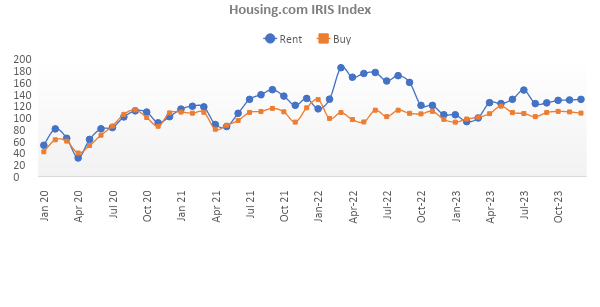
Source: Residential Rents on the Rise! A report on rental property in India 2024, Housing Research

Dhruv Agarwala, Group CEO, Housing.com, PropTiger.com & Makaan.com: Post-pandemic, there has been a sharp revival in housing demand, both for buying and renting purposes. Housing market has seen price appreciation in the last two years after almost a decade of stagnation. The average price rise has been modest at a city level, but there have been sharp rise in some major locations of top cities.”

Ankita Sood, Head of Research at Housing.com said, “Rental returns in India historically trailed global counterparts due to factors like higher interest rates and acquisition costs. However, post-pandemic dynamics, including rising property values, affordability challenges for potential buyers, and a limited supply of ready inventory, has sparked a significant surge in rental demand. We see notable spikes to the tune of 25–30% in CBDs of service sector dominant cities like Gurugram, Bengaluru, Pune, and Hyderabad.
Housing.com Research has also computed price-to-rent ratio to compare the rental returns in India’s key housing market with major global cities. The price-to-rent ratio is determined by dividing the median property value by the median annual rent price within a specific geographical area.
Lower price-to-rent ratio means higher rental yield or return on investment for property owners. This ratio helps in evaluating the comparative affordability of renting versus purchasing a property.
Price-to-rent ratio – World Vs India
| Sr no | City | Country | Price-to-Rent Ratio |
| 1 | New York | United States | 17 |
| 2 | Tokyo | Japan | 42 |
| 3 | London | United Kingdom | 24 |
| 4 | Dubai | UAE | 15 |
| 5 | Paris | France | 31 |
| 6 | Seoul | South Korea | 40 |
| 7 | Singapore | Singapore | 23 |
| 8 | Sydney | Australia | 29 |
| 9 | Mumbai (MMR*) | India | 35 |
| 10 | New Delhi | India | 37 |
| 11 | Noida | India | 33 |
| 12 | Gurugram | India | 36 |
| 13 | Pune | India | 31 |
| 14 | Hyderabad | India | 25 |
| 15 | Bengaluru | India | 25 |
| 16 | Melbourne | Australia | 21 |
| 17 | Hong Kong | China | 36 |
* Mumbai Metropolitan Region includes Mumbai, Thane and Navi Mumbai.
Source: Residential Rents on the Rise! A report on rental property in India 2024, Housing Research
Note:
Price-to-rent ratio: The price-to-rent ratio is determined by dividing the median home price by the median annual rent price within a specific geographical area. This ratio serves as a crucial tool for evaluating the comparative affordability of renting versus purchasing a property, as well as estimating potential rental returns on real estate investments. A lower price-to-rent ratio implies a higher likelihood of favourable rental returns. Conversely, a higher ratio signals reduced rental returns, suggesting a less favorable environment for property investment. The ratio can be used by potential homeowners and tenants in affordability assessment and in renting versus buying decisions. While investors can leverage it to make strategic decisions. In a city, a price-to-rent ratio of 1-15 indicates that owning is much cheaper than renting, while a ratio of 16-20 implies higher ownership costs, and a ratio of 21+ signifies significantly greater homeownership expenses compared to renting.