New Mall Supply Pegged at 16.6 mn sq ft Across Top 7 Cities in 2025-26

Mumbai, May 13, 2025: In India’s golden era of retail expansion, consumer demand and retail real estate supply are on an unprecedented growth trajectory. Rising consumption is driving a surge in new mall supply in Tier 1 over the next two years.
ANAROCK Research estimates that over 16.6 mn sq ft of new Grade A mall supply will enter the top seven cities in 2025 and 2026.
With a combined 65 per cent share of this supply, Hyderabad and Delhi-NCR will command the lion’s share, underscoring the shift of focus to high-growth consumption hubs. This surge is part of a broader pipeline that could add more than 40 million sq ft of retail space by 2029 across major urban centres.

Anuj Kejriwal, CEO and MD, ANAROCK Retail, says, “The surge is also prompted by a perceivable shortfall in the new supply of Grade A malls across cities. The previous three-year data trends show that new mall supply in the top seven cities did not match the overall leasing.”
In 2022, these cities witnessed approximately 2.6 mn sq ft of new Grade A retail supply while leasing clocked in around 3.2 mn sq ft, he adds. “Likewise, 2023 saw 5.3 mn sq ft of new Grade A mall supply while 6.5 mn sq ft were leased.”

The demand-supply gap widened further in 20204 due to approval slowing down because of general and state elections.
“New Grade A mall supply in 20204 was just 1.1 mn sq ft while leasing was 6.5 mn sq ft,. The data speaks for itself,” he further adds.
While the estimated new supply to some extend raises the spectre of potential oversupply, current absorption trends are reassuring. ANAROCK data pegs total mall leasing over the next two years at greater than 12.6 mn sq ft across the top seven cities. Both mall developers and retailers are showing resolute confidence, spurred by strong leasing and positive consumer sentiments.
“The strong leasing rate is also prompted by the entry of over 60 international retail brands in India over the last four years across categories like fashion, electronics, lifestyle and F&B. This has accelerated demand for high-grade organised retail spaces, particularly in high-footfall zones like malls and high streets.”
Data also indicates that with demand-supply imbalance of previous years now gradually normalising, mall vacancy rates in the top seven cities will stabilise over the next two years—at 8.2 per cent in 2025 and 8.5 per cent in 2026. In 2021, the vacancy rate in these cities was as high as 15.5 per cent.
Source: ANAROCK Research
Insatiable Thirst for Consumption
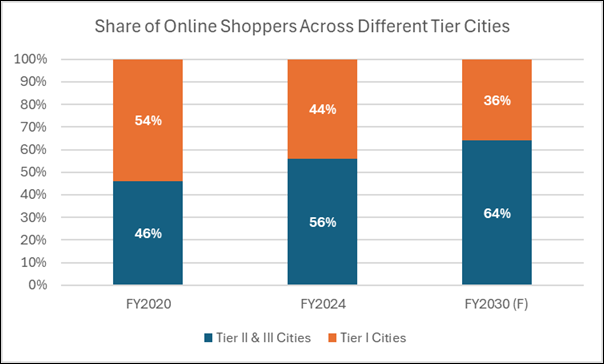
The current retail boom is not limited to urban metros. Tier 2 and Tier 3 cities have emerged as the new consumption hotbeds thanks to rising disposable incomes and deeper smartphone and internet penetration.
E-commerce adoption in these cities has outpaced that of Tier-1 cities—industry estimates peg the share of the overall online shopping pie at 65 per cent and predict it to reach 64 per cent by FY 2030.
The number of Indian online shoppers has jumped from 140 million in 2020 to nearly 260 million in 2024. It is projected to nearly double to 300 million by 2030 and 700 million by 2035.
Source: ANAROCK & Market Intelligence