Delhi NCR Office Leasing Jumps 36% in Q1-26 as Institutional Investors Eye Income-Generating
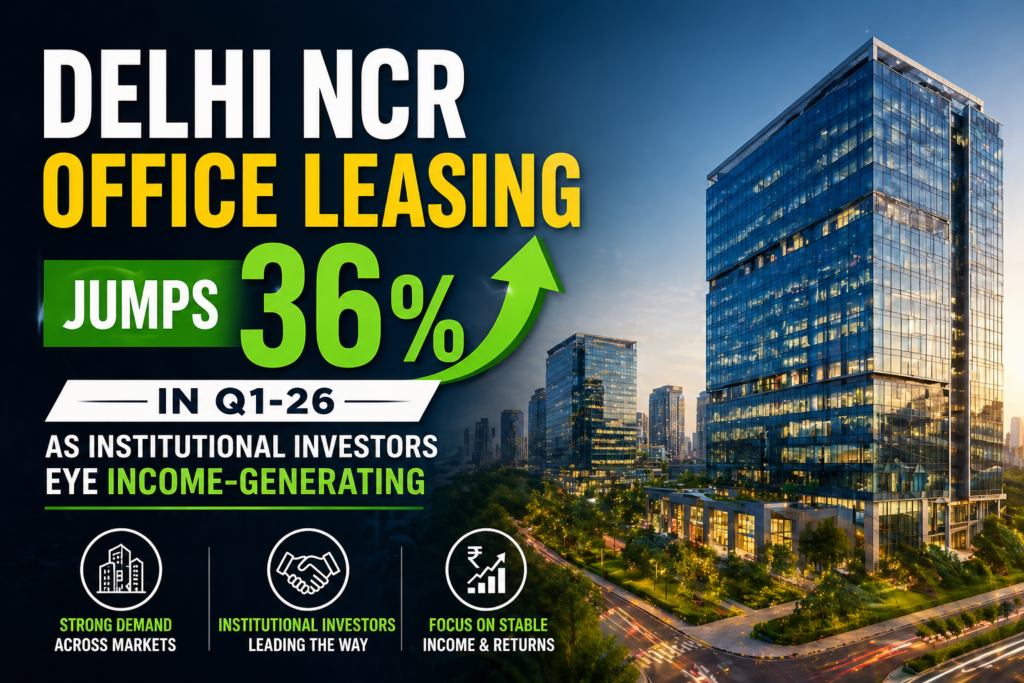
New Delhi, April 28, 2026: India’s commercial real estate (CRE) sector is witnessing a strategic transformation as investors pivot away from market timing in favor of building steady, income-generating portfolios. According to recent industry data and market experts, office and retail assets have reclaimed the spotlight, supported by consistent leasing activity and a notable shift toward “patient” capital. According to real estate industry leaders, unlike previous cycles of speculative growth, the current momentum is described as measured and deliberate, with a clear focus on long-term value and high-quality, ESG-aligned assets.
The office segment continues to serve as the market’s anchor, bolstered by the expansion of Global Capability Centres (GCCs). Data from Cushman & Wakefield highlights this resilience, revealing that Delhi NCR recorded gross leasing of 2.8 million square feet during Q1-26. This represents a 36% quarter-over-quarter increase and 2% year-on-year growth. Gurugram emerged as the primary driver with a 60% share of leasing, followed by Noida at 37%. Demand was led by flex space providers at 27%, while engineering, manufacturing, and IT/BPM sectors accounted for a combined 41% of the quarterly volume.
Retail real estate is simultaneously evolving through a trend of premiumization and experience-led formats. In the first quarter of 2026, Gurugram dominated retail lease transactions with a 54% share. The data indicates a strong preference for organized retail, with malls accounting for 64% of leasing volume compared to 36% for main streets. Industry analysts note that modern consumers are increasingly prioritizing lifestyle, entertainment, and F&B experiences over traditional product-based shopping, forcing a shift in how retail spaces are designed and tenanted.

Pankaj Jain, Founder and CMD of SPJ Group, emphasized the diverse opportunities within the NCR market, stating: “Gurugram remains at the forefront, receiving increased recognition for its infrastructure-based development approach. While developments in prime locations continue to shape the retail landscape in the city, Old Gurgaon, on the other hand, offers a completely different edge – a proven ecosystem of high density and robust consumer base. Old Gurgaon has always had a certain advantage; it’s a lived-in market with real, everyday consumption. Unlike emerging corridors, the region has dense residential clusters, working professionals, and a diverse demographic profile that drives consistent footfall. That’s a strong foundation for retail to thrive. What’s interesting now is how investor perception is catching up to this reality. There’s growing appreciation for high-street formats in such locations, where visibility and accessibility directly translate into business performance.”

The emergence of new infrastructure is also recalibrating investor expectations, particularly along high-growth corridors. Ashwani Kumar of Pyramid Infratech noted: “Gurugram, particularly the Dwarka Expressway belt, is seeing a more decisive shift in investor thinking. The focus is moving beyond appreciation alone, with greater emphasis on assets that can deliver steady income. As residential density builds up along the corridor, it is naturally drawing attention for both office and high-street retail. Its planned layout works in its favour; there’s better clarity, stronger connectivity, and a more future-ready ecosystem. That reduces a lot of uncertainty for investors. We’re also seeing a more balanced mix of capital coming in, including domestic investors who are taking a long-term view on the opportunity.”

This influx of domestic capital, including High-Net-Worth Individuals (HNIs) and family offices, is creating a more nuanced investment landscape. Paras Rai, Managing Director and Co-Founder of Property Master, added: “Across NCR, the momentum we’re seeing in commercial real estate is both broad-based and more nuanced than before. In Gurugram, offices continue to attract institutional capital due to its stability and scale, especially with GCC-led leasing, while retail is drawing interest for its stronger yield play in high-footfall locations. What’s equally important is the rise of domestic capital; HNIs and family offices are far more active today, and they’re making informed, long-term bets. Investors are evaluating micro-markets closely, looking at catchment strength, tenant mix, and exit potential. It’s no longer a one-size-fits-all approach; it’s a far more calibrated investment strategy.”
Ultimately, the market is moving toward a model where office and retail assets are viewed as complementary components of a diversified strategy. While the office sector provides long-term stability and predictable yields through REIT-friendly frameworks, the retail sector offers growth driven by rising consumption. This dual-pronged approach suggests that India’s commercial real estate market is firmly transitioning into a mature, income-based investment asset class.