Flexible Workspaces Gain Major Boost From Surging Employee Self-Care Trends, DK Vertex Survey Reveals
New Delhi, July 28, 2026: Indian co-working spaces offering wellness, mental health, and fitness amenities are witnessing talent retention rates approximately 30 percent higher than traditional office environments, according to a recent survey released by co-working platform DK Vertex. The study, conducted among more than 150 companies across Delhi-NCR, Bengaluru, Pune, Mumbai, and Chennai, underscores a structural shift in corporate India, where workplace well-being has transitioned from a fringe benefit to a fundamental competitive necessity, DK Vertex said in a press release.
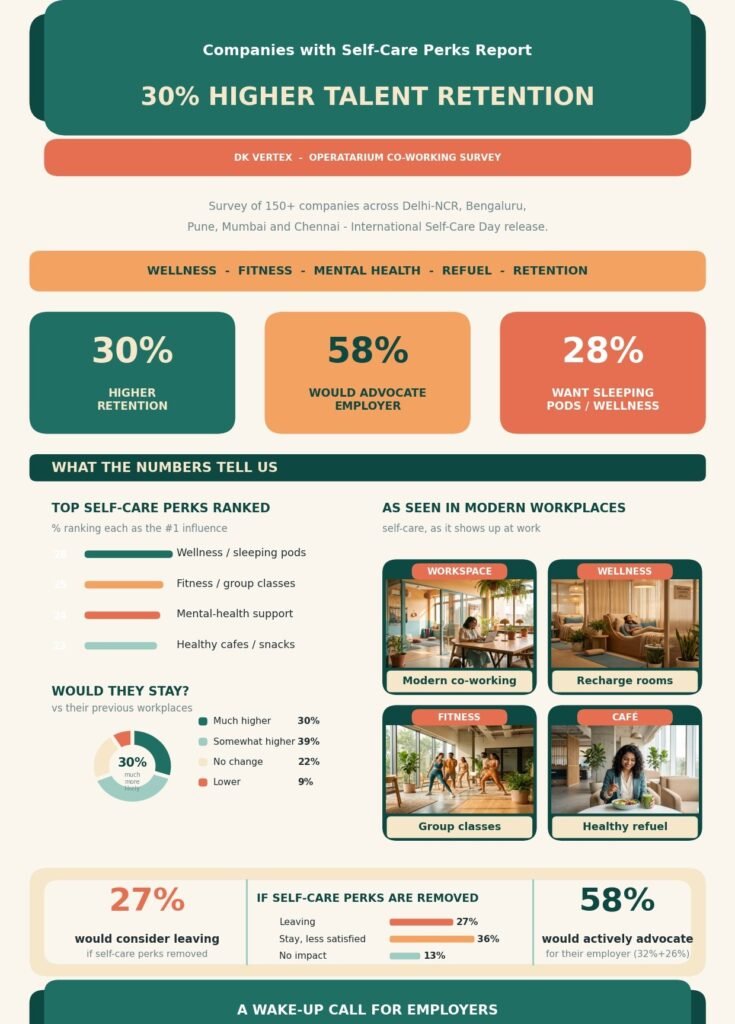
The findings highlight a notable surge in demand for mid-day recharge facilities among modern employees. Over 28 percent of survey respondents cited wellness rooms or sleeping pods as the single most influential workplace feature, followed by fitness facilities or group wellness classes at 25 percent. Onsite mental health support was ranked as a top priority by 24 percent of participants, while high-quality cafeterias offering healthy food options led choices for 23 percent. Beyond physical amenities, respondents highlighted flexible working hours, professional development opportunities, and a strong workplace community as key drivers of corporate satisfaction.

Commenting on the survey findings, Gagan Arora, Founder and President of Vertex Group and Co-Founder and CEO of DK Vertex, said, “This survey sends a powerful message to Indian employers: employee well-being is directly tied to loyalty and advocacy. The companies that put people first, by investing in self-care, flexibility, and a positive culture, will not only attract talent but keep it. The finding also highlights a stark reality: that with this growing trend, India’s co-working ecosystem needs to think of the future requirements of the modern workplace.”
Employer advocacy is heavily influenced by these perks, with 32 percent of professionals stating that self-care features make them much more likely to recommend their organization or workspace, and 26 percent reporting they would be somewhat more likely to do so. Conversely, 25 percent felt such amenities made no difference, while 7 percent indicated these features would reduce their likelihood of employer advocacy. When comparing current employers to previous workplaces lacking wellness options, 30 percent of respondents reported a significantly higher likelihood of staying, while 39 percent expressed a somewhat higher intention to remain.
Highlighting the potential risks for organizations that neglect employee well-being, the survey revealed that 27 percent of employees would consider leaving their jobs if wellness perks were eliminated, while 36 percent said they would remain but experience reduced job satisfaction. Only 13 percent indicated that the removal of such benefits would have no impact on their career decisions.
Detailing the broader implications for workplace strategy, Simar Arora, Co-Founder and Managing Partner of DK Vertex, said, “This survey signals a significant shift in what employees expect from their workplaces. It’s no longer only about salary or location; today’s professionals are prioritising well-being and self-care. Features like wellness rooms, mental health support, and recharge spaces are now decisive for retention. I believe this is a wake-up call for employers: investing in employee well-being isn’t just a perk, but a strategic necessity that drives loyalty, satisfaction, and long-term organisational success in the evolving world of work.”