Noida International Airport’s First Commercial Flight Takes Off: A Historic Leap for Indian Aviation and Real Estate
By RealtyNMore Editorial Team
The dawn of a new era in Indian aviation unfolded as the first commercial flight successfully took off from Noida International Airport, marking a transformative milestone not just for connectivity, but for the entire economic and real estate landscape of North India. The much-anticipated launch, years in the making, was executed with precision, planning, and global ambition—positioning the airport as one of India’s most significant infrastructure achievements.
A Project Years in the Making

The journey to operationalizing Noida International Airport has been defined by meticulous planning, multi-agency coordination, and phased development. Conceptualized as India’s largest airport upon completion, the project has been strategically developed in multiple phases, with the first phase designed to handle millions of passengers annually.
Developed under a public-private partnership (PPP) model, the airport integrates world-class infrastructure, sustainability benchmarks, and digital-first passenger experiences. From runway construction and air traffic management systems to terminal design and cargo logistics, every component has been aligned with international aviation standards.
The inaugural flight itself was not just a ceremonial event but a demonstration of operational readiness. Months of trial runs, calibration flights, security audits, and regulatory approvals culminated in this historic moment. Aviation authorities, ground staff, and airline operators worked in synchronized precision to ensure seamless execution—from passenger check-in to takeoff clearance.
Inside the First Flight Experience
RealtyNMore had the unique opportunity to be part of this landmark journey—not just as observers, but as passengers onboard the first commercial flight departing from Noida International Airport.
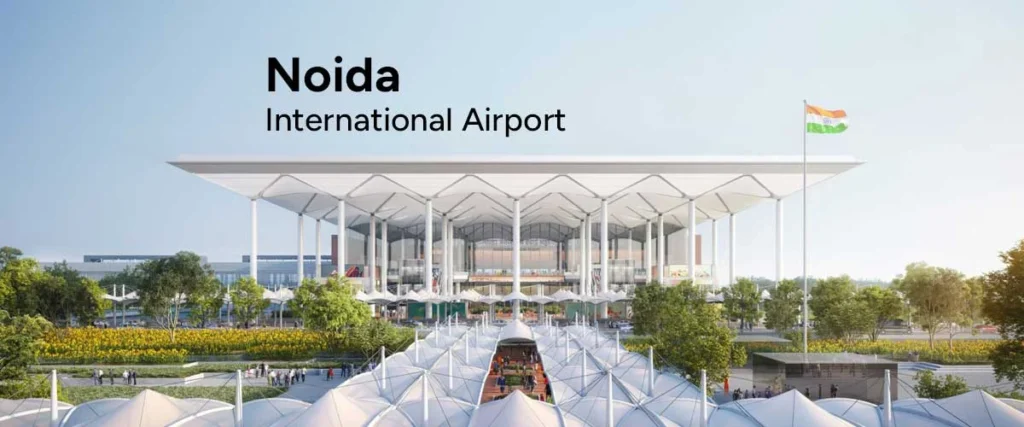
From the moment of arrival, the airport exuded efficiency and futuristic design. The terminal showcased spacious layouts, intuitive navigation systems, and advanced security infrastructure. Check-in counters operated smoothly, supported by digital kiosks and minimal wait times—reflecting the airport’s commitment to a tech-enabled travel experience.
Boarding the historic flight was a moment of pride and anticipation. Passengers onboard included aviation officials, industry leaders, media representatives, and select invitees. The atmosphere was celebratory yet professional, underscoring the significance of the occasion.
As the aircraft taxied along the newly constructed runway and lifted into the sky, it symbolized more than just a flight—it marked the beginning of a new growth corridor for the National Capital Region (NCR).
The Numbers Behind India’s Newest Aviation Gateway
The story of Noida International Airport began more than a decade ago when the need for a second international airport in the National Capital Region (NCR) became increasingly evident. With passenger traffic at Delhi’s airport rising rapidly and the NCR emerging as one of India’s largest economic zones, planners envisioned a new aviation hub that could support future growth while catalysing development across western Uttar Pradesh.
The project received central approval in 2017, followed by in-principle clearance from the Ministry of Civil Aviation in 2018. In 2019, Zurich Airport International AG emerged as the winning bidder to develop and operate the airport under a Public-Private Partnership (PPP) model. Prime Minister Narendra Modi laid the foundation stone on November 25, 2021, setting the stage for one of India’s most ambitious greenfield airport projects.
Phase-I of the airport has been developed with an investment of approximately ₹11,200 crore and currently features one runway and one integrated passenger terminal. The airport has an initial capacity of 12 million passengers per annum (1.2 crore passengers) and is designed to handle nearly 150 flight movements daily in its first operational phase.
What makes the project particularly significant is its long-term vision. The airport is being developed in four phases and is expected to scale up to a capacity of 70 million passengers annually upon full completion. Future phases will add additional terminals, runways, cargo infrastructure, maintenance facilities, and commercial development zones, transforming the airport into one of India’s largest aviation ecosystems.

According to the master plan, the total investment across all phases is estimated at nearly ₹29,500 crore. The airport’s first phase alone spans approximately 1,334 hectares, while the full development is planned over thousands of hectares, making it one of the largest airport developments in Asia.
The airport is also expected to become a major cargo and logistics hub. Initial cargo handling capacity is projected at around 2.5 lakh metric tonnes annually, with long-term expansion targets reaching nearly 18 lakh metric tonnes. This logistics capability is expected to attract warehousing, manufacturing, e-commerce, and export-oriented industries to the Yamuna Expressway region.
Industry experts estimate that the airport will contribute billions of rupees to the regional economy over the coming decades through passenger traffic, cargo operations, commercial leasing, hospitality, retail, logistics, and employment generation. While direct profit figures will depend on traffic growth and commercial performance in the coming years, the airport’s business model is designed around multiple revenue streams including aeronautical charges, retail concessions, parking, advertising, cargo operations, real estate development, and aviation-related services. This diversified revenue structure is expected to strengthen the airport’s long-term financial sustainability while creating substantial economic value for the region.
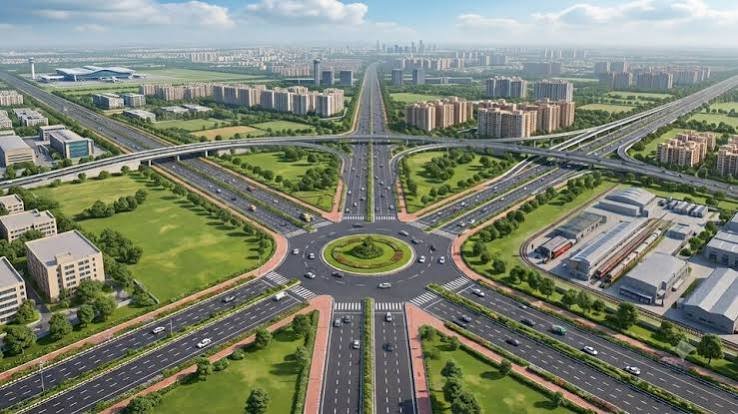
For the real estate sector, these numbers are more than statistics—they represent a once-in-a-generation infrastructure catalyst. The airport is expected to drive residential, commercial, industrial, hospitality, and logistics development across Noida, Greater Noida, Jewar, and the broader Yamuna Expressway corridor, creating an entirely new growth axis for North India.
Strategic Planning and Execution
The successful launch of operations at Noida International Airport is a testament to coordinated planning between government bodies, developers, and global consultants. Key aspects that contributed to the seamless execution include:
- Integrated Infrastructure Development: Connectivity via expressways such as the Yamuna Expressway ensured efficient passenger access.
- Regulatory Alignment: Close coordination with aviation authorities ensured compliance with DGCA norms and global safety standards.
- Smart Airport Features: Automation, AI-driven systems, and sustainable design elements were embedded into operations.
- Phased Scalability: The airport’s master plan allows for future expansion to accommodate increasing passenger and cargo demand.
The planning extended beyond aviation to include surrounding urban development, positioning the airport as the nucleus of a larger economic ecosystem.
Impact on Real Estate and Regional Growth
The operationalization of Noida International Airport is expected to trigger a profound transformation in the real estate market across Noida, Greater Noida, Yamuna Expressway, and adjoining regions.
1. Surge in Property Demand:
Residential and commercial demand in sectors along the Yamuna Expressway has already witnessed a significant uptick. The airport’s launch is expected to further accelerate buyer interest, particularly among investors and end-users seeking long-term appreciation.
2. Rise of Aerotropolis Development:
The airport is set to anchor an aerotropolis—a self-sustained urban ecosystem comprising business parks, logistics hubs, retail zones, and hospitality developments. This will redefine urban planning in the region.
3. Boost to Commercial Real Estate:
Office spaces, co-working hubs, and industrial parks are likely to witness heightened demand as businesses look to capitalize on improved connectivity and logistics efficiency.
4. Appreciation in Land Values:
Land parcels in proximity to the airport have already seen price appreciation, and this trend is expected to continue as infrastructure development progresses.
5. Employment Generation and Economic Activity:
The airport is projected to generate thousands of direct and indirect jobs, stimulating economic activity and supporting ancillary industries such as hospitality, retail, and logistics.
For RealtyNMore, being present on the first commercial flight from Noida International Airport was more than just a reporting assignment—it was a front-row seat to history in the making.
Experiencing the airport’s operations firsthand provided valuable insights into the scale, efficiency, and ambition of the project. The seamless coordination, passenger-centric design, and forward-looking infrastructure reaffirmed the airport’s potential to become a global aviation hub.
As a real estate news brand deeply rooted in tracking India’s urban transformation, RealtyNMore recognizes the airport as a catalyst that will reshape investment patterns, redefine urban growth corridors, and unlock new opportunities for developers and investors alike.
The successful launch of the first commercial flight is just the beginning. As subsequent phases of the airport are completed, capacity will expand significantly, further strengthening its position as a key gateway for domestic and international travel.
With robust infrastructure, strategic location, and a clear vision for growth, Noida International Airport is poised to become a cornerstone of India’s next-generation urban development.
For the real estate sector, the message is clear: the future of growth is taking flight—and it has begun at Jewar.
Stay tuned with RealtyNMore for exclusive insights, on-ground reports, and expert analysis on how infrastructure projects like Noida International Airport are shaping India’s real estate landscape.