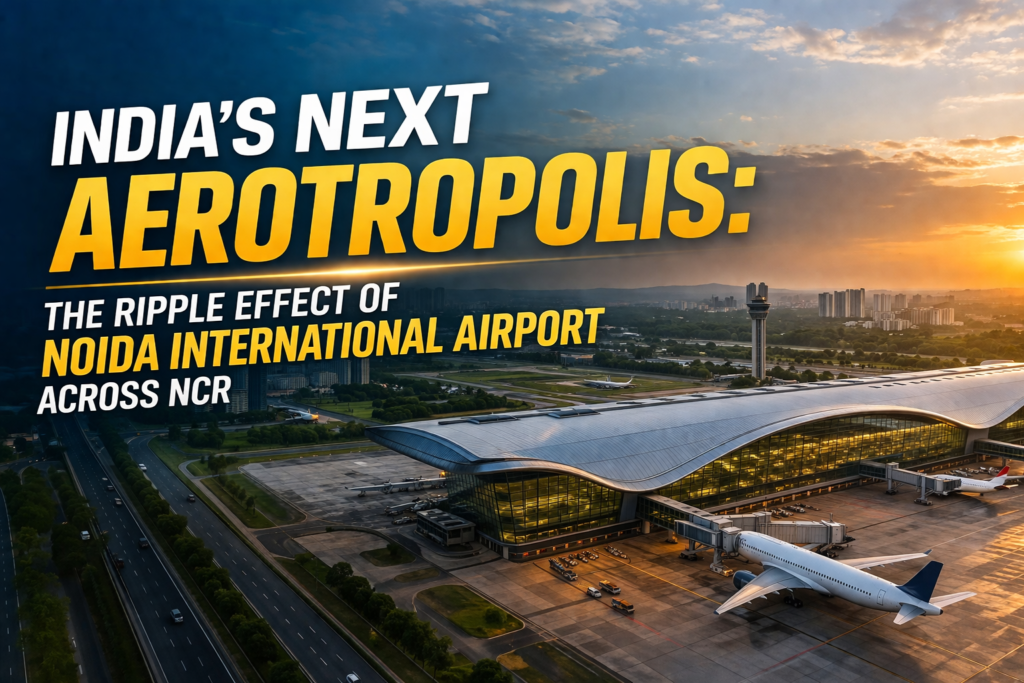
India’s Next Aerotropolis: The Ripple Effect of Noida International Airport Across NCR
By Sanjay Sharma, Director, SKA Group

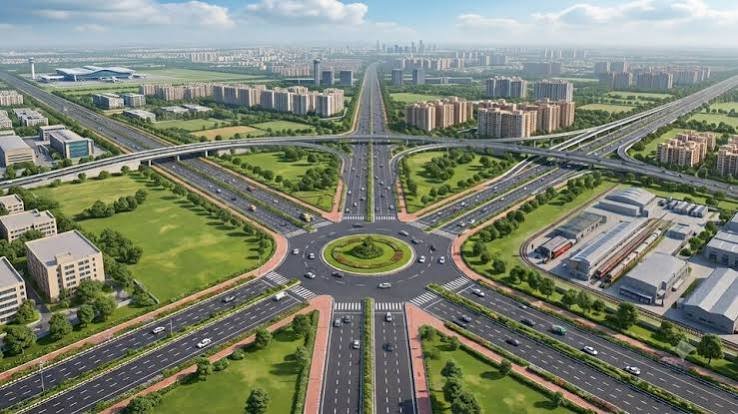
For decades, NCR’s urban expansion has unfolded in distinct waves, each anchored by a defining corridor, from Gurugram’s corporate rise to Noida’s planned residential growth and the emergence of the Dwarka Expressway as a new urban spine. Today, that pattern is set for a decisive shift. The inauguration of the first phase of the Noida International Airport signals not just the addition of another infrastructure asset but the emergence of a new epicentre of growth, one that has the potential to reorient how the region expands, invests, and evolves.
Even in its first phase, the Noida International Airport introduces sustained economic activity, driving employment generation, business movement, and, in turn, a steady expansion of residential and commercial demand. According to a report, ‘Runway to Realty: How Noida International Airport is Reshaping Realty,’ apartment prices have nearly tripled over the past five years, while plot values have risen by an average of 1.5x in the region. Select micro-markets witnessed up to 5x growth, reflecting strong investor-led momentum driven by infrastructure development. For developers, this paves the way to create a self-sustaining growth corridor where real estate is intrinsically linked to infrastructure-led momentum.
Amid this transition, developers with a proven track record of execution and delivery are emerging as key enablers of this next phase of growth. SKA Group’s 15+ years of journey reflects steady expansion anchored in disciplined execution, consistently aligning its growth with evolving infrastructure corridors. At the core of this approach lies SKA’s T3 Assurance: Transparency, Timely Delivery, and Technology—a framework that continues to define its engagement with homebuyers and stakeholders.
Execution, in this context, has gone beyond intent. SKA Group has successfully handed over SKA Orion and delivered possession of SKA Arcadia ahead of RERA timelines, reinforcing its commitment to timely delivery in an industry where delays have historically impacted buyer sentiment. The scale of this growth is further reflected in its development footprint, with 4,59,694 sq. m. currently under construction, over 1,10,000 sq. m. already delivered, and approximately 3 lakh sq. ft. in future planning.
With the launch of SKA Estate in January 2025, the response has been overwhelmingly positive, achieving nearly 80% sales by mid-April. This momentum has carried forward across SKA Divine, SKA Destiny One, and SKA Estate, with a cumulative 1,112 units sold. At the same time, SKA Group is planning to expand its presence along the Yamuna Expressway belt, catering to the rising demand within the luxury buyer segment.
Globally, there has been a development of cities around aviation hubs, which has given rise to a concept referred to as aerotropolis, where airports operate as powerful economic centers rather than merely transit nodes. Alongside, the airport’s emergence has brought a parallel shift in the buyer profile. There is a growing participation from end-users, NRIs, professionals, and entrepreneurs who are not merely investing for appreciation but seeking well-rounded living environments. For developers, this represents a clear inflection point; an opportunity to better understand evolving aspirations and curate projects that are not only well constructed but also intuitively aligned with how India now chooses to live, work, and play.
Besides, the airport’s impact is being felt across NCR, and the layered effect is evident in its micro-markets. The Noida Expressway is seeing the emergence of premiumisation, given the growing traction being seen from the professional and global workforce, and the need for larger formats. Greater Noida, being an education and institutional hub, is now shifting towards being a more well-rounded residential-commercial market, with the demand being felt in the mid and upper mid segments.
The Yamuna Expressway belt is at the forefront of this change, with traction gaining speed. Data from SquareYards indicate that property prices along the belt are expected to rise by as much as 28% by 2027 due to improved infrastructure. Property prices have already risen sharply and are expected to continue rising.
A report released by Knight Frank India also indicated that the operationalization of the airport is expected to result in an increase in developer confidence and property supply in micro-markets such as Greater Noida. Together, these shifts underscore a broader rebalancing of NCR’s residential landscape, where growth is no longer centralised, but distributed across a network of high-potential urban nodes.
As the influence of Noida International Airport continues to spread, it is becoming increasingly evident how a genuine aerotropolis ecosystem is taking shape, reaching a fully integrated economic landscape. The impact of its proximity is likely to create new-age commercial hubs, along with an increased rate of development in warehousing and logistics, facilitated through seamless last-mile connectivity and increased export-import opportunities. In this respect, it is likely to create parallel opportunities for retail and hospitality segments, while at the same time unlocking tremendous potential for MICE-based developments, making it a viable proposition for business tourism and global engagements.
So, the real impact of the Noida International Airport will be seen beyond the immediate benefits to property prices; rather, it will be seen in terms of a complete transformation in the manner in which people live, work, and travel. One could say that this is the beginning of the next chapter in the history of the NCR region, where the focus is on more distributed, planned, and relevant growth.