Guest Column
Why the New GCC Wave Will Favour Grade-A+ Offices Across India

By Ashwani Kumar

New Delhi, December 25, 2025: For nearly two decades, India’s Global Capability Centres (GCCs) were viewed largely through the lens of cost-benefit analysis. They housed back-office functions, transaction processing, and support teams that enabled global companies to operate more efficiently. That phase is decisively over, and a new wave of GCC expansion is reshaping India’s office market, with far-reaching implications for commercial real estate. As GCCs evolve into high-value engines of innovation, engineering and strategic decision-making, demand is gravitating sharply towards Grade-A+ office assets across India’s leading cities.
This shift is already visible in leasing data. GCCs are projected to drive close to 40 per cent of Grade-A office demand across the top six cities by FY2027, according to ICRA. More importantly, the nature of this demand has undergone a significant change. Expansion today is not about adding low-cost seats; it is about securing resilient, future-ready workspaces that can support AI labs, product engineering teams, data science units and global leadership functions.
The consequence is a clear preference for Grade-A+ buildings, assets that go well beyond conventional specifications. These offices offer robust digital infrastructure, high power redundancy, enterprise-grade security, superior floor plates, and advanced building management systems. For GCCs running 24/7 global operations, operational resilience is non-negotiable. Uptime, data security and continuity now sit alongside cost efficiency in real estate decision-making, tilting the scales decisively in favour of premium stock.
Talent considerations are reinforcing this trend. The Indian GCC real estate has around 1.9 million working professionals in its ecosystem. This has made workplaces themselves become a strategic weapon. Grade-A+ office spaces with wellness-oriented design, collaboration zones, enhanced air quality, food and transportation services are increasingly recognised to be an essential requirement to win and retain top talent.
Another decisive criterion that comes to the forefront is sustainability. The global corporations abide by the ESG guidelines strictly, and property decisions form a prominent and quantifiable aspect of these. As per a Colliers report, a significant 80-85 per cent of the new leasing is expected to be in green certified offices. Grade-A+ assets, with LEED or IGBC certifications, energy-efficient systems and water stewardship, align far more closely with global compliance requirements than older, non-compliant stock. This has effectively narrowed the pool of “acceptable” office space for multinational occupiers. GCCs are expected to lease 60–65 million sq. ft between 2026 and 2027, and a large share of this is likely to be funnelled into premium buildings rather than distributed evenly across the market.
City-wise, Bengaluru remains the country’s top GCC hub. Hyderabad and Chennai have also emerged as strong contenders. However, Delhi-NCR, particularly Gurugram, has been gaining ground rapidly and accounted for around 65–70 per cent of the region’s total office leasing in the first half of 2025, according to Savills. It was primarily driven by sustained demand from global firms and Fortune 500 companies. More than 250 Fortune 500 corporations already operate from Gurugram, and across NCR, such firms contributed nearly half of all GCC leasing in FY2025. Prime micro-markets such as Cyber City, Golf Course Road and NH-48 have seen strong absorption, pushing Grade-A vacancy levels down to the 13–14 per cent range.
This tightening has translated into rental momentum. In some corridors of Gurugram, rents have gone up significantly year-on-year, as until late 2025. This is evident as large transactions, involving acquisitions of hundreds of thousands of square feet space by global technology giants, clearly establish that demand is strong.
Infrastructure support and policies add to Gurugram’s positioning advantages. Access to the international airport, improved connectivity by the Dwarka Expressway, as well as focused expansion plans in the form of Haryana GCC Policy 2025, have made Gurugram ever more competitive despite being measured even against regional hubs in other countries. For international companies where long-term location decisions are involved, Gurugram presents an unusual mix of size, talent, infrastructure, and cost-effectiveness.
The broader implication for India’s commercial real estate market is clear. The GCC boom is not merely expanding demand; it is reshaping its quality threshold. As mandates deepen and India’s role in global value chains becomes more strategic, occupiers will continue to favour offices that are resilient, sustainable and adaptable. Grade-A+ assets, once a niche segment, are now becoming the default choice for the country’s most powerful demand engine.
In that sense, the current cycle is less about a rebound and more about a reset. The new GCC wave is locking in a long-term premiumisation of India’s office market, ensuring that the biggest gains accrue not to the most space, but to the best space.
The author heads sales and marketing at Pyramid Infratech
DISCLAIMER: The views expressed in the above piece are personal and solely those of the writer. They do not necessarily reflect Realty & More’s views.



Vedanta Challenges Adani’s Jaypee Takeover in Supreme Court, Claims Revised Bid is ₹3,400 Crore Higher
New Delhi, April 2, 2026: Mining billionaire Anil Agarwal’s Vedanta Ltd has moved the Supreme Court to challenge the rejection...


Real Estate Tech Platform 77Pillar Expands to Dholera Smart City to Tap Into Industrial Growth Corridor
Dholera, April 2, 2026: 77Pillar, an emerging real estate technology platform in India, has officially announced its expansion into Dholera,...


India’s Data Centre Capacity Set to Surge by 500 MW in 2026 as Investment Commitments Top $180 Billion: CBRE
NATIONAL – India’s data centre (DC) landscape is set for a massive acceleration in 2026, with total stock projected to...


Indian Real Estate Hits Four-Year Q1 High with $1.4 Billion Inflow as Domestic Capital Surges: Vestian
New Delhi, April 2, 2026: The Indian real estate sector has kicked off the year on a high note, recording...


How Technology is Changing Real Estate
A complete, human-style deep dive into the future of property, investment, and living Introduction: A Digital Revolution in Real Estate...
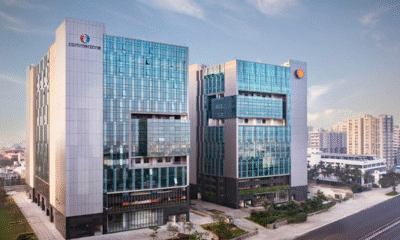

Mindspace REIT Expands Chennai Footprint with ₹2,541 Crore Acquisition of Commerzone Pallikaranai
Mumbai, April 2, 2026: Mindspace Business Parks REIT has announced a major expansion of its southern India footprint with the...
-
 Guest Column4 weeks ago
Retail Trends to Watch Out for in 2026
-

 News2 weeks ago
FractoProp Receives SEBI Registration for Ridhama Real Estate Fund
-
News1 week ago
How Noida International Airport Will Impact Property Prices
-
News4 days ago
Noida International Airport Inauguration Sparks New Real Estate Boom For NCR
-
News2 weeks ago
Rise of Airport-Linked Real Estate: Opportunities Emerging Around Jewar
-
News3 weeks ago
Enviro Infra Engineers Secures ₹411 Crore Bihar Sewerage Project Under AMRUT 2.0
-
News3 weeks ago
Greenlands Global Private Limited Appointed as Managing Partner for Big FM Realty’s ₹1,200 Crore Mixed-Use Development
-

 News3 weeks ago
India Maintains Competitive Edge as Asia-Pacific Office Fit-Out Hub, Reports Knight Frank