Infrastructure is the New Location: Why Connectivity Is Driving Gurugram’s Property Map
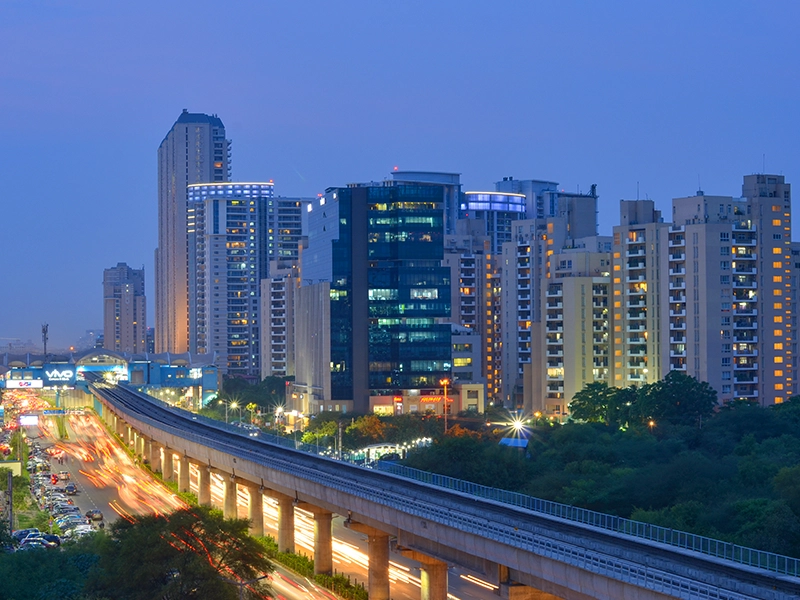
Gurugram, February 14, 2026: For decades, Gurugram’s property narrative revolved around a handful of premium micro- markets such as Golf Course Road and established DLF sectors, where address value alone dictated demand and pricing. That hierarchy is now being steadily rewritten. As large-scale infrastructure projects gather momentum from expressways and widened national highways to metro extensions and faster inter-city links, connectivity itself is emerging as the new currency of real estate.
Buyers and investors are increasingly evaluating locations through the lens of travel time, access to employment hubs and ease of movement across the NCR. This evolution has positioned infrastructure as the primary driver shaping Gurugram’s property map and influencing long-term value.
As cited by Cushman and Wakefield, Delhi NCR recorded 14,248 new residential unit launches in Q4 2025, marking a 39 per cent rise over the previous quarter, and 2.5X higher on a y-o-y basis. Gurugram alone witnessed 50 per cent of the quarterly launches. A majority of the launches in 2025 were seen in peripheral locations, such as 27 per cent along the Dwarka Expressway and 11 per cent in New Gurgaon.
Gurugram RERA also reported that the city emerged as one of India’s biggest magnets for real estate investment in 2025, with projects worth INR 86,588 crore receiving regulatory approvals during the year. Around 131 projects were registered in calendar year 2025, translating into development potential of 35,455 units across housing and commercial segments.
Further, residential assets continued to attract the bulk of investments. Of the total units approved, 31,455 were residential, reflecting sustained end-user demand as well as investor confidence in Gurugram’s long-term housing fundamentals.
Moreover, with hybrid work models becoming more entrenched, buyers are no longer fixated on living within traditional corporate districts or legacy neighbourhoods. The pandemic has also altered how homebuyers perceive distance and daily travel, triggering a noticeable shift in commuting priorities. The focus has moved to shorter, more predictable drive times and smoother access to multiple work nodes. Connectivity, rather than pin-code prestige, is shaping residential choice. Well-linked corridors that reduce time spent on the road while offering access to schools, healthcare and leisure are commanding growing attention. For many buyers, this equation of time efficiency and lifestyle convenience is also translating into stronger confidence in long-term capital appreciation.
This shift in buyer mindset is being underpinned by a series of high-impact infrastructure projects that are steadily reshaping Gurugram’s urban form. The Dwarka Expressway has emerged as a critical east–west connector, while the Gurugram–Sohna Road corridor is opening up new residential and mixed-use pockets in the city’s southern belt. Upgrades and capacity expansion along NH-8 continue to strengthen Gurugram’s link with Delhi and Jaipur, reinforcing its position as a regional business hub. At the same time, improved connection nodes along Golf Course Road, ongoing metro extensions and rapid transit plans are tightening last-mile connectivity. Together with peripheral roads and arterial spines, these networks are creating a more integrated, multi-nodal city.

Sehaj Chawla, Managing Director, TREVOC Group, said, “Golf Course Road has long been the gold standard for premium living in Gurugram, but its relevance today is being reinforced by connectivity. Improved access to key employment hubs, the airport, and major lifestyle districts has significantly strengthened the corridor’s appeal. Buyer conversations are increasingly shifting towards ease of movement and time efficiency, rather than exclusivity alone. In this context, Golf Course Road is being chosen not just for its address value, but for how seamlessly it connects residents to the wider city, reflecting a broader move towards infrastructure-led location preferences.”

Mohit Kalia, Sr. Vice president-Sales & Marketing, HCBS Developments, says, “With the Dwarka Expressway maturing into a fully functional connectivity spine, we’re observing a tectonic shift in how buyers define choice. Areas that were once fringe have become mainstream because the expressway has effectively slashed travel times to central Gurugram, Delhi, and the airport. Thus, people here are buying ease and predictability in daily movement. This proves why infrastructure is a catalyst for socio-economic densification.”
Besides, several new location hubs are beginning to feature prominently on Gurugram’s residential and investment map. Sectors 102 to 115, aligned along the Dwarka Expressway, are witnessing heightened traction as improved connectivity translates into faster access to Delhi and central Gurugram. Similarly, newer micro-markets along NH-8 are drawing interest on the back of enhanced road infrastructure and planned urban development. Areas that were earlier considered peripheral or underdeveloped are now attracting both end-users and investors, driven by the promise of connectivity-led growth and future appreciation.

Arjun Gehlot, Director, Ambience Group, says, “In Gurugram, areas like Sector 22 have historically been a key corridor for growth. It is steadily emerging as a compelling residential pocket because of its strategic positioning within Gurugram’s established urban framework. Its proximity to the airport, NH-48 and key commercial districts ensures that residents are not isolated from the city’s economic core. What makes Sector 22 distinctive is the balance it offers: access to corporate hubs, retail and hospitality infrastructure, while still retaining a certain residential calm. Buyers today are far more conscious of daily commute efficiency and ecosystem depth. In our view, it is this combination of connectivity and surrounding infrastructure that strengthens long-term asset confidence and sustained value appreciation.”

Paras Rai, Managing Director and Co-Founder, Property Master, says, “What’s fascinating now is that real estate appreciation is less about a locality’s ‘brand’ and more about its network. The Sohna Road-NH-8-Expressway triangle, new metro linkages, and upgraded arterial roads have reoriented demand patterns. Ad consultants, we regularly advise our clients to think beyond neighborhood names; to visualize time cylinders and connectivity maps. A location that keeps a buyer within 20–25 minutes of major work hubs, schools, healthcare, and recreation consistently outperforms older micro-markets with prestige but longer commute times.”
Taken together, these trends underline a clear shift towards infrastructure-first decision-making in Gurugram’s housing market. Ease of access, reduced travel time and future-ready connectivity are increasingly outweighing traditional notions of address value. The next phase of growth, market observers suggest, will be shaped by how effectively upcoming connectivity projects stitch Gurugram into a faster, more integrated NCR.