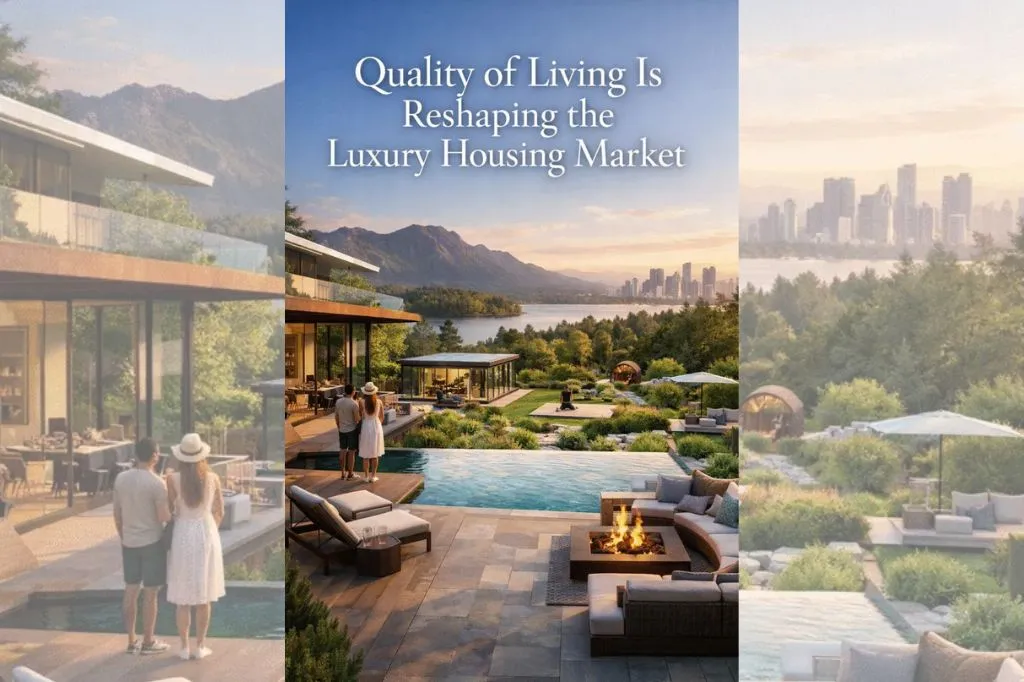
Quality of Living Is Reshaping the Luxury Housing Market

By Shyamrup Roy Choudhury, Founder and Managing Director, Aura World
From location to size and then to price: these were the three factors shaping real estate purchase decisions. Everything else, amenities, landscaping, and clubhouses, was largely decorative language around those three fundamentals. That hierarchy is beginning to blur.
Developers, of course, are not unfamiliar with lifestyle marketing. For years, brochures have promised “holistic living,” “resort-style amenities,” and “integrated communities.” But what is happening now is less about marketing vocabulary and more about structural planning.
Data emerging across industry reports only partly captures this behavioural shift. According to CBRE South Asia and ASSOCHAM, luxury housing sales in India surged by nearly 85% year-on-year in the first half of 2025, with around 7,000 high-end units sold across the top seven cities. The premium segment had already recorded 53% growth in 2024, and high-end homes now account for roughly 27% of total residential sales, more than double their share just three years ago.
Wellness, once a soft-selling point, is quietly becoming an architectural requirement. Developers are increasingly discussing air filtration systems, biophilic design, cross ventilation, sunlight studies, and noise buffers as part of project planning, rather than merely as brochure embellishments. Meditation decks, yoga pavilions and wellness centres have become nearly standard in projects priced above Rs. 3–4 crore.
The industry tends to frame this as post-pandemic behaviour. That explanation is partly true, but it also feels incomplete. In reality, a large segment of India’s affluent buyers, particularly younger HNIs and global professionals returning to India, has spent enough time abroad to internalise a different set of expectations from housing. A luxury home is expected to behave like a well-designed environment, not merely an expensive address.
This expectation is beginning to alter how projects are conceived.
Low-density developments, for instance, are reappearing in markets where vertical expansion once dominated. Villas, independent floors, and townhouse formats are gaining traction across Delhi-NCR, Hyderabad and parts of Bengaluru. In some projects, the number of units per acre has dropped noticeably compared to developments launched just five or six years ago.
The ultra-affluent segment reinforces the pattern. Knight Frank estimates that Indian ultra-high-net-worth individuals now allocate roughly 32% of their wealth to residential real estate, a proportion that would have seemed unusually high a decade ago.
One could argue that this is partly an investment story. Real estate remains a reliable store of value in uncertain economic cycles. Yet conversations with buyers suggest something less transactional.
These are not statistically measurable indicators. But they say something about evolving priorities. Technology is playing its role as well, though in a somewhat understated way. Smart home automation, voice-enabled lighting, AI-driven security systems, and energy monitoring are now embedded into luxury developments almost by default. Interestingly, buyers rarely treat these features as “luxury” anymore. They are simply expected to work quietly in the background.
Sustainability is also entering the conversation. IGBC and LEED certifications are also being increasingly cited, while rainwater harvesting, solar energy, and water recycling systems are slowly becoming standard inclusions
Transaction values in major markets illustrate the momentum. According to CRE Matrix and India Sotheby’s International Realty, Mumbai recorded luxury home sales worth Rs. 14,750 crore in the first half of 2025, while Gurugram crossed Rs. 24,120 crore in luxury transactions, the highest annual value recorded by a single Indian city.
These are large numbers. But they only partially explain the story.
Luxury housing in India is no longer merely about how much space one owns. It is increasingly about the quality of the environment that space sits within, air, light, privacy, services, convenience, and the intangible sense of ease that comes from a well-designed community.