From Cost to Value: Why Corporates are Willing to Pay a Premium for Grade A Offices

By Dr Amish Bhutani, Managing Director, Group 108
There is a decisive shift underway in how corporates evaluate their workplaces. The office is no longer viewed through the narrow lens of a cost centre, but as a strategic lever that shapes talent experience, reinforces brand identity, and drives operational efficiency at scale. For forward-looking enterprises, the workplace has become an extension of their ambition, influencing how they attract, retain, and perform. In this context, the willingness to invest in Grade A environments is not about indulgence, but intent. Premium, today, is no longer a price point, but a calibrated investment in performance, productivity, and long-term value creation.
The shift is not anecdotal. As per Cushman and Wakefield’s data, Delhi-NCR recorded an all-time high office leasing of 15.8 million square feet in 2025, marking a 24% year-on-year increase. Within this, Noida played a particularly significant role, registering a 73% rise in annual leasing. The Noida Expressway emerged as the most active leasing corridor in NCR during Q4 2025, contributing 26% of gross leasing volumes, reflecting improved infrastructure and strong occupier preference. These are not the numbers of an alternative market hedging its bets. This is a destination corridor finding its stride.
The post-pandemic period forced a reckoning. Companies that had stripped their offices down to the essentials discovered that bare-minimum real estate was quietly costing them far more than the savings suggested. What emerged was a new framework: the office is not overhead, it is infrastructure. Like bandwidth or cloud capacity, it either enables performance or limits it. Grade A office developments were built to answer that need. And enterprises are now paying the premium that the answer demands.
A genuinely Grade A building is precise in what it delivers: LEED or IGBC certification, intelligent building management systems, large column-free floor plates, redundant power and fibre infrastructure, and an amenity ecosystem that reduces friction in the workday. For MNCs and GCCs specifically, there is an additional layer that makes Grade A non-negotiable: compliance. Parent companies in the US, Europe, and Japan carry ESG reporting mandates that require their India operations to occupy certified, sustainability-compliant facilities. A building without a LEED certificate is increasingly unlikely to be on the shortlist, regardless of how competitive the rent looks. In essence, when corporates choose Grade A today, they are not merely leasing space; they are investing in certainty, continuity, and the confidence of future readiness.
Besides, the growing presence of GCCs and multinational corporations is changing the demand narrative, with a clear preference for Grade A environments that align with their global operating standards. For these occupiers, workplace parity across geographies is non-negotiable, whether in design, functionality, or employee experience. This is closely tied to stringent ESG commitments, where sustainability, efficiency, and compliance are integral to corporate mandates rather than optional add-ons. Equally critical is the need for robust data security, advanced technological infrastructure, and the ability to scale seamlessly as operations expand. According to Vestian, NCR saw the sharpest rise in GCC activity, with GCCs accounting for 45% of total absorption in 2025, up from 18% in 2024. In markets like Noida-Greater Noida, where a strong base of Grade A office stock already exists, the GCC footprint is steadily deepening.
Infrastructure has been the quiet enabler of all of this. The Aqua Line Metro connecting Noida to Greater Noida, the Yamuna Expressway stitching together a continuous economic zone, and a series of road-widening and elevated corridor projects have collectively reduced commute friction and signalled genuine, multi-decade policy commitment to the region. For an MNC signing a 10-year lease, that signal matters as much as the building specs.
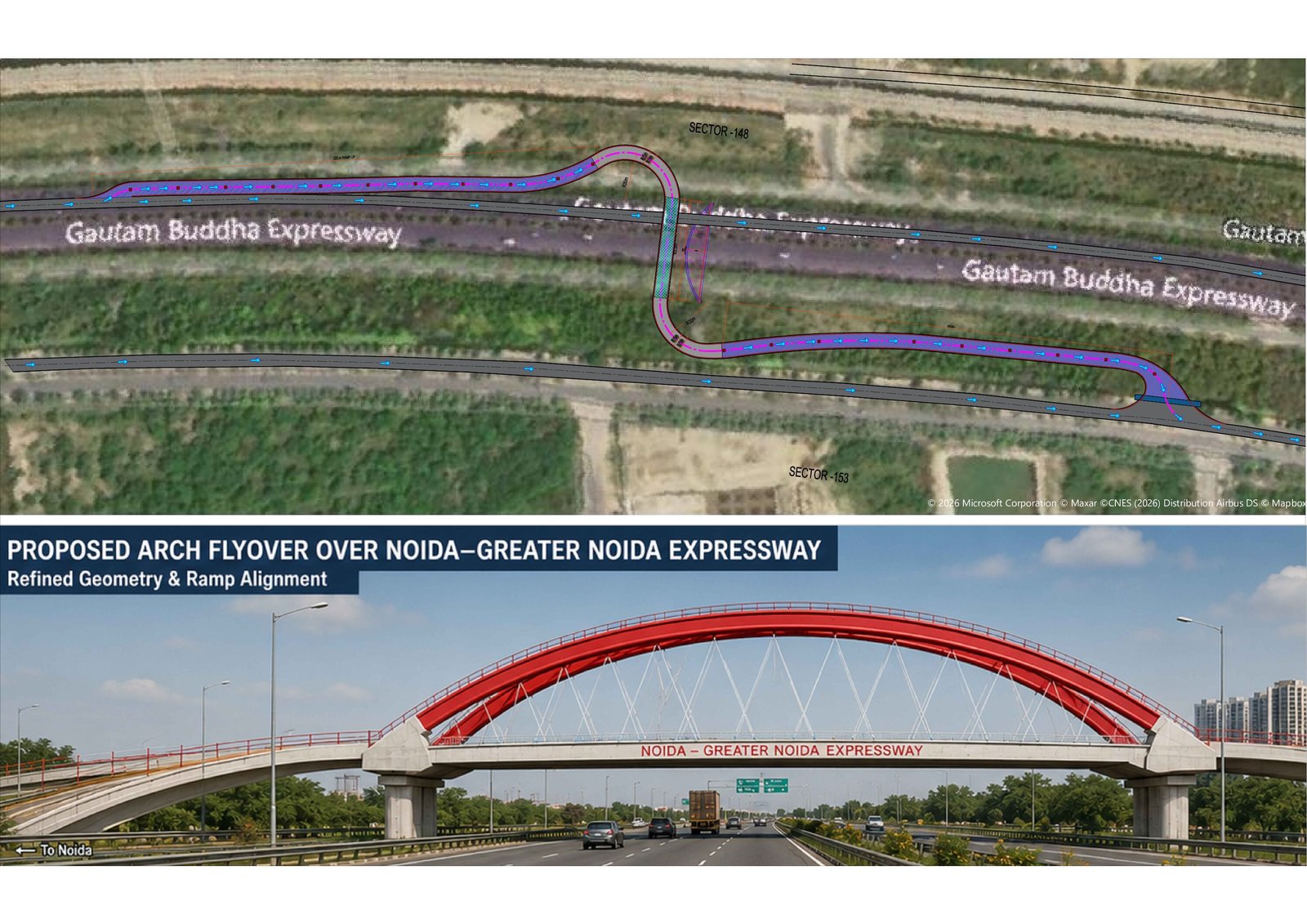
Further, the infrastructure along this Noida-Greater Noida Expressway is actively transforming micro-markets into integrated corporate ecosystems, where faster inter-city access is complemented by something equally critical: predictability of movement. Reduced commute variability, rather than just shorter travel time, is becoming a decisive factor in workforce efficiency and planning. At the same time, seamless integration with industrial, IT, and logistics clusters is creating a networked environment that supports scale and operational agility. Planned road expansions and new connectors are already being aligned with this vision, easing access while quietly enabling higher commercial density along the corridor.
The inauguration of the Noida International Airport marks another structural inflection point in the region’s evolution. For multinational corporations and GCCs, direct global access is a decisive advantage, collapsing distances and integrating operations with international markets in real time. More significantly, such infrastructure acts as a catalyst for the creation of a multi-sector economic ecosystem, drawing in logistics, data centres, advanced manufacturing, and hospitality in a coordinated growth pattern. Historically, airports have anchored some of the most valuable commercial clusters, and a similar trajectory is beginning to unfold here. What Indira Gandhi International Airport did for Gurugram, this corridor has the potential to replicate, albeit with greater planning depth and a more deliberate approach to urbanisation.
Thus, the willingness to pay a premium today is, in many ways, a quiet marker of market maturity. It reflects a decisive shift from opportunistic leasing to strategic occupancy, where decisions are anchored not in immediate cost savings, but in long-term value creation. As connectivity strengthens and ecosystems deepen in NCR, Grade A offices are steadily transitioning from being perceived as an upgrade to becoming the default choice for organisations that are building for scale, resilience, and enduring relevance.
………………..
Disclaimer: Views expressed in this article are those of the author, and not necessarily of Realty & More