A Road to Growth: How Ganga Expressway Will Transform UP’s Real Estate Market
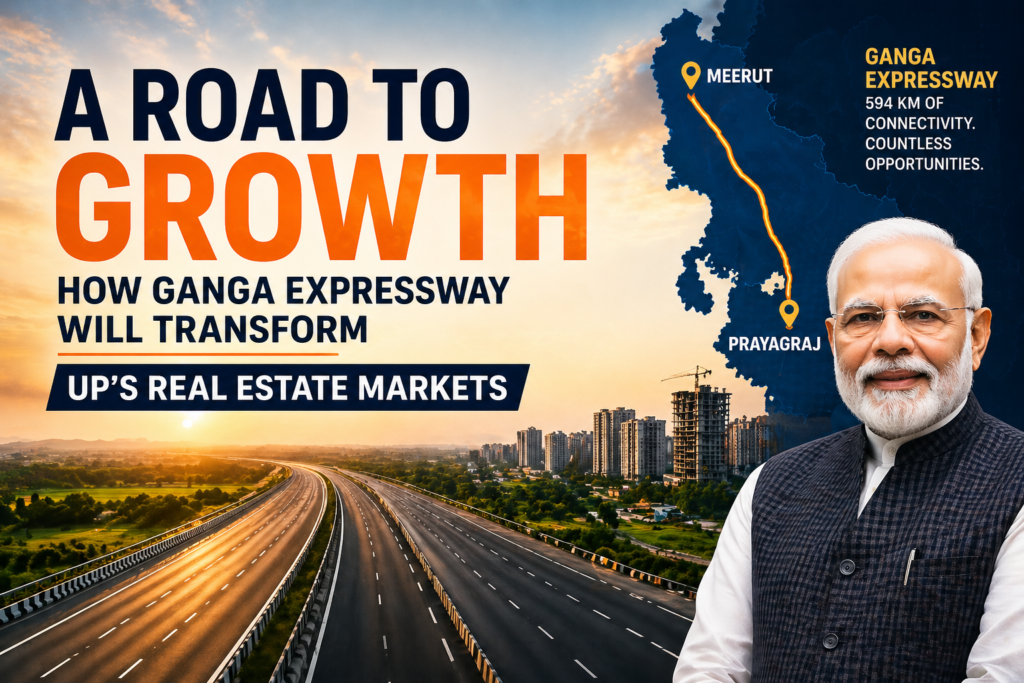
New Delhi / Lucknow: India’s infrastructure landscape is set for a major leap as Prime Minister Narendra Modi prepares to inaugurate the ambitious Ganga Expressway, one of the longest and most strategically significant expressway projects in the country. Spanning approximately 594 km, the expressway will connect Meerut in western Uttar Pradesh to Prayagraj in the east, dramatically transforming regional connectivity, logistics efficiency, and economic integration across the state.
Designed as a high-speed corridor, the Ganga Expressway will pass through several key districts including Hapur, Bulandshahr, Amroha, Sambhal, Budaun, Shahjahanpur, Hardoi, Unnao, Rae Bareli, and Pratapgarh before culminating in Prayagraj. Once operational, it is expected to reduce travel time between Meerut and Prayagraj from nearly 10–12 hours to around 6 hours, making intercity movement faster, smoother, and more predictable.
Strategic Importance and Infrastructure Boost
The expressway is more than just a road project—it is a multi-dimensional economic corridor. It has been designed with future-ready infrastructure, including provisions for industrial nodes, logistics parks, and wayside amenities. The project is also expected to integrate with other major infrastructure developments such as the Yamuna Expressway and the upcoming Noida International Airport at Jewar, thereby creating a robust and interconnected transport ecosystem in Uttar Pradesh.
From a logistics perspective, the Ganga Expressway will significantly reduce freight movement costs and improve supply chain efficiency. Agricultural produce, manufactured goods, and industrial materials will be able to move faster between regions, benefiting farmers, MSMEs, and large industries alike. The improved connectivity is also expected to attract investments in warehousing, cold storage, and manufacturing clusters along the corridor.
Real Estate Set for Major Upswing
The impact of the expressway is already being felt in the real estate sector, with early signs of price appreciation and increased developer interest in areas along the corridor.

Mohit Goel, Managing Director, Omaxe Limited, says,
“As the Ganga Expressway nears inauguration, we are already seeing early signs of value firming along the Prayagraj corridor, driven by both infrastructure momentum and its positioning as a key temple city. With the government’s proposed Rs. 5,000 crore push towards temple town development, the resulting uplift in tourism and civic infrastructure is expected to further strengthen real estate demand. Currently, residential prices in Prayagraj are averaging around ₹7,900–₹8,000 per sq. ft. across key areas, and with connectivity improvements becoming operational, we expect a 20–30% appreciation over the next 3–5 years, particularly in well-connected and infrastructure-led micro-markets.”
Meerut and Western UP to Gain Momentum
The western stretch of the expressway, particularly around Meerut, is expected to emerge as a strong residential and investment hub due to its proximity to Delhi-NCR and improved connectivity to key infrastructure nodes.

Sahil Agarwal, CEO, Nimbus Group, says:
“The Ganga Expressway will significantly boost regional connectivity by reducing travel time between Meerut and Prayagraj by nearly half, improving both mobility and logistics. In the near term, demand is expected to be rental-led, gradually translating into sustained residential growth. With current prices in Meerut averaging ₹6,500–₹6,700 per sq. ft., and improved connectivity to the Yamuna Expressway and Noida International Airport, these markets are well-positioned for 30–40% appreciation over the next few years. Importantly, connectivity between Jewar Airport and the Ganga Expressway will make these locations more accessible, easing investment decisions as Jewar emerges as a key economic hub of Uttar Pradesh. This will also drive stronger real estate traction in Greater Noida and Meerut, making them key beneficiaries of this infrastructure-led growth.”
Boost to Affordable and Mid-Income Housing
With improved accessibility, homebuyers are increasingly willing to explore locations beyond traditional city centers, leading to a shift in demand patterns.

Harvinder Singh Sikka, Chairman, Sikka Group, says:
“Today, homebuyers are prioritizing not just location, but also value for money and connectivity. The Ganga Expressway will further strengthen this shift, as it enables people to opt for better and more affordable homes even at slightly distant locations. This is expected to give a significant boost to the affordable and mid-housing segments. Additionally, as infrastructure continues to improve, social infrastructure in these areas will also develop, making them increasingly attractive for both living and investment.”
Tier-II Cities Take Centre Stage
One of the most significant outcomes of the Ganga Expressway is the rising prominence of Tier-II cities as future growth engines. Cities that were previously considered peripheral are now being viewed as viable real estate destinations due to enhanced connectivity and infrastructure development.

Kushagr Ansal, Director, Ansal Housing, says:
“Tier-II markets are clearly shaping the next phase of residential growth, and the scale of land transactions reflects this shift strongly. With the Ganga Expressway unlocking new development corridors, cities like Meerut are expected to see more structured and early-stage real estate activity. At present, Meerut’s residential prices are averaging around ₹6,400–₹6,600 per sq. ft., and as developer interest deepens alongside infrastructure-led demand, we anticipate a 25–35% price appreciation in the medium term, especially across emerging micro-markets aligned with the expressway.”
A Transformational Corridor for Uttar Pradesh
The Ganga Expressway represents a paradigm shift in how infrastructure drives regional development. By connecting western and eastern Uttar Pradesh through a high-speed corridor, it is expected to reduce regional disparities, create employment opportunities, and stimulate economic activity across sectors.
In addition to economic benefits, the expressway will also enhance access to religious destinations such as Prayagraj, boosting tourism and hospitality sectors. Improved road connectivity will make pilgrimage travel more convenient, further strengthening the local economy.
As the project moves towards inauguration, the Ganga Expressway is being seen not just as a transport corridor, but as a growth engine that will redefine urban expansion, investment patterns, and real estate dynamics across Uttar Pradesh in the coming decade.