Real Estate Industry Advocates Balanced Framework for Wetland Conservation and Community Development in Pallikaranai Ramsar Zone
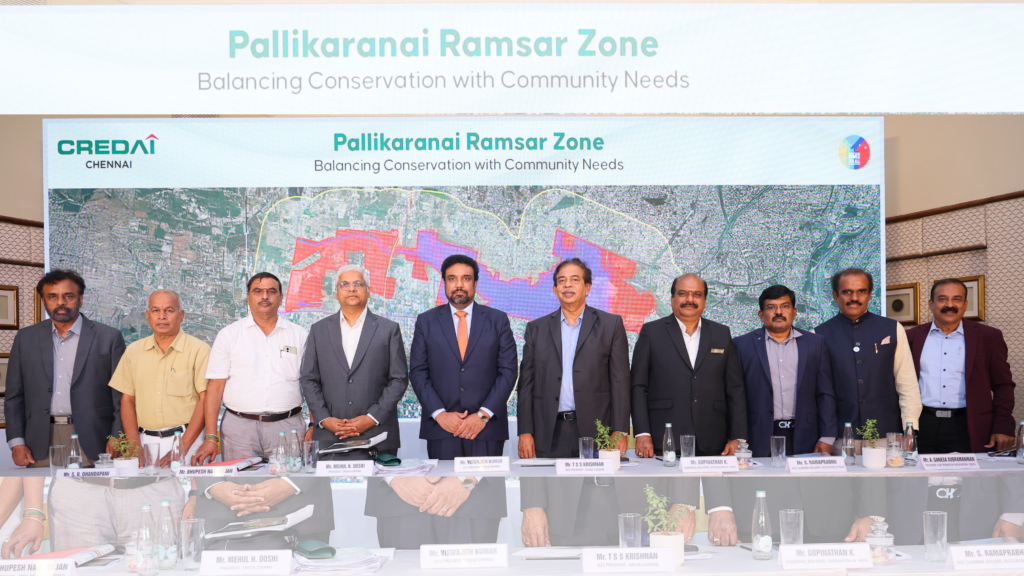
Chennai, July 8, 2026: The real estate industry has reiterated its commitment to environmental conservation while urging the government to adopt a balanced, scientific, and consultative approach to implementing regulations around the Pallikaranai Ramsar site. Industry representatives have expressed deep concern that the recent demarcation—which includes an additional 550 hectares of land added without clear identification and not following due procedure, alongside a consequent 1 km development freeze around the Ramsar site—has affected more than one lakh patta landowners, they said in a press release.
The economic impact within this 1 km zone of influence is substantial, with figures presented showing that approximately ₹51,735.88 crore in business value has been affected. The total direct and indirect revenue and economic impact is estimated at ₹19,790.48 crore, reflecting a conservative calculation of the real estate impact in the immediate area. The broader impact across patta holders, industries, and the general public may be even wider, threatening thousands of job opportunities linked to construction workers, suppliers, MSMEs, transporters, service providers, professionals, and local businesses.
Industry representatives state that there are two core issues that must be addressed immediately by the authorities. The first is the precise identification of the additional 550 hectares of land comprised in the 1,248 hectares designated as the Pallikaranai Ramsar wetland. While the Pallikaranai Swamp Reserve Forest, spread across about 698 hectares, was notified in 2007 and remains legally protected as an undisputed core area, the present concern relates entirely to lands outside this core. Although the Pallikaranai Marsh was designated as a Ramsar site in 2022 with the extra 550 hectares included, it has been four years and the Environment, Climate Change and Forests department has still not completed the due process of ground-truthing, public consultation, and notification as contemplated under the Wetlands (Conservation and Management) Rules. Industry representatives have requested authorities to expedite the scientific survey number demarcation, publish clear maps, seek public opinion, and issue a formal notification to clearly establish the exact Ramsar extent and boundaries.
The second critical issue involves the fixation of the Zone of Influence around the exact extent of land identified as the wetland, which can only be determined once the boundaries are legally finalized. According to the Wetlands (Conservation and Management) Rules, the zone of influence of a wetland is not a fixed or uniform area but is determined based on site-specific factors such as local hydrology, topography, drainage patterns, and adjoining land use, necessitating scientific methods like digital elevation models and field-level verification. Furthermore, the Care Earth Integrated Management Plan (IMP) quoted in the National Green Tribunal (NGT) order notes that while the zone of influence was delineated as 1 km, the presence of patta lands and high urbanization surrounding the marshland makes it more prudent to delineate the zone based on inlet and outlet channels and satellite wetlands in the catchment area. Industry representatives point out that a uniform 1 km zone is unscientific for a wetland situated in a highly urbanized area, citing the precedent of the East Kolkata wetlands where a 0 km zone of influence was fixed due to similar urban constraints. This uniform freeze is viewed as highly arbitrary, especially since a Right to Information (RTI) reply from the Tamil Nadu State Wetland Authority (TNSWA) revealed that the Care Earth Trust IMP remains at the draft notification stage, under scrutiny by the NCSCM, and hidden from public disclosure.
The real estate industry noted that the current demarcation could have far-reaching implications for lakhs of homeowners, businesses, educational institutions, healthcare facilities, and infrastructure projects, while stifling future investments, employment generation, and regional economic growth. Currently, ordinary families with valid pattas are unable to build homes, secure housing loans, redevelop old houses, or sell their land due to a lack of clear answers from banks and regulators, while homebuyers face severe loan delays and uncertainty even where approvals already exist.
Furthermore, vital public infrastructure is located within this 1 km zone, including the Chennai Metro Rail Limited (CMRL) Phase II stations and two existing MRTS locations, which underscores the pre-existing urban character of the area. The planning freeze directly threatens CMRL’s proposals for a major transit hub at Sholinganallur integrating retail and office spaces. The 1 km zone also houses several essential government and civic facilities, such as VAO offices, corporation offices, health centers, government hospitals, schools, utilities, post offices, TNEB facilities, Metro Water facilities, and research institutions.
In response to these challenges, the real estate industry has submitted a formal list of requests to the government. They urge authorities to review the uniform 1 km development freeze and withdraw the blanket restriction until the influence area is scientifically delineated and officially notified. They also demand the completion of a comprehensive scientific demarcation through ground-truthing, hydrological studies, and survey number validation. Additionally, the industry is calling on the government to approve and notify the Integrated Management Plan following proper statutory public consultations to ensure absolute transparency. Finally, they request that the government ensure continuity by continuing to process existing planning approvals, renewals, No Objection Certificates, individual plot applications, and housing loans within the urbanized zone so that citizens and ongoing projects are not adversely affected during the transition.