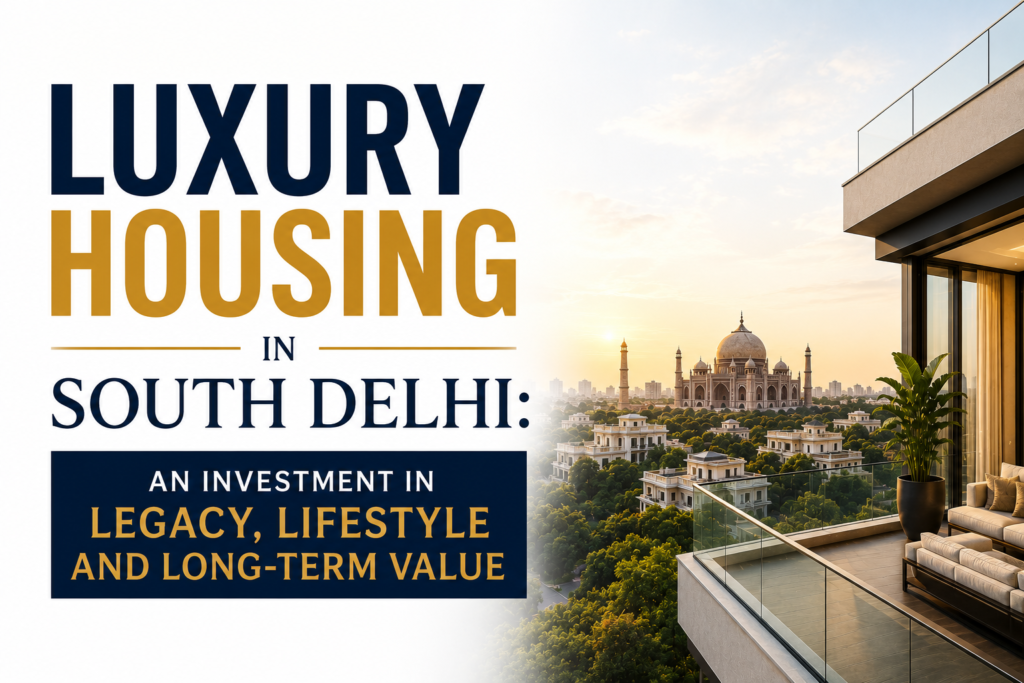
Luxury Housing in South Delhi: An Investment in Legacy, Lifestyle and Long-Term Value
By Gautam Kanodia, Founder of KREEVA and Kanodia Group
There is a tendency to explain South Delhi’s luxury housing market through its addresses. Golf Links, Jor Bagh, New Friends Colony, Greater Kailash. The names themselves carry weight, almost enough to end the discussion. Yet the longer one spends in this market, the more obvious it becomes that the address is only the visible outcome. The real story has always been about scarcity.
This is not a market that expands when demand rises. It simply absorbs it.
Over the years, NCR has produced several luxury destinations. Gurugram has developed an impressive luxury residential landscape, while Noida has steadily moved up the value chain. Buyers today have more choices than they did a decade ago. Yet a certain category of buyer, particularly entrepreneurs, business families and NRIs, often finds its way back to South Delhi. Not because alternatives are lacking, but because some advantages cannot be recreated.
A luxury residence can be built almost anywhere if enough capital is invested. A neighbourhood cannot. Schools, healthcare institutions, clubs, tree-lined avenues and established communities evolve over decades. They become part of everyday life rather than features promised in a master plan. It is perhaps for this reason that conversations with buyers have changed. They spend less time comparing amenities and more time asking whether a location will remain as relevant twenty years from now as it is today.
The expectations from luxury homes have also become more nuanced. Bigger is no longer enough. Buyers seek privacy without isolation, contemporary design that sits comfortably within its surroundings, natural light, better security, wellness-oriented spaces and professionally managed residences. These are quieter aspirations than the luxury market once projected, but they increasingly influence purchase decisions.
That shift is also redefining development in South Delhi. Every project, therefore, carries a responsibility that goes beyond construction. It has to respond to modern lifestyles while respecting the character of an established neighbourhood. More importantly, it reflects a broader shift in demand, where established neighbourhoods, professionally managed communities and thoughtfully planned living environments are valued as much as the residences themselves.
The economics support this narrative. According to Anarock Research, homes priced above Rs. 4 crore have remained among the fastest-growing segments across India’s major residential markets in recent years. Knight Frank India’s residential market assessments also continue to place Delhi among the country’s highest-valued housing markets. These numbers reinforce what market participants have experienced over time: demand at the upper end has become more selective, but it has certainly not weakened.
What has changed is the way affluent buyers view ownership. A luxury residence is no longer seen merely as an upgrade in lifestyle. It is increasingly assessed as a long-term asset capable of preserving both value and identity. Location, future supply, neighbourhood quality and the likelihood of enduring demand have become just as important as architecture or finishes.
That, in many ways, explains South Delhi’s enduring appeal. Markets can replicate luxury amenities, taller towers and contemporary design. They cannot easily replicate decades of urban evolution or the confidence that comes from knowing a neighbourhood has remained desirable across generations. In the years ahead, that distinction may prove more valuable than luxury itself.
Disclaimer: Views expressed in this article are those of the author, and not necessarily of Realty&More.