Indian Retail Landscape Shifts Toward ‘Strategic Evolution’ as Redevelopment Becomes Essential for Asset Survival
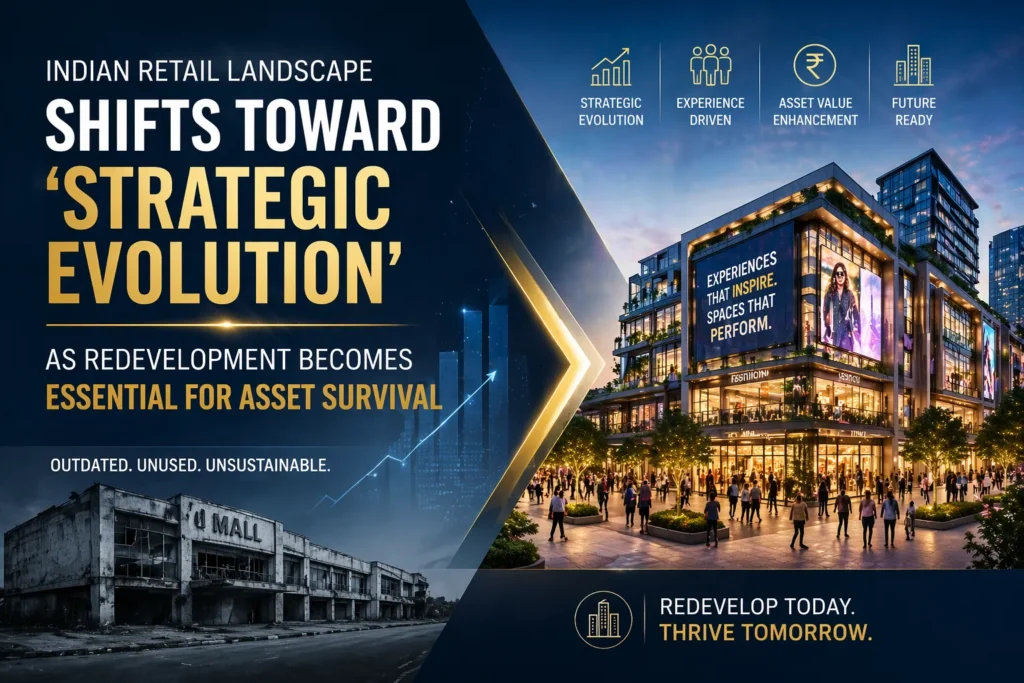
New Delhi, April 21, 2026: India’s retail sector is entering a sophisticated new phase characterized by evolution over mere expansion. With leasing activity reaching an estimated 8.9 million square feet in 2025, the market is witnessing a surge in large, destination-led developments. However, this growth has brought existing retail assets to a critical inflection point, as nearly half of the upcoming supply consists of investment-grade malls designed as immersive, mixed-use ecosystems that threaten to leave older centers behind, a group of real estate industry leaders said.
Industry data reveals a growing divide in the sector, with only 30–35% of India’s current mall inventory considered institutional-grade. The remaining stock is increasingly burdened by inefficient layouts and tenant mixes that fail to attract today’s aspirational shoppers. Recent figures from CBRE suggest that approximately 20% of these ageing assets risk becoming “ghost centers” or slipping into total obsolescence. This has prompted a surge in redevelopment projects, particularly in mature markets like the National Capital Region (NCR), where owners are treating revamping as a structural necessity to unlock rental upside and extend an asset’s lifecycle.
The shift is being driven by a change in consumer behavior, where retail is no longer viewed as a transactional errand but as a continuous, brand-driven experience. Redevelopment strategies are now focusing on opening up layouts and recalibrating tenant mixes to mirror current demand, where fashion accounts for 32% of leasing, followed by homeware at 23% and luxury at 11%. To remain relevant, older assets are being forced to integrate stronger Food & Beverage (F&B) clusters, entertainment anchors, and omnichannel technology to encourage longer dwell times and higher conversion rates.
Industry leaders emphasize that these upgrades are no longer cosmetic but are fundamental to the social and economic integration of retail spaces within cities. By transforming fragmented, transactional buildings into intuitive and adaptable environments, developers are finding they can command premium rentals and attract high-profile D2C and digital-first brands that prioritize visibility and sustained consumer engagement.

“Retail redevelopment today is no longer optional; it is a strategic necessity driven by evolving consumer expectations and changing urban lifestyles,” says Ravinder Choudhary, Vice President of Vegas Mall.
“At Unity Group, we view redevelopment as an opportunity to future-proof assets by transforming them into experience-led destinations that combine retail, entertainment, and community engagement. Modern consumers seek convenience, engagement, and a sense of place, which requires smarter layouts, stronger tenant curation, and immersive environments. By revitalizing ageing retail spaces with a forward-looking approach, we are not only enhancing asset performance but also redefining how retail integrates into the social fabric of the city.”

Nandini Taneja, CEO of Bhumika Enterprises, notes that the process is about correcting fundamental design flaws. “Redevelopment today is far more than a visual upgrade—it’s about rethinking how a space actually works,” Taneja says.
“Many older retail assets were not designed for the way consumers move and engage today, which makes zoning, circulation, and overall spatial planning critical areas of intervention. When you realign these fundamentals and pair them with a sharper positioning, the impact is immediate, both in terms of consumer experience and asset performance. Thus, revamping is essentially about unlocking latent value, making the asset more intuitive, more efficient, and ultimately more relevant for the kind of retail environments brands and consumers now expect.”

As the ecosystem becomes more dynamic, experts argue that the ability to adapt will be the primary metric for success. “The retail ecosystem is becoming increasingly dynamic, and static formats simply don’t hold the same relevance anymore,” says Ajendra Singh, Vice-President of Sales & Marketing at Spectrum@Metro.
“Consumers expect variety, flexibility, and a sense of constant newness, which means retail spaces also need to evolve continuously. Redevelopment is no longer a one-time exercise, but an ongoing process of adaptation. Whether it’s through flexible leasing, curated tenant mixes, or integrating new formats, the idea is to create spaces that can respond to change. Going forward, the success of retail assets will depend on how adaptable they are, because relevance in this sector is closely tied to the ability to evolve.”